left image  
 

Home Page - Wireless Spkrs Systems - Wireless Speaker Installation Tips


Wireless Speaker Systems - Installation Tips

Wireless Speaker Installation made easy...


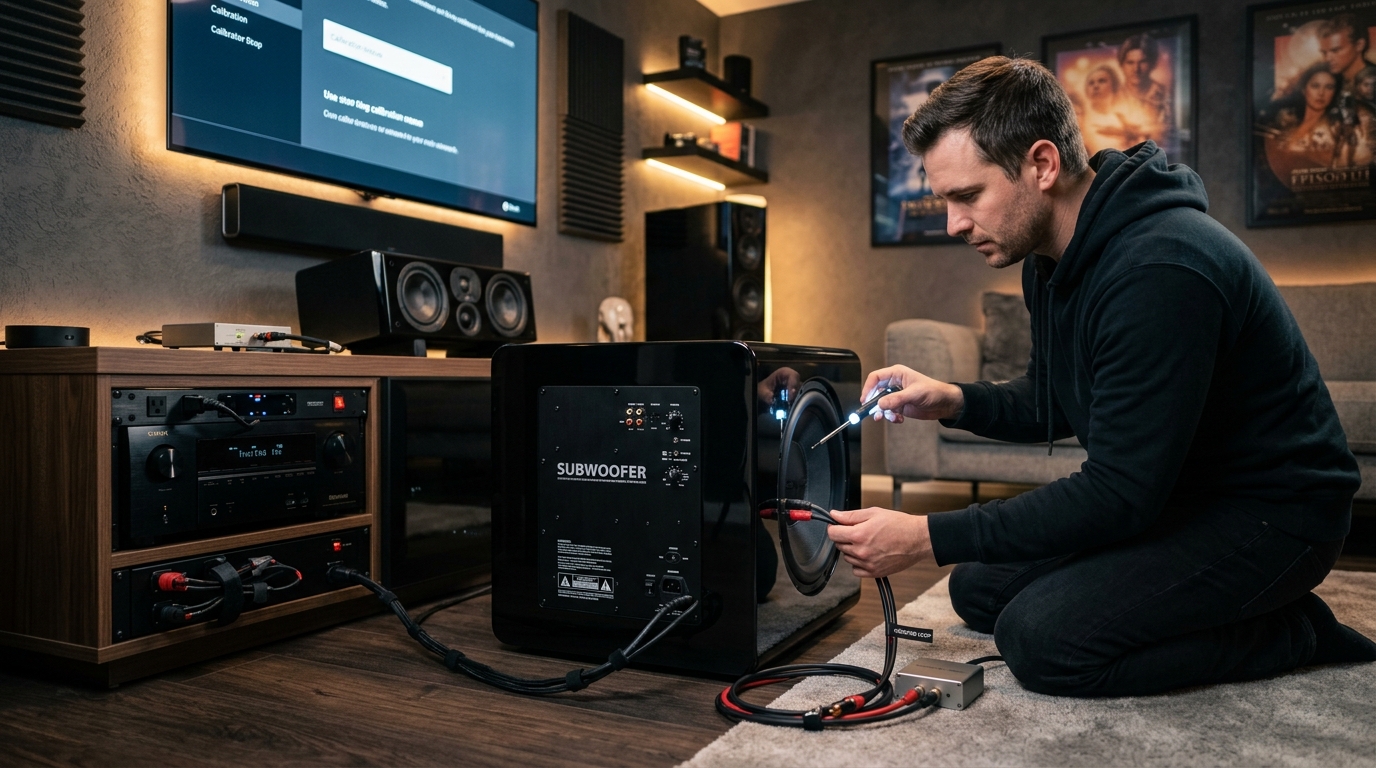
Today's wireless add-on speaker systems are simple to install - just unpack, connect to your AV receiver, and power up. However, problems still continue to arise especially when the input on your wireless kit does not provide the right match for your audio gear.

We therefore thought of presenting a few basic audio installation tips that should make it easier for you to better integrate your wireless speakers with the rest of your audio equipment.


A Complete Guide to

Home Automation, Networking & Wireless Audio/Video distribution in the home.

Home Theater Design e-book

by Duncan McClelland
More information HERE.

Last Updated: 15th Feb. 2009


Home
HDTV Guides CRT TVs
LCD TV Guide
Plasma TV Guide
Flat-panel TV Reviews Plasma TV Reviews
LCD TV Reviews
Best HDTVs
Projection Systems Projection TV
RPTV Reviews
DIY Projection TV
Projector Reviews
Projection Screens
Digital and Satellite Television Digital TV Guide
Satellite Television
Sound and Wireless Systems Surround Sound
Wireless Speakers
Headphone Guide
Media Players
Home Theater Guides Home Theater Design
Equipment Racks
HT Cables
HDCP
Set-Up DVDs
Power Protection
Refurbished Products
Movie Posters MoviePoster Guide
The Poster Store
Books and Magazines Books & Magazines
Catalogs
Home Theater Ideas! HT Pictures Gallery
Home Theater Sites
Useful Links
Find the Best Price Price Search
Store HT Online Store
Website Information About Me
About Site Built It!
Website Content
Site Use & Dislaimer
Privacy Policy
Advertise on this Site
Site Search
Contact  Form
Site BLOG
E-zine Subscription
-
[?] Subscribe To This Site

XML RSS
Add to Google
Add to My Yahoo!
Add to My MSN
Subscribe with Bloglines

More on  Wireless Speaker Systems installation will follow soon.


Subscribe to our free e-zine to remain abreast with the latest additions to our website. 

Click here for details.


Wireless Speakers Installation

Normally, installing a wireless speakers system is a fairly straightforward task... at least that is the way it should be!

But things are not always that simple. We often receive various queries from our website visitors with a few common difficulties many encounter when installing add-on wireless speakers system to existing audio gear.

The few installation tips we are presenting here should help make the whole installation process a bit easier.  These cover the most common problems that arise when installing wireless speakers.

Audio Installation Tips to help you get started

Blue bullet

Line Level Inputs

Multiroom Audio: A major potential difficulty may arise in a multiroom audio setup with wireless systems using the line-level signal.

Normally, there is only one such connection per source. This means that you will run into trouble if you want to hook up your audio source to both your AV receiver for home theater listening, and to one of these wireless speaker systems for a second-room audio installation.

The most straightforward solution is to use the headphone jack. However, this will most probably disconnect your main speakers in the home theater. The best alternative is to make use of a Y-splitter audio cable to split the audio signal from the main audio source in two.

Rear Channel Wireless Connection: Most wireless add-on speaker kits designed for use with rear speakers (normally labeled as wireless rear speaker kits), connect straight to the speaker output without problems. Again, the Rocketfish RF-WHTIB is a case in point.

However, if the wireless system you opted for needs a line level signal, then you cannot simply connect it direct to the rear speaker out on your AV receiver. Doing so is a sure way of blowing up the audio input stage on the transmitter unit of your wireless speaker kit as a result of the higher voltage levels present on the speaker outputs.

The best way forward is to make use of a speaker-to-line-level adapter. This is necessary as you need to match the voltage level found on your rear speaker output with the requirements on the wireless speaker input.


But do not just pick the first adapter you find. Try to match the power handling of the adapter with that on your rear speaker output. Choosing one that handles 200W when your surround delivers 50W would put you at risk of ending with too low a volume on your wireless rear speakers to match the rest of the audio channels.

Audioplex speaker to line-level adaptor

A better solution would be to make use of an adapter with adjustable settings. Try to go for a fixed-type adapter such as the Audioplex SPKCNV Speaker to Line Level Converter when you have a volume setting on your wireless speaker system. In most cases, the presence of a volume setting should allow you to make up for any difference in the output level on your wireless connected speakers.


The Scosche Loc80 adjustable Lineout converter

Suitable adjustable lineout converters include the Scosche Loc80 2-Channel Adjustable Lineout Converter - pictured here.

Note that most adjustable speakers to line level adapters are often intended for use in car audio. However, these would still do a fine job in a home setup.

The main difference being that car audio generally deals with lower 4 to 2 ohm impedance speakers in view of the lower supply DC voltage present. Therefore, the power input handling capacity of a unit designed for car audio will have to be lowered accordingly to match the higher voltages found on home audio systems.

A cheaper option - depending on your basic electronics know-how, is to build one yourself. In its simplest form, this consists of four cheap resistors to form a double potential divider circuit (one per channel) to lower the speaker voltage to line level value. A good explanation of what is actually needed is also available at www.termpro.com.

Blue bullet


Dealing with open circuit problems on your speaker output

Often, the transmitter end of a wireless speaker kit would present an input impedance of several thousand ohms to the connected amplifier. This is OK with a line-level connection. But when it comes to a connection over an amplifier speaker output stage, this represents an open circuit.

The problem is that some AV receivers/amplifiers come with open circuit protection on their speaker outputs as part of a mechanism designed to safeguard the amplifier output stage. This means that such systems would block the output if they do not sense any speaker load. Others would not tolerate an open circuit despite that they do not block the output with the result that you may end experiencing severe humming noise on your wireless speakers.

While these problems may render your wireless kit useless, yet these issues should not prove to be showstoppers.

The solution is rather simple: Connect a dummy load in the form of a simple resistor across each of the speaker outputs. You need to experiment to determine the best load that would work with your AV receiver. The issue is to find the maximum value for this dummy resistor that would work in your case since the lower value you choose for this resistor, the more heat it will dissipate. Often, a 100 ohm resistor connected across each of the speaker outputs on your AV receiver will do the trick.

Determining the power rating of this 100 ohm resistor is a bit more complicated. A 4-Watt resistor rating would suffice if your AV receiver delivers 50W rms into 8 ohm speakers; a 2-Watt power rating is required if the same 50W are delivered over a 4 ohm speaker load. Note however that as you increase the power, this dummy resistor load will start to get hot to the touch. So be careful how you position it; in particular, be extra careful to avoid possible damage to other connecting cables.

Blue bullet

7.1 Surround Sound Hook-Up

We are often asked if it is possible to use two wireless rear speaker units to connect the rear and back speakers in a 7.1 surround system setup.

There is no reason why one cannot use two such kits for the purpose. However, there is one important issue which needs to take into account here:

Select wireless kits that will allow you to use multiple systems in the same room without interfering with each other. This means the selected wireless rear speakers system should have the sender/receiver pair uniquely matched at the factory; this is the case with the Rocketfish system. Alternatively, go for a system that makes it possible for the user to select different communication channels for different units when used in a common environment.

Having two wireless systems gives you the added bonus that you will have greater flexibility when wiring the speakers between the wireless receiver units at the back of the room. This in view that most wireless rear speaker systems come with a single receiver unit to drive the two rear speakers via a physical wire connection. The use of a single receiver unit is mostly a cost issue. However, with two such receiver units, you can wire your wireless speakers in a way that will allow you to eliminate the need of wires crossing the room from one side to the other and the receiver unit. This would prove to be a great solution if for example, there is a door between the two rear/back speaker placements.

Basically, all you have to do is to wire the left rear surround and left back speakers through one wireless system and the right rear surround and right back speaker through the second wireless rear speaker system.


Wireless Speakers Systems Guides and Reviews:

Wireless Speaker articles appearing under this section 

Basic Guide to Wireless Audio Systems

Introduction to Wireless Home Entertainment Systems

Home theater wireless systems: an HTiB or a component-based solution?

Wireless Security Basics in Home Entertainment

Rocketfish RF-WHTIB Wireless Rear speaker Kit

Add-on wireless speaker modules for Surround and Multi-Room Audio

Wireless HTiB Reviews

Wireless Digital Media Players

 Home Theater Guides:

Recommended Technical Guides 

PC - Home Entertainment Integration through Wireless Media Players
Are you ready to expand your wireless networking from a simple home-office to a fully integrated wireless home entertainment system? Today’s wireless media players make all this easily achievable.

A Practical Guide to Wireless Headphones and Dolby Headphone technology
Ever told to turn it down? Wireless headphones may be a solution. However, you need to combine the flexibility of a wireless headset with Dolby Headphone technology to enjoy a great sound experience.

Speaker Placement in Multi-Channel Audio
Correct home theater speaker placement is critical to achieve that seamless ‘enveloping’ sound so important in the overall home theater experience.

Time Delay Settings in Surround Systems
Directly related with your home theater speaker placement is a correctly set surround sound field in multi-channel audio playback systems.

Selecting and Installing Speaker Wire
A correct home theater wiring approach is important for your home theater sound. Poor workmanship and low quality speaker wire will surely impact...

The HoloVision Rak Master Pull-out/Swivel AV RacksEquipment Racks:
There is more to equipment racks than a storage space for your system components. More in this informative guide.


Best BuyWireless Speaker  Systems @

Featured wireless speaker kits 


Rocketfish  Universal Wireless Rear Speaker Kit

Rocketfish Universal Wireless Rear Speakers Kit

5 of 5

Providing uncompressed CD-quality audio to rear speakers via wireless within a 100'.

For our detailed review,
click here.

Bose Wireless Surround Link

Bose Wireless Surround Link

5 of 5

Using 5.8Ghz wireless technology to connect your  Bose 5.1-channel Lifestyle® and Acoustimass® home entertainment systems with the surround speakers. 

Rocketfish digital wireless speaker pair - 8W RMS  

Rocketfish™ - Wireless Digital Speakers (Pair)

3.6 out of 5 stars

Delivering 8W RMS of clear quality audio over 4" woofers and 1.5" tweeters.

Griffin Evolve Wireless Sound System for Apple iPod and Most MP3 Players - High-Gloss Black

Griffin Evolve 20W Wireless Sound System for Apple iPod and Most MP3 Players

4.0 out of 5 stars 

Play your iPod through this wireless rechargeable speaker system anywhere within 150'.


A Quick Guide to Home Theater Design

Discover how to research, design, and build your Home Theater.

Home Theater Design e-book

by Duncan McClelland
More information HERE.

You can also recharge your

iPod while streaming music to amplified speakers.

Rocketfish digital wireless speaker 20W rms

Rocketfish™ - Digital Wireless Speaker (Each)

4.0 out of 5 stars

20W RMS of clear sound via a 5" driver and 2" tweeters. Can be paired with a second unit for stereo, in which case control of both speakers is possible via one of the units.


Return from wireless speakers Installation Tips


'Wireless Speakers' Main Section

Home Page