Site logo  

Search
Practical HT Guide
 in collaboration with


Home
E-zine Subscription
CRT TVs
LCD TV Guide
LCD TV Reviews
Plasma TV Guide
Plasma TV Reviews
Projection TV
DIY Projection TV
RPTV Reviews
Digital TV Guide
Projector Reviews
Projection Screens
HT Cables
HDCP
Set-Up DVDs
Home Theater Design
HT Pictures Gallery
Equipment Racks
MoviePoster Guide
The Poster Store
Surround Sound
Headphone Guide
Wireless Speakers
Media Players
Books & Magazines
Catalogs
Power Protection
Satellite TV
Useful Links
Refurbished Products
Price Search
HT Online Store
Advertise on this Site
About Me
Contact Form
Privacy Policy
Site Search
Site BLOG

XML RSS
What is this?
Add to My Yahoo!
Add to My MSN
Add to Google

side image

A Guide to Multi-Channel Dolby Surround
 Dolby Virtual Surround Sound Technology


Virtual Surround Sound technology makes it possible to enjoy a 5.1-channel Dolby surround sound through a pair of headphones, or even a single speaker playback set-up.

Many may wonder how it is possible to cram five speakers and a sub-woofer into a set of two-speaker headphones, least image a single speaker system! Yet, this is all possible through Dolby Headphone and Dolby Virtual Speaker technology. Read here to discover more.


Introducing Virtual Surround Sound Technology

It may sound contradictory - playing a 5.1-channel sound system over an ordinary pair of stereo headphones, while still enjoying practically the same immersive experience generated by a multi-channel surround sound, multi-speaker playback system.

But when you start thinking about it, there isn't anything contradictory in the whole idea, after all...

We only have two ears through which we capture all sound information - irrespective of the different number of sound sources present at any time. This is the concept behind Dolby Headphone Technology.

So after all, getting a surround soundstage through a pair of stereo headphones isn't that unrealistic, but what about single speaker systems to enjoy 5.1 Dolby surround sound listening experience? 

This is all possible through the use of advanced virtual surround technologies that manipulate audio signals with sonic spatial cues by applying varying delays and phase-shifts between the different channels. The whole process is based on extensive room-modeling technologies to reproduce the sonic spectrum and dynamics of a properly placed 5.1 multi-speaker system in a typical room environment.

In this respect, Dolby Surround Virtual Speaker technology is just one of the many proprietary advanced digital processing algorithms in use today for virtual surround.

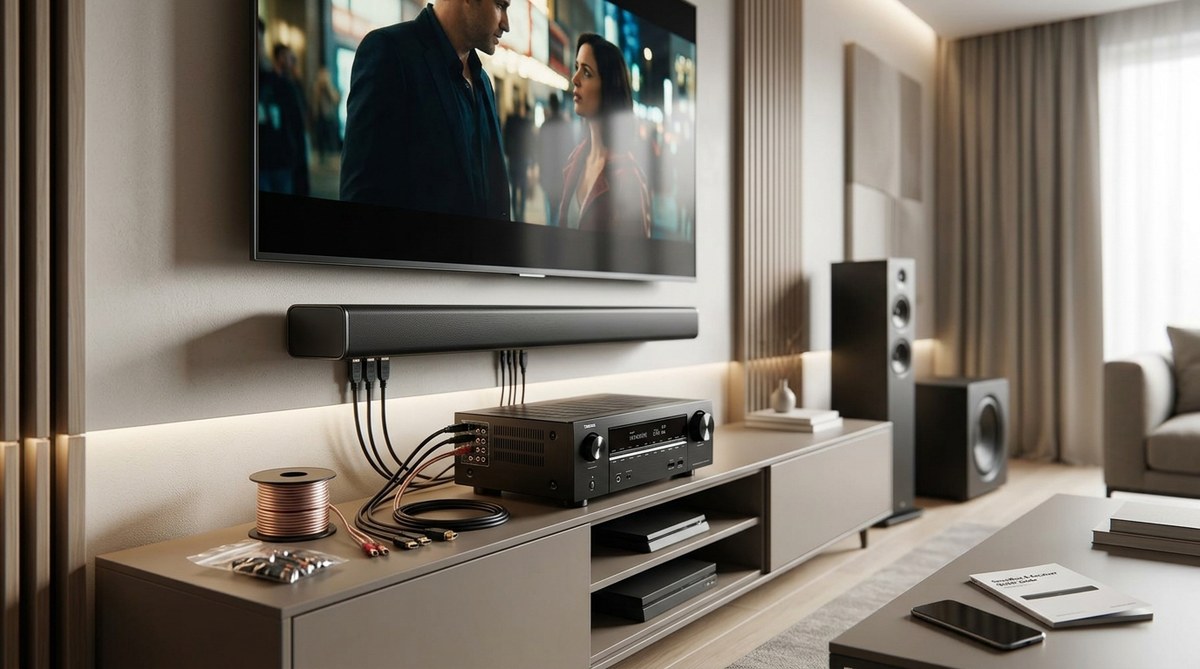
It is important to understand here that irrespective of the digital signal processing (DSP) algorithm used to generate a virtual surround soundstage, these single speaker systems consist in reality of a speaker-bar with multiple mini-speakers mounted onto the speaker unit. A minimum of two such speaker channels are necessary; in fact, to be more precise, Dolby Virtual Speaker technology is a 5.1 virtual surround over a 2-speaker playback setup.

It is through the use of these mini-speakers within the speaker bar unit that it is possible to generate a virtual surround sound stage. More complex single speaker designs incorporate additional mini-speaker drivers and tweeters - all mounted into the same single speaker unit, while some units also include a sub-woofer driver.

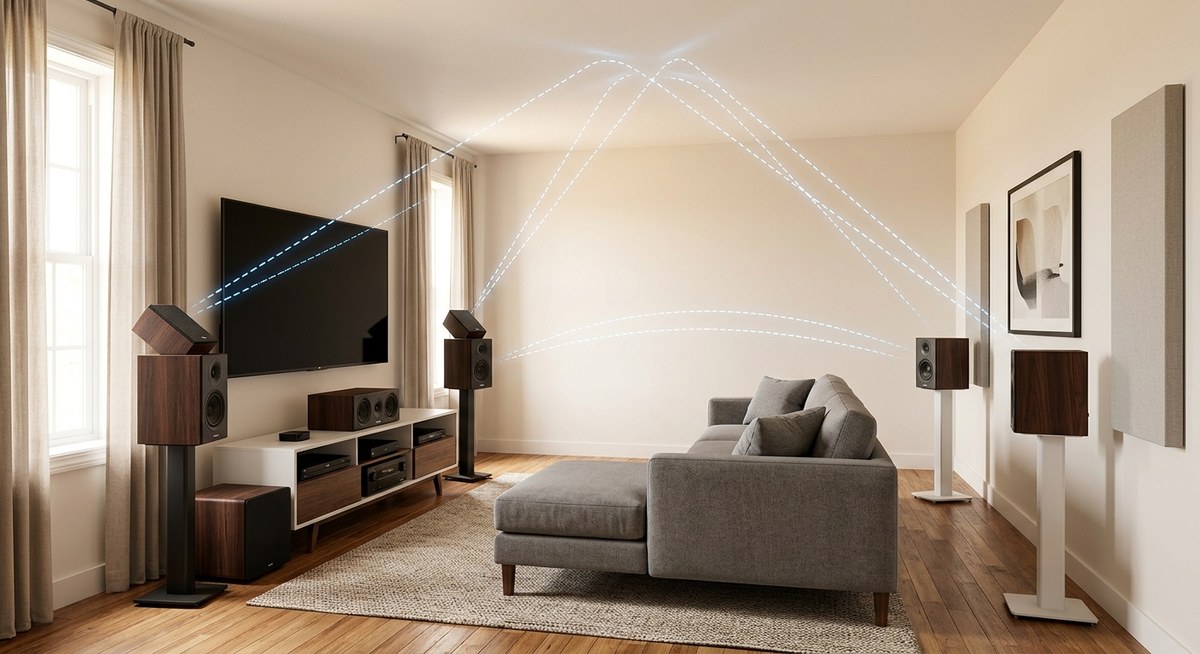
Further more, while some of these single speaker units such as the Cambridge SoundWorks SurroundWorks 200 and the Polk Audio SurroundBar Speaker System rely solely on proprietary virtual surround sound DSP algorithms to generate an immersive soundstage, others like the Yamaha Digital Sound Projector YSP-800 rely on sound projection techniques. The Yamaha YSP-800 makes use of a large number of micro-speaker drivers (as much as 21 1.5-inch microspeakers in addition to a pair of sub-woofers), positioned in such a manner within the speaker bar to literally project the sound and bounce it off the walls, in an attempt to generate a more convincing virtual enveloping soundstage.


Dolby Virtual Surround Sound


Dolby Headphone

Dolby Headphone makes use of powerful digital signal processing techniques to manipulate the audio signal from a multi-channel sound source - so that when it is reproduced by any pair of ordinary headphones, the resultant sound imaging appears as though one is listening to different virtual loudspeakers in a virtual room.


This allows the listener to enjoy a realistic 5.1 surround soundstage from any pair of headphones when listening to music, watching movies, or playing games, without disturbing others. In other words, it is ideal for personal and portable surround sound listening

This Dolby Virtual surround sound technology can also be used with 24-bit/96 kHz audio encoded with MLP LosslessTM found on DVD-Audio discs. This means that Dolby headphone technology has the ability to play the best quality audio that is bit-for-bit identical to original studio masters.

Interesting to note that there may appear two Dolby Headphone technology logos - one using Dolby Digital and the other using Dolby Pro Logic II. There is a rather simple explanation behind these different logos. 

Dolby Headphone is designed to process a 5.1 signal, and though it can be used to process stereo sources to get a virtual 5.1 surround sound experience through over an ordinary pair of headphones, the stereo signal must first be converted to a 5.1 signal. Products featuring this form of Dolby surround sound expansion are labeled with a Dolby Pro Logic II/Dolby Headphone logo.

Products with a Dolby Digital/Dolby Headphone logo decode 5.1-channel Dolby Digital soundtracks. In other words, Dolby Headphone processing is applied to the multiple (discrete) channels of an already encoded 5.1 Dolby Digital material to produce the virtual surround soundstage over a pair of headphones.

One major benefit of Dolby Headphone technology is that of improving the listening comfort by reducing what is referred to as 'listener fatigue'; the latter is the result of a rather unnatural in-the-head sound effect produced by standard stereo headphones.

Instead, the virtual surround soundstage produced by Dolby Headphone technology leads to a more natural 'out-of-head' effect that allows the listener to fully enjoy a three-dimensional soundstage that is much easier on the mind.

More information is available in our Dolby Headphone Technology article appearing under the Headphones section of the site.


Dolby Virtual Speaker

Dolby Virtual Speaker delivers a 5.1-channel surround sound listening experience from just two speakers, making it an ideal technology for digital TVs, stereo mini-systems, PCs, and a variety of consumer audio/visual products.

Dolby Virtual Speaker technology also creates a wider two-channel environment during playback of stereo CDs and MP3s, and when combined with Dolby Pro Logic® II processing, thus delivering a virtual surround listening experience from any high-quality stereo source; the result in this case is more than just a simple 'expanded stereo' performance.

It can be included in a variety of products (such as DVD players, TV sets, PCs, personal speaker systems, and home theater systems) to provide a true-to-life 5.1 surround-sound experience with just two speakers. Working in conjunction with Dolby Digital and Dolby Pro Logic® II decoding, it enhances the playback of any program material, from 5.1-channel DVDs and satellite programming to stereo music CDs and MP3 files.

Dolby Virtual Speaker incorporates highly advanced algorithms and extensive room-modeling technologies to reproduce the sonic spectrum and dynamics of a properly placed 5.1-speaker system in a room environment. This is possible by reproducing the direct and indirect (reflected) sounds as these would arrive to the ear in a real 5.1 multi-speaker setup; this means that this virtual speaker technology has to take into account the lower levels of indirect sound as well as the different spectral balance between direct and indirect sound waves arriving at the ear.

It is by comparing and analyzing these two composites (direct and indirect), arriving at each ear - also referred to as sonic signatures - that the brain is able to determine where the sound originates, and the size and acoustic character of the environment.

One may say that Dolby Virtual speaker is basically the same as Dolby Headphone. True that the virtual surround sound stage produced in either case is basically the same, but there is a major technological difference between the two.

While with headphone listening, the sound produced by each earpiece is only heard by the respective ear, this is not the case with speaker listening. Yet, to create a virtual surround sound stage over two speakers requires not only recreating the sonic signatures for each ear, but also ensuring that neither ear can hear the signature intended for the other. In other words, the left ear must hear only the Left speaker, and the right ear must hear only the Right speaker.

Dolby Virtual Speaker technology accomplished this through a crosstalk cancellation technique whereby a delayed mirror image say from the Right speaker's sound is generated by the Left speaker such that when this reaches the left ear, it cancels out the sound arriving from the Right speaker at the left ear. In this manner, the right ear hears sound only from the Right speaker and similarly for the left ear.

To experience the full effectiveness of this cancellation, the listener needs to be in a listening zone equidistant from each speaker.

This renders the listening area somewhat restricted, and therefore, this virtual surround sound technology is most appropriate for such activities as using a PC or casual TV viewing - where a full surround system might be unsuitable or impractical.

Sound Cancellation in Dolby Virtual Speaker

Dolby Virtual Speaker technology does provide two listening modes that produce different listening environments. Both differ in the surround effect as well as in the apparent localization of the virtual speakers; these are termed 'Reference', and 'Wide'.

The Reference mode creates a realistic five-speaker surround sound from two speakers with the apparent width of the sound across the front image defined by the distance between the two speakers. Instead, the Wide mode creates a more spacious front image than that defined by physical position of the two speakers used in the playback setup.


More on Virtual Surround Sound Systems
will follow soon.
Last updated on:

19th Dec. 2006

Subscribe to our free e-zine to remain abreast with the latest additions.

Click here for details.


 ...back to Dolby Sound Formats Sec. Index


 Copyright © - Practical-Home-Theater-Guide.com  All rights reserved.


Google

Web

Practical HT Guide


More Information at

Practical Home Theater Guide


Red BulletRECOMMENDEDRed Bullet Home Theater Guides Suggested further reading:

Surround Sound Format
The never ending list of terms and brand names - Dolby, DTS, THX - associated with surround formats is starting to get a bit too complicated...

Speaker Placement in Multi-Channel Audio Correct home theater speaker placement plays a critical role towards achieving that seamless ‘enveloping’ sound so important in the overall home theater experience.

Time Delay Settings in Surround Sound Systems
Directly related with your home theater speaker placement is a  correctly set surround sound field in multi-channel audio playback systems.

TV Viewing Distance
Buying a big screen TV? Care should be taken as you may easily fall into the trap of buying a too large TV.

Home Theater room design basics (1):  Room acoustics and lighting
Acoustics & lighting are dependent on the shape, size and layout of your room – a fact often overlooked by many during their home theater design stage...

A Guide to Home Theater Seats
Don’t underestimate the importance of proper home theater seating - the layout of home theater seats play a determining role in your home theater experience.

Home Theater Equipment Placement
Just as important as which equipment to buy, is deciding where to put them. Correct placement of system components is a major contributor towards...

Selecting and Installing Speaker Wire
A correct home theater wiring approach is important for your home theater sound. Poor workmanship and low quality speaker wire will surely impact...


To access the full range of home theater design guides appearing on our site, click here.


Featured

Single Speaker Systems


Available in Black or Titanium color


Available in Black or Sliver color