![]() |
|||||||||||||
|
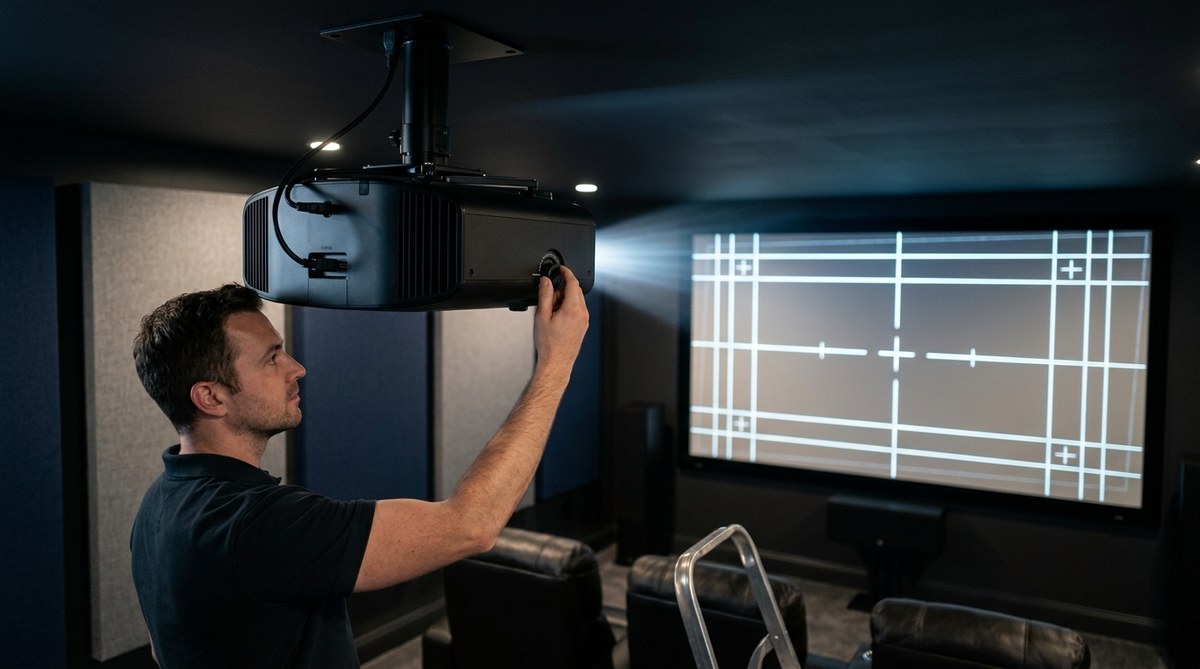
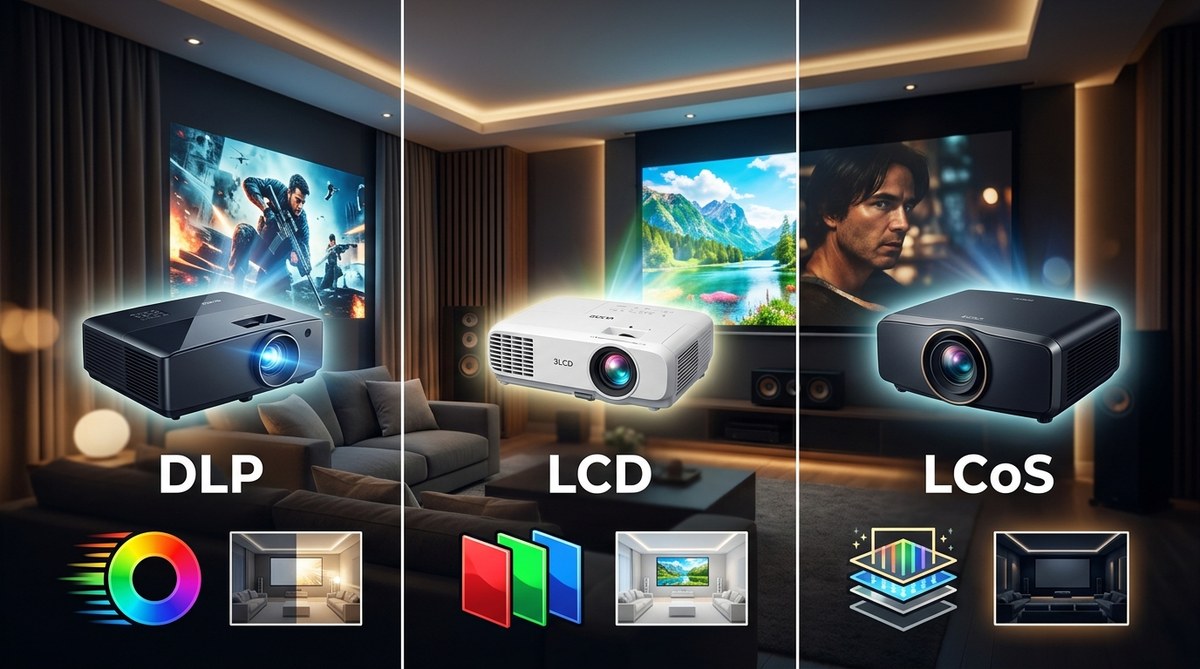
Today's multimedia video projectors represent a versatile, practical, and affordable tool that can serve different purposes both in the business as well as in the home entertainment arena. The fall in price and the developments in video projection technology we have experienced during these last few years, have made the digital projector even more accessible to a larger group of home users. Demand has increased to such an extent that manufactures are not only producing what are referred to as 'cross-over' models - i.e. projectors that can handle both PowerPoint presentations in the office as well as DVD movies at home, but they have also started to target the home entertainment domain by producing models specifically designed for home theater use. ...why? It is true that 'cross-over' projectors can handle both worlds, but this does not mean that a video projector that can deliver a great presentation in the boardroom is also capable of delivering a great cinematic experience in the home theater. Home theater projectors and business projectors have to fulfill distinct requirements in their use which can only be met if the video projector is specifically designed for the purpose. The contents of this article should be seen in the light of the information already available in related front projection guides under the Projection TV section of this site; details and links for each of the guides in question, are given at the end of this article. What characteristics differentiate Business Video Projectors from Home Theater Projectors? It is no surprise that video projectors are becoming a popular choice with many home theater enthusiasts. The digital projector can deliver the largest image for your dollar. Simply hook up your DVD and there you have the most cinema-like image in the home theater. Or connect a HDTV source such as a cable set-top box or satellite receiver, and there you have a huge 100" HDTV for the cost of a 50" plasma TV. And in the boardroom, today's powerful digital multimedia projectors are proving to be more than ideal for business presentations; they are capable of delivering bright huge images under normal ambient room lighting - something only dreamt of in the days of the overhead projector. Simply plug in your laptop, and there you have the most fantastic business presentation in the world! However, it is important to keep in mind that the boardroom and the home theater are two different arenas that require different beasts. The distinct requirements between the two are important; the discussion that follows explains what video projector attributes should apply in these two cases. Important Projector Attributes Brightness: The brightness level (measured in lumens or ANSI-Lumens) is an indication of the level of light thrown out by the projector. Brightness is a lot more important for business use - this in view that many presentations are given in conference rooms with standard office lighting rather than in reduced ambient light. This means that the image needs to be bright enough to be seen, otherwise the projection would look washed out. For small boardrooms and presentations with a lot of ambient light, a brightness of around 1000 to 1500 lumens should normally be fine. However, keep in mind that the projector brightness required depends on the projected screen size, the level of ambient light, and the projection screen gain (more on this in our projector screen guide). For home theater applications, a high brightness level is not important. Some video projectors intended for home theater use come with bulb setting to enable the user to dim the light source for improved viewing and deeper blacks when viewing takes place in a darkened room. Contrast:As discussed in our Contrast Ratio article, even a minimal level of ambient light may render a high contrast image of say 5000:1 similar to one with a contrast ratio of 500:1. This means that though a minimum level of contrast is important for the eye to perceive a sufficient bright image, yet contrast is not an important attribute in business applications, nor it is in home use if one will be using the projector in the living room with the lights turned on. In reality, anything above 400:1 for the contrast ratio would not be perceived by the eye if viewing does not take place in a completely darkened environment. In addition, due to the eye's contrast sensitivity function, a contrast ratio of say 2000:1 would not be perceived as five times better than one with a contrast ratio of 400:1. Therefore, pay more and go for a high contrast ratio only in the case of a home theater projector and as long as viewing takes place under controlled lighting. Color, Gray-Scale Performance, and Smooth Video Playback:These are all attributes that are more critical in home theater applications. In fact, color accuracy with natural-looking skin tones and capability to present subtle detail in bright and dark areas of the image matter more to the home user. Similarly, the projector's ability to present smooth, video playback with no added motion artifacts, when presenting fast action sports and movie scenes, is of prime importance in any home theater application. LCD or DLP:It all depends. Strictly speaking, both technologies can do a good job in either of these applications in that advancement in technology has closed the gap between the two. Yet LCD projectors are normally the primary choice with business projectors in view that these still have a brightness edge over DLP. On the other hand, DLP is still the favored technology when it comes to home theater use due to their improved black level performance and smoother looking projections that resembles more closely those at the movie theater. Portability:This is a major issue with the business video projector. Smaller and lighter is better, especially if you travel frequently. Weight is more of an issue for the business user. Business mobile professionals will want to hook up a lightweight projector to a computer or laptop, projecting an image on a large screen or wall for presentations. Most business-oriented projectors weigh just a few pounds - some very light business models weigh no more than three pounds! These video projectors usually come with carrying cases and wireless remote controls that enable the user to control not only the projector, but also to send commands to the PC through appropriate connectivity. Some remotes include an integrated laser pointer. Most multimedia projectors under this category come with a small integrated speaker for the sound; more expensive projectors have security features such as locking cables, etc. Portability issue is of no concern in the home theater. One would normally setup a fixed place for the projector. For home theater projectors, the best installation spot is on the ceiling. This means that some planning has to go into how it is best to run cables into the ceiling to connect your projector with the rest of your home theater gear. Video Projector ConnectivityIt is critical that your video projector comes equipped with the appropriate inputs to enable you to connect with your PC or laptop in the case of a business projector, and home theater gear, DVD, or HDTV set-top-box in the case of a home theater projector. It is clear that connectivity requirements between these two video projector categories vary. Most - but not all - models support component, composite, S-video, and RGB connectivity (for more info on these analog video connections, check our video cables guide). Home theater projectors normally also include a DVI or an HDMI port; this is very useful when it comes to interconnecting with a compatible DVD player or HDTV set-top boxes. One standard that is starting to show up more on video projectors, and that is most appropriate in the business arena, is the M1, EVC, or P&D standard; this is most commonly referred to as M1 or M1-DA. The M1 connector allows for the same connectivity as DVI – digital single or dual link or analog transmissions in the case of DVI-I. But the added advantage of the M1 over DVI is that the M1 also provides connectivity to the USB or FireWire port on your PC. The USB/FireWire connection is used to supply commands from the projector's remote control to the computer - thus allowing you to scroll through PowerPoint presentations, etc. Our advice: Always check before you buy to be sure that the projector has the inputs you need. Projector Resolution: SVGA, XGA or Widescreen (WVGA or WXGA)?This refers to the native or optical resolution and measures the level of picture detail that the projector can handle without compressing (down-scaling) the number of pixels in the original video content. Downscaling degrades picture quality and leads to picture content loss. This is probably by far the most important video projector attribute that differentiate business from home theater projectors. In reality, it is not the number of pixels but rather how these are arranged on the screen in terms of width vs height i.e. the native aspect ratio of the projector. SXGA (1280x1024) is currently the highest resolution available for portable projectors; these video projectors are relatively very expensive. Most common video projector resolutions in the 4:3 aspect ratio are XGA (1024x768 pixels) and SVGA (800x600 pixels). Widescreen versions of SVGA (WVGA: 854x480) and XGA (WXGA: 1280x720) have also started to emerge. These enable better projections of widescreen 16:9 content. Business Video Projectors: SVGA and XGA projectors are more suited for business presentations, with the higher resolution XGA projectors being more capable of showing fine detail in your slide show. Many may thing that the higher the resolution the better - but this does not necessary apply in the case of the business projector. A word of caution here arise out of the fact that if the text on a PowerPoint slide makes use of a too small a font to show using an SVGA projector (and therefore it necessitates the need of an XGA projector), it means that probably, the audience at the very back would still not be able to read it. Surely, you do not want that. In these circumstances, the cheaper SVGA projector would - in most circumstances - be able to do more than a good job. On the other hand, the XGA projector is the best option for presentations that include graphics, software demonstrations, or full Web pages; this resolution also represents a better match for laptop computer displays. Home Theater Projectors: If you want to use a video projector to project a huge image on a screen in your home theater, then the higher the resolution, the better since you will be less likely to suffer from pixelation issues. It is true that pixelation disappears as one moves further away from the screen but in the home theater, many would prefer to move a little bit closer for a wider angle of view and a more immersing movie experience. Although most SVGA projectors can display HD images from your HD cable tuner or satellite, they don't have enough resolution to do it justice. The two main HD resolution formats are 1080i (1920 x 1080 pixels) and 720p (1280 x 720 pixels). SVGA projectors, with 800 x 600 pixels of resolution, don't have the ability to display either format without downscaling. Even with DVD content - which at 852x480, comes with a lower resolution than HDTV - the lower-priced SVGA projectors cannot do a good job with DVD movies. XGA, on the other hand, gets much closer but...
Widescreen projectors come in either WVGA or WXGA. Opting for the cheaper WVGA projector makes sense if you will be watching only DVD movies. For HDTV content, a WXGA projector is necessary. This will enable you to display all HDTV content up to 720p without re-scaling. You still will be able to see 1080i HDTV material on a WXGA projector but the projected image will have to be compressed to fit the 1920x1080 pixels in a 1080i or 1080p HDTV, in the available pixel field of a WXGA video projector. What about video projectors with a native resolution that can handle 1080i without rescaling? In Sept., 2005, Texas Instruments exhibited at the CEDIA, a 1080p resolution (1920 x 1080) chipsets for the front projection market. 1080p is the high-definition resolution standard for many highly anticipated content applications in the near future, including broadcast, gaming, and high-definition video players. DLP 1080p resolution chips will be made available to customers for both single-chip and 3-chip applications, enabling incredible detail for the ultimate HD viewing experience. Manufacturers who will be announcing front projection products in the near future - based on the new DLP 1080p technology include: BenQ, Christie Digital, Digital Projection International, InFocus, Marantz, Mitsubishi, Panasonic, Optoma, Samsung, Sharp, and Yamaha. Best Multi-media Business Projectors: Among the present top-selling video business projectors worth considering, there is the InFocus X2 SVGA Multimedia DLP Projector. It is presently selling at amazon at under $800 and features a screen native resolution of 800x600, 2,000:1 contrast ratio, 1,600 maximum ANSI lumens, and PC and Mac compatible. Another entry level projector that is also selling at under $800 is the Toshiba TDP-S25U SVGA 6.6LB DLP Projector. It is capable of delivering up to 1800 lumens. As for an XGA video projector, there is hardly anything that can beat the InFocus X3 DLP XGA Video Projector within its category. This multimedia projector is relatively compact and light for a 1,600 ANSI lumens multimedia projector. It also boasts a 2000:1 contrast ratio, 4000 hours lamp life, and a full range of connectivity options - including an M1 port to interconnect with a computer source; last but not least, the InFocus X3 also features a price that is hard to resist.
Best Home theater projectors: Options are wide open. In the lower end of the resolution scale, one finds the Optoma DV10 MovieTime Home Theater DLP Projector. An interesting product worth considering. It is one of the few projectors that come with a built-In DVD Player. It is presently selling online at around $1,300 and features a 1000 ANSI Lumens light engine, an 854 x 480 (WVGA) resolution, a 16:9 aspect ratio for a perfect match with DVD content, and a 4000:1 contrast ratio. What if you want a projector that can handle HDTV? In our opinion, the Panasonic PT-AE700U High-Definition Home Cinema LCD Projector is one of the few great affordable products under $1,800 that deserves a five star rating. This is a 1000 ANSI Lumens projector with a rated 2000:1 contrast ratio. It incorporates 3:2 pulldown detection and reversal, a handy feature for watching progressive-scan movie programs in their native 24-frame format. It is capable of delivering smooth, film-like images for a most enjoyable movie experience in the home. If you think that LCD cannot deliver deep blacks, see this projector in action and you will soon realize that this is no longer the case. This Panasonic LCD projector has come a long way in displaying BLACK close to true black. The PT-AE700U has a native 1,280x720 HD resolution - meaning that it can handle up to 720p HDTV without re-scaling. It also comes with a full set of connectivity options including HDMI, component-video, composite-video, S-video, and RGB inputs. If you would like to know more about this high definition LCD home theater projector, please check our review article here: Panasonic PT-AE700U Review If you think that a Front Projection Setup represents a solution to your needs, we suggest that you also take a look at the following Projection TV guides: Visit also our Projection Screens section for detailed information on how to choose an appropriate projection screen for your front projection setup. Remember that irrespective of whether it is for business or home theater use, you will only get the best results out of your video projector if you invest in an appropriate projection screen.
...back to Projection TV Guides - Main Section Index
|
Copyright © - Practical-Home-Theater-Guide.com All rights reserved. |
|||||||||||