left image


Home Page - Surround Sound - Audio Amplifiers (3): Delay setting in surround sound systems

Update: 22nd May 2010


Comprehensive Home SoundProofing Guide

Comprehensive Guide to Soundproofing Your Home

e-book by Craig Williams.

Inexpensive yet effective tips on do-it-yourself soundproofing for floors, ceilings, walls, windows and doors. You will also get practical advice on how to soundproof your home theater.

For more information,
click here.


Harman Kardon Home Theater bundle from amazon

Harman Kardon AVR2600 Home Theater bundle from amazon

Time Delay Setting in Multi-channel Surround Sound Systems
 

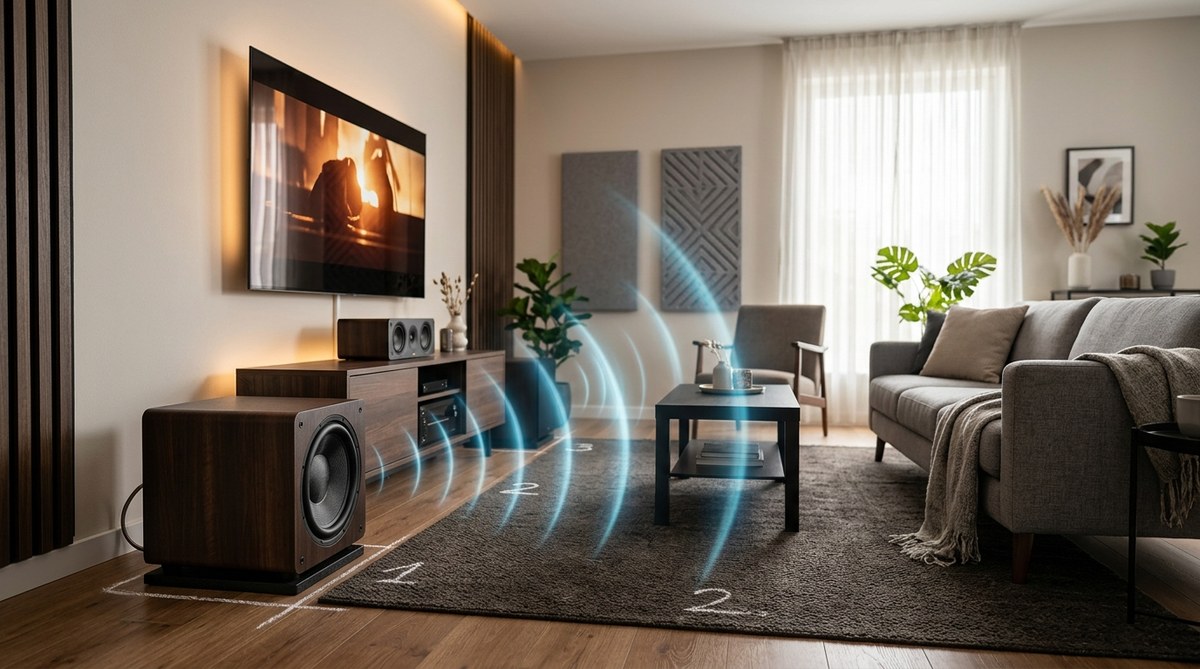
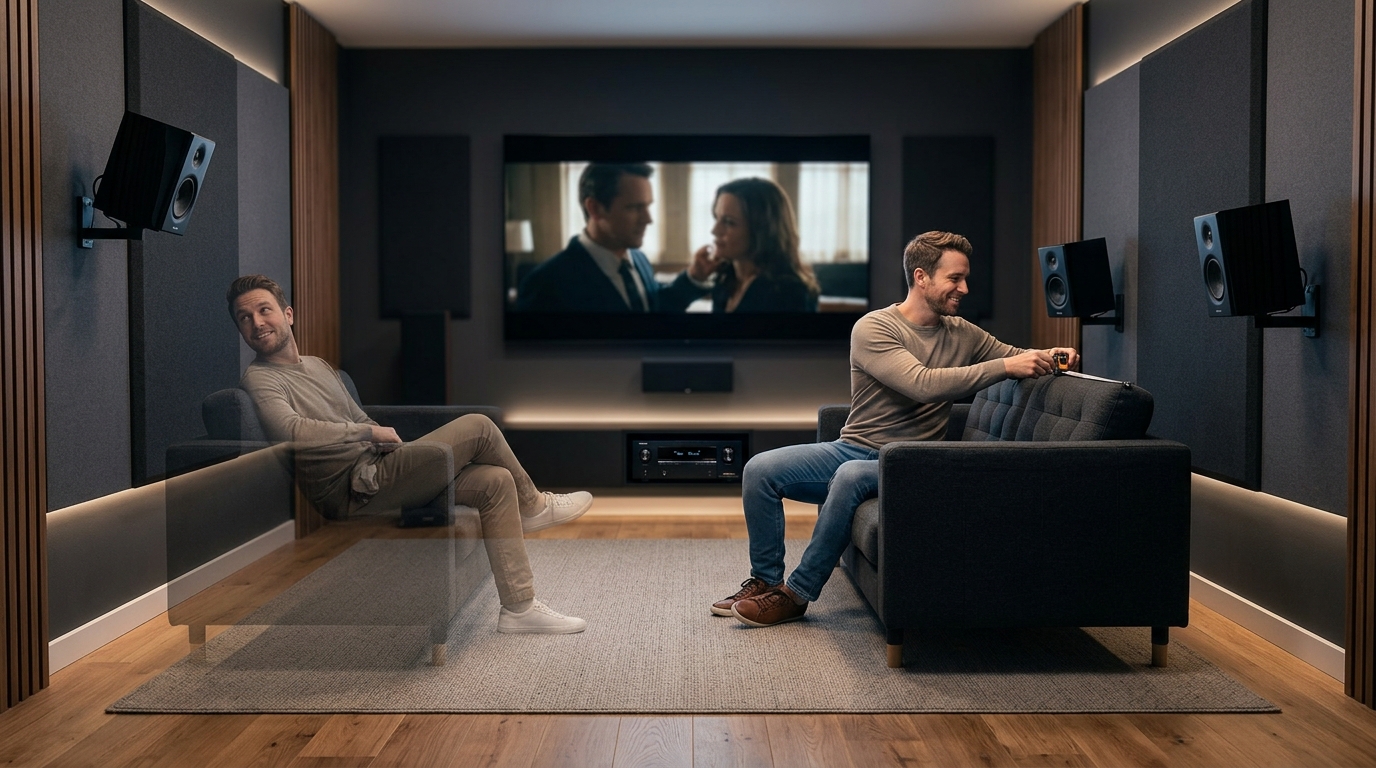
Correct home theater speaker placement and properly balanced sound levels between the different channels in multi-channel audio, while crucial, are not enough to sustain a unified soundfield in a surround sound setup.

A correctly set surround sound system requires that sound from all the different speakers should reach the listener at exactly the same instant.  

This explains why all fronts, left, right and center channel speakers, should be set at exactly the same distance from the listening position. At the same time, in a typical home theater setup, the surround speakers are closer to the viewer than the fronts.

To compensate for this distance discrepancy, Dolby Digital and Dolby Surround Pro Logic based playback systems apply a split-second delay to the surround sound channels.

Setting the time delay in a surround sound system would effectively adjust the soundfield between the front and rear channels to ensure that simultaneous sounds from each speaker arrive at the listener's ear at about the same time.

However, in Dolby Pro-Logic surround sound systems, there is a second reason for applying delay to the surround channels.

In Pro-Logic mode, sound tends to leak between the front left and right channels and the rear surround channels as a result of the way the original multi-channel sound from the different sources is encoded over the two (stereo) right and left channels.

These leakages tend to disturb the proper perception of the sound field as a result of what is referred to as the Haas effect, also known as the law of the first wave front.

This effect will occur when the arrival difference between the two sources is within 10 to 40 milliseconds.

The Haas effect is basically the subjective perception by a listener that whenever identical sound arrives from two sources positioned at different distances, sound is perceived to be coming only from the closer source. Since surround speakers are closer to the listener, any sound leaking onto the surrounds but that should be coming from the fronts, would appear as coming from the surround speakers. This effect would distort the proper placement of the different sounds within the 'enveloping' soundfield in a Dolby Pro-Logic surround sound system.

In these circumstances, applying the correct amount of delay to a Pro-Logic encoded surround sound system would help ensure that even if you are physically sitting closer to the surround speakers, sounds that are supposed to be coming from the front - but that are also leaking onto the surround - will still be perceived as coming from the front speakers.

However, this necessitates the application of a slightly longer delay setting in a Pro-Logic surround sound system - typically in the region of 15 to 20 milliseconds - than that applied in Dolby Digital systems. This extended delay helps to improve the inherent lower channel separation found on these surround sound systems by reducing the audibility of sound leakages from the front to the surround.

This is not the case with Dolby Digital surround sound systems, where each channel is discrete, i.e. separate and therefore is not encoded over a second sound channel.


Adjusting the Time Delay Settings

Thanks to advancement in technology, time delay adjustments in the latest generation of A/V receivers have become much easier than ever. Some of the latest home theater receivers incorporate an auto setup and calibration routine that uses a microphone for the multi-channel surround sound system to pick-up the different sounds and set the correct levels.

This does not mean that with these new systems, there is no need for further fine tuning. A home theater calibration disc and an inexpensive sound pressure level meter such as the Galaxy Audio CM130 SPL Meter, would still be required if you want to get the very best out of your system. At the same time, one has to admit that these built-in auto setup routines are more than adequate for a quick startup.


More information on the use of calibration discs can be found at our Home Theater Set-Up Discs section.


But even in AV receivers without an auto setup, setting delay times in a surround sound system has become easier than before. Up to a few years ago, the user had to calculate and then choose the right amount of delay in milliseconds, based on the positioning of the speakers with respect to the listener.

A good home theater amplifier or AV receiver without an auto set-up would simply ask you to key in the respective distances of each speaker from your listening position, and then the system would make the appropriate choice for you based on your response. No mathematics - just key in the distances and you are done!

Time Delay Calculations

Unfortunately, not all surround sound systems provide such a friendly user interface as detailed above. With some less intelligent systems, the user will have to key directly the delay settings in milliseconds.

To set the time delay between the fronts and the surrounds correctly, you need to determine the 'difference' in the distances between a front speaker and a surround speaker when this distance is measured with respect to your main viewing position.

To translate this in terms of delay, we make use of a simple physics equation, namely:

Time Delay (in seconds) = Distance/Speed (of sound in air).

The speed of sound in air is approximately given by the following equation:

Vsound in air = [331.4 + 0.6 Tc]m/sec

where Tc is the air temperature in Celsius.

At a typical ambient temperature of 22 deg. Celsius (72 deg. Fahrenheit), the speed of sound in air is 345m/s or 1132ft/sec.

This means that if say the difference in the distances between the surround and the main front speakers measured with respect to your main viewing position is 15ft, the required delay is ≈ 13msec., or approximately 1 msec per foot.

Remember however that in the case of 'matrixed' surround sound formats such as Dolby Surround Pro Logic, the minimum delay should be set to at least 15msec and even longer to allow for the Haas Effect referred to earlier on in this discussion.


Looking for affordable Surround Sound Systems and AV Receivers?

Amazon offers an extensive range of home theater audio at significantly reduced pricing. In addition, the various buying options available from the different retailers present on the amazon storefront make amazon one of the most comprehensive online sources in this respect. 

Prior to any decision, we advise to do some research of your own. Look at what other customers had to say about their purchase especially with respect to product quality and manufacturer customer support. A good starting point is the customer feedback posted on amazon. 

You can search the amazon storefront without leaving our site by using the amazon search box below; your search results will appear here under.


Home Theater Sound

Articles covered under this section 

Surround Sound Formats

Dolby Sound formats including High-definition Audio Formats and Virtual Surround Technology

DTS Sound formats including DTS High-definition Audio

High Definition Audio for Music Listening covering DVD-Audio and Super Audio CD - including DualDisc and Hybrid SACD.

Audio Speakers

Home Theater Speaker Basics: An introduction

Speakers for Multi-Channel Audio: Discussing the different types of speakers and  the speaker requirements associated with the different surround sound channels.

Home Theater Speaker Choice: What to look for when shopping for audio speakers for use in multi-channel audio

Speaker Placement in Multi-Channel Audio: Discussing the home theater speaker placement associated with both music listening and movie watching

Understanding speaker specs: Explaining the different terms associated with audio speakers.

AV Receiver & Amplifiers

Understanding Amplifier Specs: How different specs relate to an amplifier's ability to deliver adequate audio power and sound quality.

Amplifier Power: Matching the amplifier power output to your expected level of loudness.

Additional Articles:

Tips for Better Sound: Simple steps you can take to a better sound.

Dolby vs. DTS - Which is better?  Discussing the differences between these surround sound formats.

THX Home Cinema - An Overview: This short guide to THX explains this certification system, together with the different certification logos, and related technology.


 Home Theater Guides:

Recommended Technical Guides 

3D TV in the Home
We experienced 3D in the movie theater; now 3D is coming to your home thanks to the latest 3D HDTVs. Discover all you need to know about the 3D technology in home entertainment.

The Complete LCD TV Guide:
LCD HDTVs are turning out sharper, bigger, better, and cheaper. Discover all you need to know about LCD TV sets in this series of articles on LCD televisions.

Plasma Television
Discover all you need to know about plasma TVs - from the features to look for when purchasing a plasma television, to installing and protecting your plasma TV investment.

Guide to Digital Satellite TV
Covering satellite TV basics - with a special emphasis on satellite TV decoder choice and satellite dish installation.

The HoloVision Rak Master Pull-out/Swivel AV RacksEquipment Racks:
There is more to equipment racks than a storage space for your system components. More in this informative home theater guide.

TV Viewing Distance
Buying a big screen TV? Care should be taken as you may easily fall into the trap of buying a too large TV.

Room acoustics and lighting
Acoustics & lighting are dependent on the shape, size and layout of your room – a fact often overlooked by many during their home theater design stage...

Home Theater Seating
Don’t underestimate the importance of proper home theater seating - the layout of home theater seats play a determining role in your home theater experience.

Equipment Placement
Just as important as which equipment to buy, is deciding where to put them. Correct placement of system components is a major contributor towards...

Selecting and Installing Speaker Wire
A correct home theater wiring approach is important for your home theater sound. Poor workmanship and low quality speaker wire will surely impact...

Understanding HDTV Formats
Discover the strengths and weaknesses of the different HD formats - 720p, 1080i, and 1080p - in this HDTV Guide.

 HT Books and Magazines

Recommended Home Theater Reading

Home Theater

Loads of useful information, equipment reviews and buyer's guides.

Home Theater Magazine

Sound & Vision

Provides good reviews on the latest home theater gear.

Sound & Vision Magazine

Practical
Home Theater
Well-written home theater guide - a useful reference to anyone interested in home theater.

Practical Home Theater

Quick Guide to Home Theater Design

How to research, design, and build your Home Theater.

Home Theater Design e-book

by Duncan McClelland
More information HERE


Featured Home Theater Speakers & AV Receivers

Check out the latest reduced pricing  at amazon


Find us on Facebook
Follow us on twitter

Home
HDTV Guides CRT TVs
LCD TV Guide
Plasma TV Guide
3D TV
Flat-panel TV Reviews Plasma TV Reviews
LCD TV Reviews
Best HDTVs
Projection Systems Projection TV
RPTV Reviews
DIY Projection TV
Projector Reviews
Projection Screens
Digital and Satellite Television Digital TV Guide
Satellite Television
Home Theater Audio Surround Sound
AV Amplifiers
Speakers
Wireless Home Theater Wireless Speakers
Headphone Guide
Media Players
Home Theater Guides Home Theater Design
Equipment Racks
AV Cables
HDCP
Set-Up DVDs
Power Protection
Books and Magazines Books / Magazines
Catalogs
Home Theater Ideas! Home Theater Sites
HT Pictures Gallery
Useful Links
Movie Posters MoviePoster Guide
The Poster Store
Shopping Online Price Search
Refurbished Products
Online Store
Website Information About Me
Website Content
Site Use & Dislaimer
Privacy Policy
Advertise
Site Search
Contact  Form
Site BLOG
E-zine Subscription
.

[?] Subscribe To This Site

XML RSS
Add to Google
Add to My Yahoo!
Add to My MSN
Subscribe with Bloglines


Please Note:

Double-underline links appearing on this site represent additional information and special deals related to the page content; this added information is being supplied directly by Kontera.

To view this information, please place your cursor over these double-underline links.


return from Delay Settings in Surround Sound Systems


Back to: Understanding Audio Amplifiers

Next:: Tips for Better Sound

Surround Sound - Main Index

Home Theater Design

Home Page