site logo    

Home
HDTV Guides CRT TVs
LCD TV Guide
Plasma TV Guide
3D TV
Flat-panel TV Reviews Plasma TV Reviews
LCD TV Reviews
Best HDTVs
Projection Systems Projection TV
RPTV Reviews
DIY Projection TV
Projector Reviews
Projection Screens
Digital and Satellite Television Digital TV Guide
Satellite Television
Home Theater Audio Surround Sound
AV Amplifiers
Speakers
Wireless Home Theater Wireless Speakers
Headphone Guide
Media Players
Home Theater Guides Home Theater Design
Equipment Racks
AV Cables
HDCP
Set-Up DVDs
Power Protection
Books and Magazines Books / Magazines
Catalogs
Home Theater Ideas! Home Theater Sites
HT Pictures Gallery
Useful Links
Movie Posters MoviePoster Guide
The Poster Store
Shopping Online Price Search
Refurbished Products
Online Store
Website Information About Me
Website Content
Site Use & Dislaimer
Privacy Policy
Advertise
Site Search
Contact  Form
Site BLOG
E-zine Subscription
.
[?] Subscribe To This Site

XML RSS
Add to Google
Add to My Yahoo!
Add to My MSN
Subscribe with Bloglines


side navbar picture

The D-I-Y TV Calibration System that leaves the guesswork out!
Datacolor Colorvision SpyderTV


Colorvision SpyderTV by Datacolor is a colorimeter based 'software-driven' easy-to-use' solution designed to help home users optimize their direct-view television screen or monitor for a better viewing experience. Being colorimeter based means the video calibration process is not subjective to the human eye perceived levels of color, contrast, and brightness.

It is an affordable solution for D-I-Y videophiles. In fact, it promises a lot for the price, even though the Datacolor TV calibration system is substantially more expensive than the AVIA or DVE set-up discs ...but does it deliver on what it promises?


ColorVision SpyderTV Colorimenter

Colorvision SpyderTV Colorimeter


Introducing the Datacolor Video Calibration System

Originally exhibited during CES2005, the Datacolor SpyderTV colorimeter and software promises to deliver an easy-to-use TV calibration solution.

And at approximately $200, it brings TV calibration to the home user at the fraction of the cost of an ISF calibration package.

At this price bracket, Datacolor has come up with a product that fills the enormous gap between a full-blown professional video calibration solution costing  a few thousand dollars, and home theater set-up DVDs selling at under $40.

This should not be interpreted that calibration DVDs such as the AVIA or DVE - reviewed on our site, do not provide you with the necessary tools to help you optimize your system.

These set-up discs come with a comprehensive set of video test patterns and audio test tones that can lead to an excellent system calibration when the set-up process is done correctly. But these calibration discs do so in a passive way in that when it comes to some of the video calibration test patterns, you have to rely solely on your eyes.

Instead, SpyderTV makes use of a sensor (colorimeter) that is placed in front of your television screen to get accurate measurements for contrast, brightness, color, tint, and color temperature.

The sensor analyzes the test patterns as appearing on the TV screen. Based on the information it sees, the software running on your computer instructs you how to adjust your settings accurately without any guesswork. In other words, the Datacolor solution provides the user with a scientific means to make the necessary video adjustments in an accurate and repeatable fashion. But...

This should not be taken to imply that the Datacolor Colorvision SpyderTV solution is a direct replacement to a professional set-up DVD.

First and foremost, the set of video test patterns supplied with SpyderTV - though sufficient for the scope of the calibration process, and will therefore serve the system purpose nicely, yet cannot be considered 'comprehensive'.

In this respect, both the AVIA Guide and Digital Video Essentials set-up DVDs come with a more complete range of 'key' test patterns that would surely prove useful in the hands of knowledgeable users.

Secondly, the 'Spyder' is a video calibration system only while AVIA and DVE provide you with both a comprehensive range of reference video test patterns and audio test tones.

In other words, if you are after calibrating both your home theater audio and video equipment, then the SpyderTV solution alone is not sufficient. Rather, the Spyder solution - should in our opinion, be supplemented by one of these set-up discs for a more comprehensive home theater calibration.

Datacolor SpyderTV - Video Calibration Solution

The SpyderTV kit comes with a software CD, a Quick Start guide, a DVD (NTSC for US and PAL for Europe), the SpyderTV sensor, and a suction-cup complete with a tripod holder latch. All is housed nicely in a neat bag.

The Spyder sensor is used to measure the red, green, and blue levels emanating from direct-view displays and rear-projection television screens.

The DVD contains a complete tutorial/walk-through as well as the test patterns which work on both 4:3 and 16:9 TV screens. The test patterns on the SpyderTV are accompanied by easy-to-use calibration wizard software that guides the user through the entire optimization process with its intuitive interface. Comprehensive help screens guide you through each step to achieve the desired optimal settings for your video display device.

To use the SpyderTV to calibrate your TV screen, you need a DVD player, and a PC close to your TV, or laptop, running Windows XP or 2000. The 'Spyder' sensor connects to your computer using the USB port.

The SpyderTV software supports direct view and rear projection TV systems. It differentiates between plasma, LCD, and CRT, and adjusts the calibration process accordingly.

While there is no reason why the supplied sensor should not work also with a front projection set-up, yet the software delivered with Spyder does not support guided calibration for front projection systems. For this, Datacolor have a different product - Spyder 3 Elite - which is presently selling on-line for around $250.

The 'Spyder' sensor is shaped like a three-legged spider; it includes three tiny suction cups that serve to attach the sensor to the TV screen. The sensor's cable comes with a sliding counterweight. This is designed to help ensure that the sensor's weight does not dislodge it from the screen. In our case, the sensor under review did at times fail to remain firmly attached to the screen surface of the TV we were using for the calibration process.

The 'Spyder' DVD - Test Patterns, Guided Set-up, and Tutorial

In addition to the set of video test patterns used by the 'Spyder' during the calibration process, the SpyderTV DVD also provides the user with a detailed tutorial on how to use the system.

The DVD is divided into 6 chapters. It starts with an overview of the SpyderTV system, and goes on from verifying that you have everything you need to get started, to explaining the reasons behind TV calibration.

The tutorial is complete and informative. It guides the user through the process required to use SpyderTV, including locating the video controls on your TV or monitor and understanding how to designate the methods your TV uses to make picture and color adjustments. It then goes over set-up and launching of the software as well as how to attach the Spyder colorimeter to the television set.

There is a whole section that explains how to use the 7 test patterns supplied with the DVD. Additional test patterns are also available to users who wish to check sharpness and the like, but the software does not directly interface with these controls except to let you know what these are.

The 'Spyder' DVD also explains how the 'Before and After' feature will allow you to see the difference in video performance brought about by the SpyderTV calibration process.

The tutorial part ends up with a walk-through of a typical calibration session.

SpyderTV Video Calibration Process

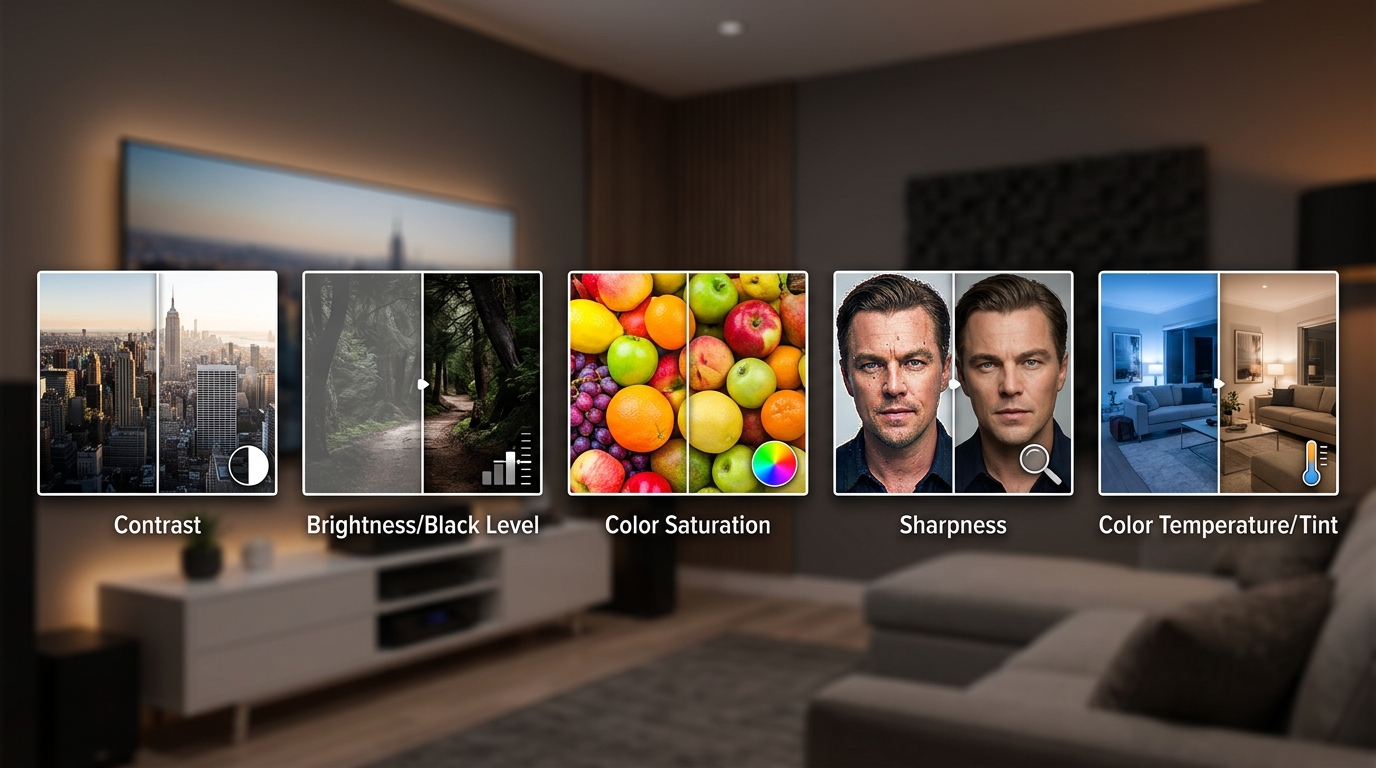
Datacolor SpyderTV system focuses on the five major video calibration points: Brightness (black level), Contrast (white level), Color (saturation), Tint (hue), and Color Temperature.

The whole video calibration process would not take more than 30 minutes to complete. On launching the process, the system first asks the user to select the display type and then fill out the model and current display settings for each of these five key video calibration points. It also asks the user to enter the maximum and minimum values that each of these video parameters can take.

At this point, you can also edit the color temperature choices - high (cool), medium, low (warm) - to reflect the actual settings on your TV. If a particular setting is not available on your display, simply leave it out and the SpyderTV software will ignore it in the calibration process.

To go through the test and calibration process, select the test pattern on the DVD and then tell the application to take a reading; do this for all the settings and follow the instructions on the PC.

Throughout the testing process, SpyderTV attempts to understand the minimum and maximum values and settings before making adjustments. This is achieved by going back and forth - in various steps - over the respective parameter values to arrive at what it feels is the best setting.

System Reporting

At the end of the video calibration process, the system issues a summary report that gives details of what has changed, together with a number of other charts. The latter give you the adjustment potential for the respective system parameter setting as against the slider value for that video parameter. All reports can be printed or save for later reference.


Conclusion:

We did not encounter any specific problems with the Spyder TV system when in use; what's more, results were quite accurate, and repeatable.

Using the SpyderTV interface is extremely easy. Reporting is interesting though a bit short of numbers, but then it is obvious that this is designed with the novice in mind.

The 'Before-and-After' viewing feature offers an interesting way to help the user understands the actual changes that have taken place during the calibration process by comparing the before and after states of the TV screen.

On a negative note, feature set is minimal; there are no R/G/B comparison charts or gamma calibration, but then such systems would cost substantially more.

While it is true that the SpyderTV calibration kit do not cater for 100% of the calibration functionality one may dream of, yet considering its relatively inexpensive price tag, it surely delivers on what it promises in an exceptional way. It provides the user with all the key video calibration parameters necessary to get the very best out of any TV - irrespective of whether this is an old CRT TV or one of the latest LCD or plasma HDTVs. It has the potential to serve home users - from experienced videophiles to the novice - in getting a rock-solid basic video setup that can make any TV really stand out.

Finally, though the SpyderTV solution is not  a direct replacement for calibration discs like the AVIA or DVE set-up DVDs when it comes to TV calibration, yet the Spyder is much faster and easier to handle than any set-up disc. It is a major step in the right direction. It represents a clear shift from the more user-demanding set-up disc based calibration, to a semi-automated software-driven set-up solution.


Datacolor Colorvision SpyderTV and the Spyder 3 Elite calibration kits are both available at amazon at reduced prices; for more information on the latest price offers from amazon, please check the following links:Spyder 3 Elite

Colorvision SpyderTV Colorimeter

DataColor Spyder 3 Elite


Complement your Spyder TV calibration system with one of the following home theater set-up DVDs for a complete home theater optimization solution:

AVIA II Guide to Home Theater (NTSC Version)

Digital Video Essentials HD DVD Set-up Disc

The Ultimate DVD - Home Theater Fine Tuning Made Simple


 Copyright © - Practical-Home-Theater-Guide.com  All rights reserved.


Search
Practical HT Guide
 in collaboration with

Google

Web

Practical HT Guide

Review date:
1st June, 2006


Lots more info at

Practical Home Theater Guide


More Home Theater Setup DVD reviews:

DVE High Definition

Digital Video Essentials DVD

AVIA Guide to HT


Suggested Technical Guides:

Choosing a Plasma Television
Discussing the features to look for when choosing your  Plasma Television set.

Guide to LCD HDTVs
LCD HDTVs are turning out sharper, bigger, better, and cheaper. Discover all you need to know about LCD TV sets in this series of articles.

Guide to Rear Projection HDTV Technology
Pros and Cons of the different rear projection technologies: CRT, DLP, LCD, and LCoS

Home Theater Projector Guide
Understanding the different characteristics of CRT, LCD, and DMD (DLP) projection technologies as applicable to front and rear projection TVs.

TV Viewing Distance
Buying a big screen TV? Care should be taken as you may easily fall into the trap of buying a too large TV.

Quick Guide to DVI
The DVI Cable Guide - explaining the different flavors of DVI interconnects

HDMI Cable Guide
A short guide explaining all you need to know about HDMI cables & connectors.

Audio Video Equipment Racks
There is more to equipment racks than a storage space for your home theater gear. More in this info guide. 

Home Theater Surround Sound
 This home theater guide takes a detailed look at the different sound formats and certifications in use today in the home theater world.

Speaker Placement in Multi-Channel Audio Correct home theater speaker placement plays a critical role towards achieving that seamless ‘enveloping’ sound so important in the overall home theater experience.

Time Delay Settings in Surround Systems
Directly related with your home theater speaker placement is a  correctly set surround sound field in multi-channel audio playback.


Home Theater Set-Up DVDs and Calibrations Tools
@

amazon.
com