left image


Home - AV Cable Guide - Speaker Wires  

Updated: 26th Dec. 2009


BetterCables.com Premium A/V Cables

Speaker Connection Basics:
Polarity and Gauge

Each speaker connection requires a two-lead interconnect between the positive and negative terminals on your home theater receiver or amplifier, and the speaker unit. 

Polarity: Maintaining the correct polarity is important especially in a multi-channel system such as in home theater surround sound.

Incorrect polarity will throw the respective speaker in an out-of-phase mode with the rest. For this reason, speaker cables and terminals are normally color coded - black for the -ve terminal and red for +ve side.

Gauge: Wire is identified by its gauge or thickness; normal thickness range from gauge 18 to 10. The smaller the number, the thicker is the copper conductor, and the better its capacity to pass the amplified audio signal. Most speaker wires provided with HTiB systems are normally gauge 18; this is too thin to be of any use except for very short lengths - typically less than 25 feet.

A thicker wire gauge is definitely required for longer lengths; in other words, which speaker cable gauge to use depends mainly on your speaker wire length. You can use the following chart as a guideline:

Distance between speaker and amplifier

Speaker Wire Gauge

Less than 50 feet

16

50 to 100 feet

14

100 to 150 feet

12

more than 150 feet

10

Gauge 16 is the minimum we recommend with short runs and often represents the best option for moderately priced systems when speakers are placed close to the AV receiver. Gauge 16 speaker wire is relatively inexpensive, apart from being thinner, which makes it easier to work with e.g. to pass along door frames and under fitted carpets.

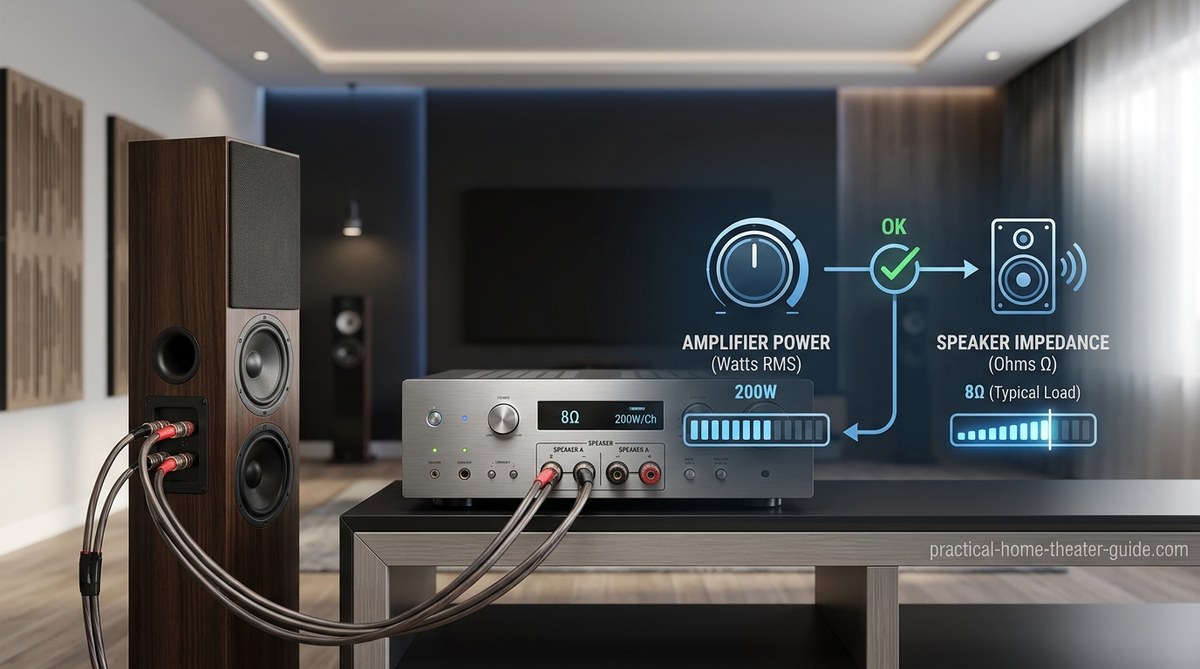
Using the length factor as a guide to help you determine which speaker cable gauge to use should generally suffice under most applications. However, we suggest using the next thicker gauge to that indicated in that above table with lower impedance 6 and 4 Ohm speaker loads. And in the case of 2-Ohm speakers, gauge 12 is the minimum we recommend for distances up to 30 feet.

The main reason is that any connecting speaker cable represents an additional load on the amplifier - which load is in effect added in series to that of the speaker impedance. Ideally, the total speaker wire resistance should only represent a very small percentage in relation to the connected speaker impedance. In his very interesting and detailed article on Speaker Wire - A History, Roger Russell recommends a total speaker wire resistance of less than 5% of the nominal speaker impedance though as he admits, this is somewhat on the conservative side in that some amplification systems would even tolerate twice as much resistance (i.e. up to 10% of the speaker load) without any noticeable audible effect.

In any case, the fact remains that the thicker and most practical wire you use for your speaker connection, the better in that it reduces the load on your amplifier while helping to deliver more of the amplifier output to your speakers. Not only, this may also help your system deliver the fine musical detail audiophile-quality music systems are capable of as well as those blasting effects in multi-channel surround sound.

Selecting Your Speaker Wire

There exists a variety of speaker cables and wires - ranging from standard pre-terminated cables and in-wall speaker wires to ultra-flat speaker cables with self-adhesive backing which can be easily concealed by being painted over, run underneath flooring and carpets, or covered with wall paper.

Speaker cables are generally pre-terminated with the appropriate speaker connectors while speaker wire is cut to custom length and then terminated with the appropriate connectors by the user. At the same time, some use the term 'cable' to refer to a more robust and higher quality speaker wire.

Pre-terminated Speaker Cables and Standard Speaker Wires

You can buy complete speaker cables in standard lengths pre-terminated with the respective speaker connectors.

However, if you order pre-terminated speaker wire, always check the type of connectors for compatibility with your equipment. In addition, it you are after in-wall installation, ensure that the end connectors will pass through the access holes you have in the wall.

Pre-terminated speaker cables from Dayton

Dayton SCP-6 Speaker Cable Pair w/Banana plugs - 6 ft.

Alternatively, you can purchase the required length of wire - always adding a little extra per speaker to allow for a margin of error when measuring cable runs, and then connect the required plugs or terminals to suit your needs.

In-Wall Speaker Wire: In-wall installations are ideal for multi-channel surround sound setups and multi-room audio installation throughout the house.

However, it is important that with any in-wall installation, you use specially certified wires (UL-rated CL3 wires) that comply with national standards for resistance to fire, chemicals, abrasion, and temperature extremes.

Speaker cable for in-wall installations

Monster Cable UL CL3 Gauge 14 Speaker Cable
for in-wall installations


Self-adhesive ultra-flat ribbon cable for speaker installation from Acoustic Research

Ultra-Flat speaker Wire: Surface mounted wires leading to speakers around the room in a multi-channel surround sound setup can be distracting and surely not the best way to complement your room decor.

If in-wall installation is not possible, then ultra-thin paint-able speaker wires such as Acoustic Research PR391 Pro Series 800-Watt Microflat Speaker Cable featured on the left can be used to help you hide unsightly home theater wiring.


We also suggest going through our detailed Home Theater Speaker Wiring Guide for additional information on speaker cables and cable connection basics.


What should you use: Expensive Oxygen-Free and Silver Speaker Wires, or Standard Copper Wire?

In their attempt to enjoy the best sound performance, some may want to consider expensive exotic speaker cables using oxygen-free copper or even silver wire. But apart from an extremely expensive price tag - in particular when it comes to speaker cables using silver wire, we say that the use of these expensive speaker wires do not lead to any noticeable difference in audible performance.  Why?

Oxygen-free copper wire comes with a slightly lower resistance than standard copper speaker wire but the difference is too small to make any difference in speaker applications.  For this reason, oxygen-free speaker wire can be considered to be the same as standard copper wire when it comes to resistance. The lower resistance arises not because of the removal of oxygen but because the process used to remove oxygen helps remove other impurities present in standard copper, which impurities lead to a minimal increase in the copper wire resistance.

In contrast, silver wire has a lower resistance compared to that of the same gauge of copper - meaning that a thinner silver wire may be used in replacement to thicker standard copper wire. But the use of silver would make even standard length speaker cables extremely expensive especially in a multi-channel speaker setup without actually leading to any benefits in audible performance.

The reality behind these often very expensive cables is that exotic AV cables are associated with huge profit margins - profits that are possible thanks to the 'magical' hype brought by professional sales people that praise the 'magical' benefits of such cables without any scientific proof to substantiate their claims.

Cable Quality and Sonic Performance:

At this point, one very valid question that may arise is: What kind of speaker wire is best?

The simple truth is that irrespective of whether you use silver, standard copper, or oxygen-free copper, there is no difference in the audio quality as long as the speaker wire resistance is just minimal compared to the speaker impedance.

The only difference that may arise with different speaker wires is between multi-stranded and solid speaker wire. But this difference is one of convenience and not sonic quality. Due to its rigidity, solid wire is generally more suitable for in-wall applications while the added flexibility offered by multi-stranded wire would make stranded wire more suitable for the end termination between say a speaker wall-plate and the speaker unit.

This does not mean that any low quality speaker wire will do. Some wires, despite their thick insulation, still come with a thin copper conductor inside. So be aware of such manufacturers' tricks and do not be mislead by the wire external thickness alone.

This does not mean that insulation is not important. Rather, one major issue with cheap speaker cables is that with some poor quality speaker wires, the wire insulation does not offer a sufficient barrier to atmospheric elements to prevent the copper strands inside from corroding along the full length of the wire. Worst still is that with some cheap wires, the insulation itself may be the cause of copper corrosion, a clear sign that materials used in the making of the speaker wire were not researched correctly. These low quality speaker wires should be avoided.

In addition, some low quality speaker wires are not coded to help you identify the correct polarity to maintain proper phasing between speakers. This means that unless you trace each separate wire, you risk inverting speaker polarity.


Speaker Terminals and Amplifier Speaker Connectors

More important than the use of oxygen-free copper or silver wire is the quality of the connectors used to connect the speakers to your amplifier or AV receiver. These often use a pressure device - either through a spring loaded mechanism or through the use of a binding post type connector. Spring terminals will only accept pin connectors or tinned base wire ends. Binding posts may accept many types of connection, including pin, banana plug and spade.

Spring Terminals: Spring terminals use spring-loaded connectors to create a compression connection around either pin connector or bare wire.

The spring terminal connection is limited by the small size of the actual connection surface, and the fact that the connection itself is not as tight as other options.

To help obtain a better connection, it is important to pull slightly the wires after these have been secured in the terminals. This will cause the teeth inside the connectors to 'bite' into the wire.

Typical spring-loaded connectors found on low to mid-range equipment

Typical spring-loaded connectors found on low to mid-range equipment. 

Spring-loaded speaker terminals from Dayton

Dayton SPLT-RB Spring Loaded Terminal Pair

Binding Post Terminals: Normally used in pro or high power applications (over 100watts), binding posts create a connection by either accepting banana plugs, or by screwing down over spade connectors. 

Binding posts make a significantly better connection to speaker wire than spring terminals do because the connections are more mechanically sound.

Binding post speaker connector plate Gold Recessed Binding-Post Speaker Terminal plate


Whether it is spring loaded or binding post, the result is always the same, creating a connection by forcing two metals against each other. Unfortunately, this is not the ideal way - though it is the most practical - of providing the best connection between your amplifier and the speakers.

A pressure connection often deteriorates with time. This also explains why in some cases, simply removing and cleaning the wires and terminals and reconnecting them can make an audible difference - the same difference many hear when replacing their speaker wire with some expensive speaker cables. A soldered connection - possibly using silver solder - straight from your amplifier output direct to your speaker would surely provided a lower resistance connection. The problem is that this type of 'soldered through' setup is not practical.

The use of good quality speaker terminals and speaker connectors is thus more important that the use of some exotic speaker wire.


Speaker Connection Tip: Do not rely on a bare wire connection when connecting wires between your amplifier and the speakers. Bare wires tend to corrode, leading to a degraded connection over time. For a solid connection, terminate speaker wires with the appropriate connectors such as the 24k gold-plated banana-type speaker plugs shown here.

Use of speaker connectors also helps safeguard against harmful short circuits as a result of loose strands from bare wire between the positive and negative leads. Short circuits may lead from a simple temporarily amplifier shutdown to costly amplifier damage.


Gold-plated banana type connectors for use with binding post speaker terminals

GLS Audio Black Chrome Series Gold Connector Banana Plugs


Now you can search the amazon storefront for your Speaker cables and connectors without leaving our site by using the amazon search box below; your search results will appear here under.


More A/V Cable Guides

Suggested further reading...@ Practical Home Theater Guide

Quality, Cable Length, and Performance Implications: How does cable quality and cable length impact system performance?

HT Connections - An Introduction to Cable Anatomy: Do silver-coated conductors make a real difference in system performance? Discover more here.

Video Cables Basics: Explaining the different analog and digital video interconnects

Audio Cables: An introductory guide to analog and digital home theater audio cables and interconnects.

DVI Cable Guide: The numerous flavors of DVI cables can turn out to be an incomprehensible mess. This need no longer be the case...

Extending DVI and HDMI Cables - Fiber or Copper? Possible available options to extend a HDTV connection beyond the practical distances supported by DVI and HDMI.

Digital vs Analog: RGB and Component video vs DVI and HDMI: Is digital always better?

HDMI Cables
To many, HDMI is still an unfamiliar term. This short guide will explain all there is the need to know about HDMI Cables and interconnects.

Home Theater Cables Connection tips: Discover how to get the best results out of your AV cables.

A Guide to HDCP: What is HDCP and how does it impact the end user?

 Home Theater Guides

Recommended Technical Guides

Image Sticking in LCD TVs
This is one of the least known phenomena associated with the use of TFT LCD panels, yet image retention is not just an issue with plasma TVs...

LCD Response Time - Is faster always better?
Is it possible to compare LCD TV response times between different brands? What about 120Hz LCD TVs - are they really better at eliminating motion blur?

TV Viewing Distance
A big screen TV for your home theater? Do not fall into the trap of buying a too large TV!

Contrast Ratio - Playing with Numbers!
To what extent high contrast ratios affect the performance of a home theater projector or a video display device?

The HoloVision Rak Master Pull-out/Swivel AV RacksEquipment Racks:
There is more to equipment racks than a storage space for your system components. More in this home theater guide.

Dolby vs. DTS - Which delivers better sound?
We discuss the differences between these surround sound formats to help you understand why this Dolby vs. DTS controversy prevails.

Plasma vs. LCD TV
A detailed 360 degrees comparative guide to choosing between a plasma television and an LCD HDTV.

Feel the Shake!
Bass Shakers, Buttkickers... Add the sensation of tactile sound and discover a whole new world in home entertainment.

The HDMI Cable Guide
To many, HDMI is still an unfamiliar term. This easy-to follow home theater guide explains all you need to know about HDMI.

Satellite Dish Installation Guide
We show you how to select your dish, choose the best location, install, and even fine tune your satellite antenna for best satellite TV reception.

Guide to Digital TV
A complete guide to Digital Television - DTV converters, TV antennas, and DTV transition.

Poster Light Boxes:
Poster light boxes from MovieGoodsMovie Posters help bring about the Hollywood magic in the home. But the fascinating world of movie pictures is more than just a beautiful poster hanging on the wall. But for that unique finishing touch, you need a poster light box.

 Miscellaneous Guides:

Buying Online Guides 

A Buyer's Guide to Shopping Online
Shopping online is cheaper, but is it safe? Discover how to manage the risks while still enjoying big savings.

Buying Refurbished Electronics
A way to a cheap HDTV is to opt for a refurbished product. However, to make the most out of your purchase, you first need to understand what refurbished products are.

 HT Books and Magazines

Recommended Home Theater Reading

Home Theater
Loads of useful information, equipment reviews and buyer's guides.


Sound & Vision
 Good reviews on the latest home theater gear

Practical
Home Theater
Well-written home theater guide - a useful reference to anyone interested in home theater.

Great Escapes
Unique source of ideas, and interesting designs illustrated with over hundred photos.

Quick Guide to Home Theater Design

Easy-to-follow e-book on how to design and build your Home Theater

Home Theater Design e-book

by Duncan McClelland
More information
HERE.

Featured Speaker Wires and Connectors:

Affordable Quality HDMI Cables...

Check out the latest offers on quality Speaker Wires at Amazon


Find us on Facebook
Follow us on twitter

Home
HDTV Guides CRT TVs
LCD TV Guide
Plasma TV Guide
3D TV
Flat-panel TV Reviews Plasma TV Reviews
LCD TV Reviews
Best HDTVs
Projection Systems Projection TV
RPTV Reviews
DIY Projection TV
Projector Reviews
Projection Screens
Digital and Satellite Television Digital TV Guide
Satellite Television
Home Theater Audio Surround Sound
AV Amplifiers
Speakers
Wireless Home Theater Wireless Speakers
Headphone Guide
Media Players
Home Theater Guides Home Theater Design
Equipment Racks
AV Cables
HDCP
Set-Up DVDs
Power Protection
Books and Magazines Books / Magazines
Catalogs
Home Theater Ideas! Home Theater Sites
HT Pictures Gallery
Useful Links
Movie Posters MoviePoster Guide
The Poster Store
Shopping Online Price Search
Refurbished Products
Online Store
Website Information About Me
Website Content
Site Use & Dislaimer
Privacy Policy
Advertise
Site Search
Contact  Form
Site BLOG
E-zine Subscription
.

[?] Subscribe To This Site

XML RSS
Add to Google
Add to My Yahoo!
Add to My MSN
Subscribe with Bloglines


Please Note:

Double-underline links appearing on this site represent additional information and special deals related to the page content; this added information is being supplied directly by Kontera.

To view this information, please place your cursor over these double-underline links.