site logo    

Home
HDTV Guides CRT TVs
LCD TV Guide
Plasma TV Guide
3D TV
Flat-panel TV Reviews Plasma TV Reviews
LCD TV Reviews
Best HDTVs
Projection Systems Projection TV
RPTV Reviews
DIY Projection TV
Projector Reviews
Projection Screens
Digital and Satellite Television Digital TV Guide
Satellite Television
Home Theater Audio Surround Sound
AV Amplifiers
Speakers
Wireless Home Theater Wireless Speakers
Headphone Guide
Media Players
Home Theater Guides Home Theater Design
Equipment Racks
AV Cables
HDCP
Set-Up DVDs
Power Protection
Books and Magazines Books / Magazines
Catalogs
Home Theater Ideas! Home Theater Sites
HT Pictures Gallery
Useful Links
Movie Posters MoviePoster Guide
The Poster Store
Shopping Online Price Search
Refurbished Products
Online Store
Website Information About Me
Website Content
Site Use & Dislaimer
Privacy Policy
Advertise
Site Search
Contact  Form
Site BLOG
E-zine Subscription
.
[?] Subscribe To This Site

XML RSS
Add to Google
Add to My Yahoo!
Add to My MSN
Subscribe with Bloglines


More Sony Projection Television Reviews will follow soon.


Subscribe to our free monthly e-zine to remain abreast with the latest additions to our website. 

Click here for details.


side navbar picture

1080p HDTV Sony Projection Television Sets - Product Review
Sony SXRD KDS-60A3000 60" HDTV


The KDS-60A3000 forms part of the latest A3000 series of Sony SXRD 1080p rear projection HDTVs. This SXRD-based Sony projection television is capable of exceptional picture performance with deep blacks and accurate colors.

Equally important, it comes with a comprehensive array of connectivity options, a massive selection of picture settings, and an affordable price tag.

Nothing is perfect; the Sony SXRD RPTV does have a bit of a problem with its video processing. Still, it represents an excellent big screen option from one of the leaders in the field. More in this Sony projection TV review article.


KDS-60A3000 Sony SXRD 1080p RPTV

Sony Bravia SXRD KDS-60A3000 60" 1080p Rear Projection HDTV

Sony SXRD line of 1080p Rear Projection HDTV sets:

The 2007 line of Sony projection televisions comprises a total of 6 different models covering screen sizes from 37 up to 60-inch; two additional rear projection TVs are also in the pipeline for a total of eight models.

Five of these rear projection HDTVs are based on Sony LCoS chip, rebranded in 2006 as SXRD (Silicon X-tal Reflective Display).

The Sony SXRD line of 1080p rear projection HDTV sets represents Sony's premium line of rear projection televisions; it is a step-up over Sony's 3-LCD rear projection sets.

All models in the SXRD line are 1080p rear projection HDTVs. Three of these sets fall within the 'entry' series in Sony's premium line-up of SXRD sets, the A3000. This is the same series that includes the KDS-60A3000 60-inch Sony projection television on review here.

The other two SXRD sets forms part of Sony's XBR5 range - the 60-inch KDS-Z60XBR5 and the 70-inch KDS-Z70XBR5. This Sony SXRD series represents Sony's flagship in rear projection technology. These sets were supposed to be released late in 2007; however there is no release date yet for the 60-inch whereas the 70-inch version is now expected some time in January 2008.

As stated earlier on, SXRD is Sony's version of LCoS-based rear projection technology. Like their DLP counterparts, LCoS, or Liquid Crystal on Silicon based projection systems are characterized by deep black levels and excellent pixel fill in contrast to LCD based systems.

However, in favor of LCoS, there is no rainbow effect as instead one may find on 'traditional' lamp-based DLP based systems.

We are referring to 'traditional' lamp-based DLPs since the latest LED light DLPs as found on the Samsung HLT6187S 61" LED Engine 1080p DLP HDTV, do not exhibit tendencies of rainbow effects. For more details on the Samsung HL-T87S series, check our Samsung DLP HDTV review article here.

On the other hand, as with LCD-based projection systems, LCoS systems tend to have more white-field uniformity issues than DLPs.

Sony is not the only one that uses LCoS projection technology. JVC has been producing LCoS-based rear projection TVs since 2004 under its HD-ILA brand using JVC D-ILA (Direct-drive Image Light Amplifier) LCoS chip.

The A3000 series - represented here by the 60-inch KDS-60A3000 on review, includes two additional models, the 50-inch KDS-50A3000 and the 55-inch KDS-55A3000. All three models in this series share the same specs sheet with the only difference being a matter of screen size.

This SXRD-based series of Sony projection televisions is characterized by an interesting feature set; main highlights include:

  Blue bullet

Full 1080p resolution and Sony's MotionFlow™ with its 120Hz refresh rate,

  Blue bullet

Improved BRAVIA™ Engine EX (Bravia is another Sony's acronym for "Best Resolution Audio-Visual Integrated Architecture) based on Sony's 12-bit 1080p SXRD image chip,

  Blue bullet

HDMI ver. 1.3 supporting full extended color space (x.v. Color™ compatibility),

  Blue bullet

1080p/24Hz input capability, and

  Blue bullet Slimmer cabinet design and interchangeable speaker grilles.


The KDS-60A3000 60-inch 1080p SXRD-based Sony Projection Television

Sony has managed to come up with a top performer with its new KDS-A3000 series, and this applies irrespective of technology. The 60-inch KDS-60A3000 on review is capable of delivering exceptional picture quality, with deep blacks and accurate colors.

Sony SXRD-based projection technology had already proved to be among the best in the past, yet the latest breed of SXRD-based Sony projection televisions has resulted in even significant improvements over previous models.

We are not saying that this is the perfect rear projection HDTV. The Sony KDS-60A3000 has its share of weaknesses as well. In particular, its video processing seems unable to deinterlace 1080i film-based content correctly. But then this deinterlacing issue is typical not only with the Sony KDS-60A3000 but with most progressive-based displays as well.

This Sony projection television is presently selling on line at under $2,000. Well, the latest price at amazon is in the region of $1,700 - that's $500 below the suggested list price. At this price bracket, the KDS-60A3000 represents an exceptional inexpensive big-screen option from one of the main leaders in the field.

Main Features

  • The Sony SXRD A-3000 series is characterized by a film-like image with no visible pixel structure as a result of the higher pixel-fill associated with the LCoS chip.

  • Furthermore, the Sony SXRD® chip features full HD 1080p resolution thanks to the presence of 1920 x 1080 pixels on the LCoS chip. Instead, present DLP chips generate the 1080p/60Hz image through wobulating a 960 x 1080 image by half a pixel 120 times a second.

  • The BRAVIA Engine™ EX Video Processor represents Sony's latest update to the original BRAVIA engine. It is a full digital video processing system supporting all the features found on the original BRAVIA, plus the added ability to upconvert 480i via Sony's DRC (Digital Reality Creation) MultiFunction technology. The latter aims at delivering improved detail and definition when displaying standard definition content over the set 1080p screen.

  • Another option of the Sony video engine is the Advance Iris Function that adjusts brightness on-the-fly. This leads to improved overall contrast and deeper blacks, especially with predominantly dark content.

  • Default out-of-the-box 'standard' settings are spot-on with accurate primary colors and an almost perfect grayscale. Furthermore, the numerous picture controls found on the Sony KDS-60A3000 let more demanding users zero-in on the best picture settings.

  • Superb connectivity - with full assortment of digital and analog options - including 3 HDMI inputs Ver. 1.3 (the Sony website incorrectly indicates 2 HDMI ports), and a D-Sub 15 pin PC input.

  • Directly associated with HDMI ver. 1.3 is support for xvYCC expanded color space (referred to by Sony as x.v.Color™ technology). The latter means that this Sony projection television can handle an expanded color space - displaying 1.8 times the colors possible with the standard color space.

  • Motionflow™ 120Hz Technology: This is Sony's version of the latest hot spec of the moment - 120Hz. This means that the KDS-60A3000 Sony projection television uses 120Hz refresh rate by interpolating content in intermediate frames. Technically, this should help reduce judder and produce smoother images both when handling film sourced at 24fps encoded content and also with 60fps 1080i HD content.

A detailed look....

Main Design: More picture and less frame! This is the present trend in rear projection TV design with major TV makers, and this is the way this Sony projection television follows.

A reduced bezel width that is no more than ¾-inches thick along the sides and top, surrounds the 60-inch screen of the KDS-60A3000 rear projection 1080p HDTV.

Overall design takes a minimalistic yet trendy approach. The surrounding bezel and pedestal stand are finished in silver, while the speaker grille - placed along the bottom edge of the screen is finished in black.

Interesting is that the black speaker grille on the A3000 Sony projection television sets is interchangeable for a better match with the rest of the room decor. You can choose one of four optional colors including Burgundy Red, Metallic Silver, Satin Black and Cacao. The speaker grilles are sold separately for about $50 each.

The Sony logo resides at the center of the speaker grille. A clear panel separates the bottom edge of the speaker grille from the surrounding silver frame. Three status LED's plus the IR sensor resides on the clear glass panel just beneath the Sony logo.

Side-view of the Sony KDS-60A3000

The set basic control buttons - power, channel selection, volume control, input selector, and a Home button - are placed along the vertical side on the lower right-part of the cabinet. This placement makes the controls invisible from the front while further enhancing the simplistic look of this Sony projection television.

The 60-inch Sony projection television measures 54 (W) x 38.9 (H) x 16.75 (D) inches. This renders the KDS-60A3000 Sony SXRD projection HDTV relatively compact for this screen size. Still, at this depth, the Sony is a far cry from the 12.3-inches of the ultra-slim 61-inch Samsung HL-T6176S DLP HDTV referred to in our Samsung rear projection TV review. Overall weight of the Sony is 91 pounds.

Power Consumption: The rated power consumption of the Sony KDS-60A3000 is 240W under default settings; this falls to around 200W in power save mode. In stand-by mode, power consumption is 0.4W.

Lamp Life: As with all traditional lamp-powered rear projection HDTVs, the high intensity discharge lamp (HID) on the Sony projection television has to be replaced on regular basis to enjoy continued performance over time. Lamp life depends not only on usage, but also on the display settings as well; a too bright an image would lead to a shorter lamp life.

Sony recommends to exchange the lamp on the KDS-60A3000 HDTV every 8,000 hours of use. This corresponds to approximately 3yrs at eight hours a day. The lamp is user replaceable. A lamp status indicator will light when it is time to change the lamp on your Sony projection television; you will also get a displayed message on start-up in this respect.

Product Features: Apart from the full 1080p HD capabilities of the Sony projection television highlighted earlier on in this rear projection TV review article, this Sony SXRD HDTV also comes with a number of other interesting features.

Among the most important, there is the set 12-bit SXRD video chip, which is ultimately responsible for the impeccable image on the KDS-60A3000. Without going into the actual mathematics, 12-bit gives you 4096 times more levels of color - or shades of gray - than a 8-bit image chip or display panel (i.e. sixteen more levels for each primary color). This translates into smoother transitions from color to color making it possible for the display to produce subtle color changes even more accurately.

Our only issue here is that while Sony boasts of a 12-bit video image chip, yet it does not mention anything about the capabilities of the BRAVIA video processing. Rather, it seems that here, Sony is playing some sort of a number game as it is most likely that the BRAVIA video processing is 10-bit. If this is the case, then the extra bits on the Sony SXRD chip would not contribute anything to the final image quality.

In any case, even 10-bit video processing is capable of delivering impressive results over the more common 8-bit processing found on most TVs.

The KDS-60A3000 comes with a rated dynamic contrast ratio of 10,000:1 which is typical of what the competition is offering for similar premium rear projection HDTVs.

This high rating is possible thanks to the use of real-time image processing to adjust the contrast along with optimizing the image brightness to better match the displayed content. Sony uses what it refers to as 'Advanced Iris' feature.

This Advanced Iris function supports both auto and manual settings and uses algorithms designed to analyze the histogram of each picture along with nonlinear amplification to adjust the iris for its optimum opening on-the-fly. The result is improved high dynamic contrast ratio of up to 10,000:1, with images that exhibits deeper blacks in dark scenes while still maintaining good shadow detail.

As indicated earlier on, a new feature on A3000 series Sony projection television sets is the 'Motionflow' 120Hz high frame rate technology, and which is also available on Sony latest XBR4 series of LCD HDTVs. Mainly the 120Hz refresh rate is designed to help smooth out artifacts when converting 24fps film-based content to 60Hz 1080p HDTV. The 2:3 pull-down process would normally result in a rather jerky movement that is generated when handling pans and other camera movement. The 120Hz refresh rate provides the only first integral that is a whole multiple for both 24Hz and 60Hz, thus eliminating the need for 2:3 pull-down altogether.

In general the Sony did a good job smoothing things out and still keeping them looking natural. However, the end effect may not always be according to your preference in that certain film content may appear more like video than film. In any case, you can always deactivate the MotionFlow feature.

Another feature found on the KDS-60A3000 Sony projection television and which seems capable of doing a worthy job is Sony's DRC or Digital Reality Creation. This Sony 1080p rear projection HDTV uses DRC-Multi-Function version 1.  This technology is an integral part of the BRAVIA engine and is designed to upconvert standard definition 480i to 1080p.

We find the use of version 1 on its A3000 series of rear projection HDTVs rather surprising though in that this is an earlier version of Sony's DRC technology. In comparison, on its XBR4 range of LCD HDTVs, Sony is using a much more advanced version of DRC (Ver. 2.5) that works also with 480p and 1080i encoded content.

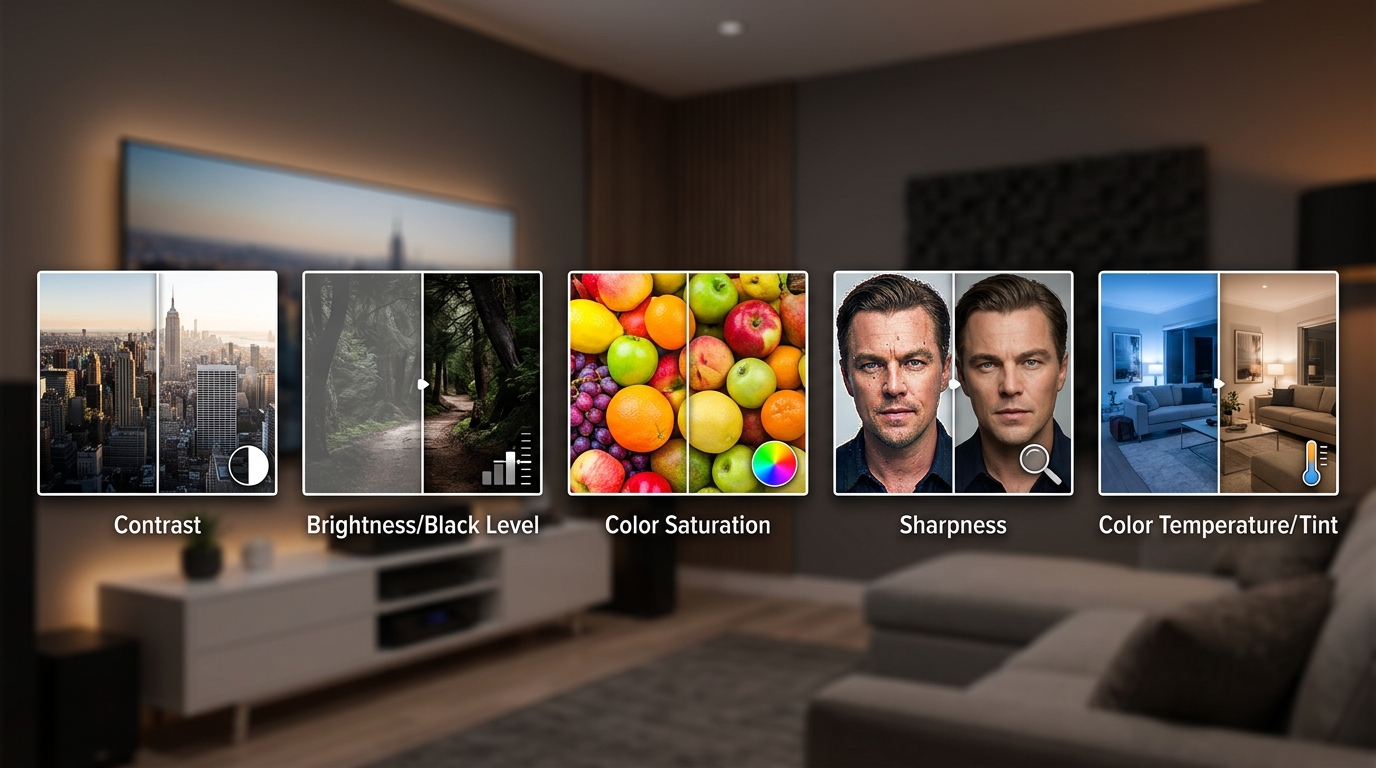
The KDS-60A3000 Sony projection television offers a complete assortment of picture controls and settings in addition to the usual standard adjustments for contrast, brightness, gamma, hue, etc.

Apart from adjustable presets for pre-defined settings (Vivid, Standard, Custom, Photo, and Cinema), there are also four preset settings for color temperature, with the Standard/Warm 2 combination providing the best out-of-the-box factory settings. Each of the presets can be set independently for each input.

While the Warm 2 setting for color temperature provides the most accurate default out-of-the-box setting, yet Sony also includes a white balance setting that lets the user adjust the color temperature color by color.

Other picture adjustments on the Sony KDS-60A3000 SXRD TV include:

  • Separate noise reduction features for both video and MPEG photos,

  • Image detail and edge enhancer in addition to a sharpness setting,

  • A black level corrector to enhance the black areas of the picture for a stronger contrast,

  • Color space selection that allows the user to set the range of colors this Sony projection television can reproduce on the screen,

  • An extensive collection of zoom options for both HD and SD content


The level of possible user picture control that this Sony projection television incorporates is probably more than any other. You name it and it is there!

Good for the more technically minded that is after the perfect picture setting. For many though, this mass of user controls may also lead to a more confusing situation. If this is the case, our advice is to stick with the pre-set default settings. As stated, choosing the 'Standard' setting for the picture mode in conjunction with the 'Warm 2' factory pre-set for the color temperature would lead to a pretty accurate picture set-up that is very close to the ATSC broadcast standard.

Audio support on the Sony KDS-60A3000 is typical of what you expect on similar premium rear projection 1080p HDTVs. The Sony projection television can deliver up to 12W per channel. Included, there is also on-board sound decoding for Dolby® Digital to reproduce Dolby Digital soundtracks from HDTV broadcasts and DVDs through the TV stereo 5-inch speakers.

Sony did fail to include SRS TruSurround audio processing as instead it does on its premium LCD HDTV line-up. However, it provides what Sony defines as 'S-FORCE Front Surround'. This is Sony's way of providing a virtual surround sound field over the television's built-in stereo speakers.

Finally, the TV speakers may be disabled through the set-up menu when using the TV with a home theater system.

Convenience features include among others, a 'Game/Text' mode for use with 480p, 720p, and 1080p signals to provide the best screen settings for fine lines and graphics associates with text based content and video games.

A 'Freeze' function lets you temporarily freeze the picture in a separate window while the program continues - thus enabling you to take note of say a phone number or a website address. All that it takes is to push the 'FREEZE' button on the remote and then copy down the required information at your leisure.

Those looking for Picture-in-Picture (PIP) and Picture and Picture (P&P) support would be disappointment. These features are not available on the A3000 series of Sony projection televisions. Instead, you will get other convinces like Parental Control - including the option to block any channel irrespective of its rating, video labeling, a power saver mode, and Sony's latest menu structure, termed XrossMediaBar or XMB interface.

This XMB graphical user interface is more of a Media Center or PSP style menu than a traditional TV menu - with items arranged horizontally and vertically on a sort of cross structure. Either you love it or you hate it in that this type of menu structure does not always result in the shortest path to access sub-menus, yet the overall effect is a clean and easy to navigate menu.

The supplied TV remote control is more longish than typical TV remotes. It also doubles as a universal remote, controlling up to three other pieces of gear. It comes pre-programmed for the Sony BD, DVD and Sony satellite receiver, but it can easily be re-programmed to cater for devices from various brands.

It comes with just enough keys to make cycling through picture, sound, and aspect ratio controls quick and easy. A convenient 'Options' key calls up a couple of often-used submenus covering both picture and sound modes, while a 'Theater' short-cut button switches the picture to 'cinema mode'.

One peculiar feature of the latest Sony's remotes - including that supplied with the A3000 series of Sony projection televisions - is the presence of a blue button labeled 'HOME'. This is equivalent to the 'MENU' key on other remotes. The different name is probably Sony's way of informing you that the on-screen menu of your new KDS-60A3000 Sony SXRD HDTV looks more stylish than that of the average TV.

Connectivity: It seems that the present trend with rear projection HDTVs is to place the rear connection panel on the side instead dead center in the back. Sony has followed suit and the KDS-60A3000 comes with the connectivity panel placed on the left-hand side.

This placement - while still concealing the connection panel from the viewing position, yet it makes all connections easily accessible from the side without having to move the TV.

Connectivity on the KDS-60A3000 Sony projection television is typical for a premium line HDTV. As with most TVs in its category, this Sony SXRD TV includes a total of 3 HDMI connectors, and a PC input.

The HDMI inputs are HDMI 1.3 compliant; the latter supports a higher bandwidth and xvYCC - referred to by Sony as xvColor technology.

The xvYCC standard is a newly approved international color standard with a greatly expanded color space. More specifically, it supports 1.8 times as many natural colors as existing HDTV signals for a more faithful reproduction of color.

As far as we know, xvYCC HD content is not yet available - so for the time being, this is not much of value except for 'future proofing'. In any case, the capability to deliver this expanded color space depends not just on the HDMI interface, but equally important on the set video processing and microdisplay capabilities.

A USB port is also included on this Sony 1080p rear projection HDTV. However, this can only serve a purpose for servicing unless you decide to opt for Sony's optional BRAVIA expansion module. Sony refers to this USB port as DMeX/Service port, where DMeX stands for Sony's Digital Media Extender. DMeX provides a digital connection path for optional modules like the new Sony Bravia Internet Video Link; the latter lets you stream video content direct from your broadband connection without the need for a PC.

Unfortunately, this connectivity option comes at a relatively high cost; in our opinion, an 'open' USB port would have been more suited considering that here we are dealing with a premium HDTV.

The list below summaries the whole set of connections available on the KDS-60A3000 60-inch Sony Projection Television:


Inputs and Outputs

Quantity

Remarks

HDMI (19-pin Type A)

3

HDMI 1.3 compatible; one of the HDMI on the rear comes with external R-Audio-L inputs for use with a DVI source.

Composite (A/V) - RCA Phono

3

Connects composite video and audio

S-Video (4-pin mini-DIN)

1

Connects S-video and audio

Antenna In

1

Connects to your cable STB or VHF/UHF antenna

Component (Y/Pb/Pr)

2

Includes audio

PC Input - Video

1

15 pin D-Sub

PC Audio In

1

Mini-phone stereo 3.5 mm

USB 2.0

1

For service / firmware upgrade, or DMeX Module only

Analog Audio Out

1

Left/right channels only

Digital Audio Out (optical) - TOS

1

PCM/Dolby Digital compatible

Performance: Most of today's 1080p HDTVs TV sets are capable of doing a very good job in delivering a great picture irrespective of their brand. Yet it is a fact that some are capable of doing a better job than others. The Sony KDS-60A3000 reviewed here forms part of this last category. Overall, this Sony projection television is one of the best HDTVs ever released, and this applies irrespective of technology.

There is a lot to like about this SXRD-based Sony projection television. Picture performance is one of the very best with solid deep blacks. A deep shade of black is important as it helps improve the realism of dark scenes while making colors look richer and more saturated. Also, primary colors are spot on when setting the Color Space to Standard, while color decoding is excellent for both standard definition and high definition content.

Similarly, grayscale is linear over the full range and almost spot on to the ATSC standard. There is hardly any need to tweak the white balance - the Warm 2 factory preset for the color temperature is just right.

The noise reduction feature is capable of doing a good job in eliminating noise without over smoothing the image.

And as expected, the Sony KDS-60A3000 is capable of resolving every single pixel in a 1080p signal. This means that it can deliver the full 1920 pixels horizontally by 1080 lines when presented with a static image in Full Pixel mode.

Deinterlacing of 1080i HD broadcasts can be tricky and most would simply discard every other frame to end up with 50% of the vertical resolution. However, this Sony projection television did manage to deliver the full 1080 lines when set to Standard, Cinema, and Custom mode.

On the other hand, the Sony SXRD KDS-60A30000 did fail to deinterlace 1080i film-based material properly; the result is a reduced vertical resolution when viewing 1080i HD film-based content from digital off-air TV broadcasts, cable and satellite TV programs. This deinterlacing problem when handling 1080i film based content is typical of most progressive scan displays. Note that this issue would not arise with Blu-ray and HD DVD as long as you set the DVD player to output content in 1080p.


Need help setting up your new 1080p SXRD Sony Projection Television?

Set-up DVDs: There is no better way to make the most out of your new 1080p KDS60A3000 Sony projection television then to invest in a good set-up DVD.

A great calibration disc we used to recommend is the AVIA Home Theater Set-up DVD, an exceptional AV calibration tool for both the novice and the expert. This disc is being replaced by the Avia II, an updated version with dozens of new calibration tools and additional information on the latest HD technologies.

Another interesting TV calibration tool that comes in an HD version is the Digital Video Essentials HD, but this is more suitable for advanced users.

For more information on set-up discs, check our Guide to Home Theater Set-Up DVDs.

Conclusion

The KDS-60A3000 SXRD 60-inch Sony projection television is - without doubt - one of the very best 1080p HDTVs we have seen so far.

Overall image is clean, sharp, and free from noise, with deep blacks, accurate primary colors, and linear grayscale.

Furthermore, the many picture settings would surely enable you to zero in on the best picture for your liking. The mass of user controls available on this Sony is more than a welcome feature for those looking for the perfect picture set-up.

At the same time, the factory pre-sets are almost spot-on, making tweaking of the various picture controls almost unnecessary.

It is true that the Sony cannot deinterlace 1080i film-based content correctly, but this in itself is not enough to outbalance the otherwise excellent performance of this KDS-60A3000 Sony projection television.

Additionally, it comes at a relatively affordable price tag for a premium TV from a leader in the field. The result is a great 60-inch big screen 1080p HDTV option for those looking for premium performance at less than half the price of a similar screen size plasma or LCD HDTV.


We did not review the other 1080p SXRD Sony projection televisions in the A3000 series, namely the 50-inch KDS-50A3000 and the 55-inch KDS-55A3000 rear projection HDTVs, yet their only difference is just a matter of screen size. We therefore expect these to perform in a similar manner to the model on review here.


Prior to any decision, we advise to do some research of your own. In particular, look at what other customers had to say about these Sony projection televisions following their purchase.

A good starting point is the customer feedback posted on the amazon site. Just click on the links below to access the respective Sony SXRD HDTV product page at amazon.com; then follow through the 'Customers Reviews' on the same page:


More Sony Projection Television Reviews will follow soon.


Return from the Sony KDS-60A3000 SXRD Projection TV Product Review


 Copyright © - Practical-Home-Theater-Guide.com  All rights reserved.


Search
Practical HT Guide
 in collaboration with

Google

Web

Practical HT Guide

Review Date:
28th December, 2007


Lots more info at

Practical Home Theater Guide


Suggested Further Reading:

Projection TV
A series of guides covering both front and rear projection TV systems.

Guide to Rear Projection HDTV Technology
Pros and Cons of the different rear projection technologies: CRT, DLP, LCD, and LCoS

Rear Projection TV Facts
Discussing the advantageous and disadvantages of rear projection TV.

LCD TV Guide
A series of articles to help you better understand all you need to know about LCD TVs.

Choosing a Plasma Television
Features to look for when buying a Plasma Television.

TV Viewing Distance
Buying a big screen TV? Care should be taken as you may easily fall into the trap of buying a too large TV.

The Contrast Ratio Game!
Contrast ratio ratings affect the performance of a display device, but to what extent?

Should You Opt for a 1080p HDTV?
Discover the strengths and weaknesses of the different HD formats - 720p, 1080i, and 1080p - in this HDTV Guide.

Quick Guide to DVI
The DVI Cable Guide - explaining the different flavors of DVI interconnects

HDMI Cable Guide
A short guide explaining all you need to know about HDMI cables & connectors.

Extending DVI & HDMI: Fiber or Copper?
Discover available options to extend a HDTV connection beyond the practical distances supported by DVI and HDMI.

RGB & Component video, or DVI & HDMI?
Is digital always better?

HDCP and HDTV:
What is HDCP, and why it impacts HDTV viewing? What about HDCP strippers as a solution to non-compliant devices?

Home Theater Set-Up DVDs
Discover how these calibration discs can come in handy during equipment setup.

Home Theater Design:
A series of articles covering all aspects of a home theater from design to realization.

Audio Video Equipment Racks
There is more to equipment racks than a storage space for your home theater gear. More in this info guide. 


A Quick Guide to

Home Theater Design

A complete e-Book on how to research, design and build your own Home Theater.

Home Theater Design e-book

by Duncan McClelland

More information HERE.


Featured
1080p Rear Projection HDTV Sets


Sharper, Better, Bigger

CHEAPER

Check out the latest special offers on 1080p Rear Projection  TVs
@

Amazon.com

For our detailed review of the Samsung HLT-6187S LED DLP HDTV, click here.


Recommended
Rear Projection TV Stands


Adjustable width DLP stand for RPTV sets up to 61-inch

Sony SU-RS12X Stand for A-Series SXRD Televisions

Mitsubishi MB-73PB Matching Base for WD-73734/WD-73733