left image


Home Page - LCD TV Reviews - 2009 Samsung LCD TVs: Series 6 LCDs

Date: 30th October 2009


Home Theater Design

Quick guide on how to research, design, and build your Home Theater.

Home Theater Design e-book

by Duncan McClelland
More information HERE

 
Samsung 55-inch UN55D8000 with Micro Dimming Plus Technology LED backlight technology

Samsung 55-inch UN55D8000
Rated as best Samsung LCD TV for 2011


Available from amazon US & Amazon UK


Introducing Samsung 2009 Series-6 LCDs

Samsung Series 6 LCDs represents Samsung mid-tier LCD TV lineup.

It also represents Samsung entry-ticket to 120Hz LCD processing technology - with Samsung Auto motion plus™ 120Hz technology representing the main upgrade over the less expensive Series 5 HDTVs.

Popular sets within Samsung Series 6 include the 46-inch LN46B630 ($1,230), the 52-inch LN52B630 ($1,780), and the 40-inch LN40B650 ($1,190). This is also the series that comes with Samsung's largest LCD HDTV for 2009, the massive 65-inch LN65B650 ($4,670).

As indicated in our introduction, Samsung Series 6 covers 18 different models spread over four lineups - the B610, B630, B640, and the B650.

However, apart from the different features, all Series 6 lineups share the same basic picture related specifications. The few differences relate to the use of a different 'Ultra-Clear' panel on B640 and B650 sets, and the marginal increase in dynamic contrast ratio of B650 LCDs over the rest. However, in our opinion, the benefits of the latter would be difficult to perceive in actual use.

This means that all Series 6 Samsung LCD HDTVs - except for the 19-inch and 22-inch B650 LCDs which among others come with a 720p display panel - should support very similar picture performance.

Features-wise, Samsung Series 6 LCDs range from the 'bare' 120Hz 1080p B610 LCD TVs, to full interactive features with Internet-enabled content and DLNA support present on B650 HDTVs.


Samsung Series LCDs in detail...

Samsung B610

Least expensive within Series 6 LCDs is the Samsung B610. This represents the basic entry-120Hz Samsung LCD TV series and is equivalent to Sony's V5100 LCD HDTVs.

Samsung B610 series comes with a rated dynamic contrast ratio of 80,000:1 and a pixel response time of 4 msec. The latter is necessary to support the 120Hz refresh rate.

B610 LCDs come in three screen sizes, the 52-inch LN52B610 ($1,420), the 46-inch LN46B610 ($1,080) - which happens to be the best-selling model within the B610 lineup, and the 40-inch LN40B610. These sets feature the least stylish design of all. However, they still include Samsung's trademark, the crystal neck support stand with the much-appreciated 20 degrees swivel action on either side, and also Samsung's Touch-of-Color which takes a subtle gray accent.

Despite being Series 6 entry lineup, B610 sets still come with plenty of connectivity - complemented by four HDMI ver. 1.3 inputs (3 on the rear and one on the side) with CEC support to control other connected compatible HDMI devices via the TV remote, a USB2.0, and PC input apart from the usual analog composite and component video inputs.

You would not get S-Video input; unfortunately, the later is disappearing fast from most HDTVs.

Samsung B630

Next in line is Samsung B630 lineup. The only real enhancement over entry-level Series 6 B610 HDTVs is the addition of Samsung's InfoLink. This introduces a form of reduced Internet-driven content.

InfoLink provides real-time feeds for stock, quotes, weather updates, news articles and the like straight to the TV screen via your internet broadband connection. This feature adds approximately $200 to the base price over corresponding B610 models though prices online vary considerably.

The addition of an 'Internet' connection brings about an important convenience with B630 Samsung LCD TVs. These HDTVs come with the possibility to download firmware updates straight to the TV when connected to the Internet. With previous models, you had to visit the Samsung website on your PC and then transfer the software update using a thumbdrive.

Picture-in-Picture: From a convenience perspective, B630 Samsung LCD TVs also adds a basic picture-in-picture that lets you preview TV broadcasts on the PIP sub-screen when the main picture is from an external source e.g. HDMI; it does not work the other way round. However, this useful feature is often missing on most of the competition.

Other features are basically the same as those present on Samsung B610 LCD HDTVs. The only difference is a design issue - with the lower part of the frame on the B630 taking a more v-shaped look than on B610 HDTVs, while the Touch-of-Color on B630 sets takes a red accent instead of dark gray.

Like the B610, the B630 line includes three screen sizes, the 52-inch LN52B630 ($1,780), the 46-inch LN46B630 ($1,230), and the 40-inch LN40B630 ($960). Both the 52-inch and the 40-inch are among the best-selling HDTVs in major stores - thanks to their relatively affordable price for a mid-tier HDTV.

Samsung B640

Stepping up from the B630 is Samsung B640 LCD HDTVs.  B640 introduces Samsung Series 6 to the new for 2009, 55-inch screen size - the LN55B640 ($2,129), while doing away with the 52-inch screen. However, the B640 lineup includes four additional screen sizes apart from the 55-inch already referred to here. These are the 46-inch LN46B640 ($1,350), the 40-inch LN40B640 ($1,099), the 37-inch LN37B640, and the 32-inch LN32B640 ($800).

Price-wise, these sets come at approximately $100 more than corresponding B630 LCD HDTVs.

From a design perspective, B640 LCDs takes a more refreshing look and do away with the curved - almost V-shaped - lower part of the frame present on the rest of the Series 6 Samsung LCD TVs.

Samsung's Touch-of-Color also takes a more subtle gray accent instead of the more predominant red. Overall design resemble that of Samsung high-end Series 7 LCD; it is the design we like most out of the four different designs that come with the full Series 6 lineup.

Samsung 55-inch B640 LCD HDTV

Screen: B640 sets come with Samsung's Ultra Clear Panel. This however means that B640 and B650 HDTVs come with a glossy screen. Instead, B630 and B610 HDTVs come with a matte screen surface that may prove better under bright lighting.

The new Ultra Clear panel is the same as that used on Samsung more expensive LCD lineup, the B750 featured on our site here. Samsung 'Ultra-Clear' panel does a very good job on Series 7 LCDs in maintaining blacks and color saturation even in brightly lit environments - performing better than most matte screens found on LCD TVs from other brands. We expect similar performance on Samsung Series 6 B640 and B650 LCDs. Reflections from Samsung's shinny screen however - especially of brightly lit objects in the room may still turn out to be rather distracting especially during predominantly dark scenes.

Many often ask why Samsung use a glossy screen on its LCD panels instead of the matte screen found on the competition. The truth however is that this is a more of technical decision. A glossy screen tends to better render and maintain deeper blacks and rich colors even under a bright environment - thus explaining Samsung's advantage in this respect.

However, in the end it is always a trade-off between the advantage of having a glossy screen and the disadvantage of the resultant reflections. The truth is that if you really want to enjoy the very best picture, you need to enjoy your TV viewing under controlled darkened environment; and this applies to any HDTV irrespective of the screen finish.

DLNA Connectivity: Another upgrade over the B630 is the addition of DLNA CERTIFIED™ connectivity on B640 Samsung LCDs. This gives you remote access via the set Ethernet port, to your PC's personal media - downloaded music, video, and photos - to enjoy these anywhere in the home where your TV is. Note however that you will need to install the supplied Samsung DLNA application on your PC first.

As with the rest of the Samsung LCD TV line for 2009, there is no built-in wireless connectivity but you can add wireless support for under $60 through Samsung USB Wireless Adaptor (WIS09ABGN) - supporting up to 802.11n.

Samsung B650

Top within Series 6 is the Samsung B650 lineup. Feature-wise, this is the most interesting of the full Series 6 Samsung LCD TVs - with the most important upgrade over B640 LCD HDTVs being the addition of Samsung's full suite of interactive content.

B650 Samsung LCDs also come with marginally improved contrast ratio rating (100,000:1) over the less expensive Series 6 HDTVs. We say marginally because while this represents a 20% increase over the rest of Series 6 Samsung LCDs, in real life performance, it will be practically impossible to perceive any difference between the two ratings. More information on this issue appears in our contrast ratio article.

This is the only Series 6 lineup that covers the full range of HDTV screen sizes - from 19-inch up to a massive 65-inch. However 19-inch and 22-inch models come with a reduced specification set - including 720p resolution and a reduced contrast ratio rating amongst others. They also lack any form of interactive features and come with a pixel response time of 8msec; the latter means that they do not even support 120Hz processing. To a certain extent, we cannot understand why Samsung did include these models under its Series 6 in the first place, least imagine under its top Series 6 B650 line.

As to the rest of the B650 LCD HDTVs, namely the 32-inch LN32B650 ($890), the 37-inch LN37B650 ($1,020), the 40-inch LN40B650 ($1,190), the 46-inch LN46B650 ($1,449), the 55-inch LN55B650 ($2,300), and the largest in the series, the 65-inch LN65B650 ($4,670), all come with the same features.

B650 sets take a rather strange design - with a sort of pronounced V-shaped edge along the bottom side of the display frame.

This is more of a like-it or hate-it but if you like it, then there is a lot more for you in terms of features and performance from Samsung B650 LCD TVs.

Samsung B650 frame detial - with red Touch-of-Color

B650 frame detail - showing the red ToC on the 'V-shaped' lower panel frame


As with the rest of the Series 6, B650 sets come with the same glass clear stand that swivels and the clear protruding plastic edge along the glossy black frame. Samsung's Touch-of-Color takes a red accent. This is however very subtle, with a rather brownish tint instead of the bright red color often shown in some adverts. In other words, even if red is not for you, we still think that the B650 overall design would still integrate well with most room decors.

Auto Motion Plus: From a specifications perspective, this is the Series 6 Samsung LCD lineup that comes closest to Samsung's high-end CCFL based Series 7 LCDs. In fact, the only real differentiator between the two - apart from Series 7 more stylish design, is the presence of Samsung's Auto motion plus™ 240Hz on the more expensive Samsung series instead of Series 6 LCDs 120Hz processing technology. This may appear a major drawback with B650 at a time when TV makers and retailers alike are pushing 240Hz technology to help them drive TV sales. Unfortunately, there is too much confusion surrounding the subject of 120Hz and 240Hz refresh rates.

But... The truth is that while 240Hz processing do really result in improved motion resolution, the difference between 120Hz and 240Hz LCD refresh rate technology is such that it would be extremely hard to perceive with normal broadcast content.

Directly related to Samsung's 120Hz/240Hz Auto motion plus technology is Samsung's dejudder processing. As expressed elsewhere on our site, this is one of the best implementations every found on any TV - thanks to a two-slider custom setting under the Picture Options Menu that lets you select the desired blur reduction and judder effects. Increasing the blur reduction slider towards the maximum increases the number of lines of motion resolution while increasing the Judder reduction leads to more action smoothness - making 24Hz content more video like.

It is not the scope of this Series 6 Samsung LCD TV review to go into the details of higher refresh rates and dejudder processing. Yet it is important to note that the resultant smoothing action applies mainly to film-based (24 frame-per-second) content; it helps eliminate judder (jerky movement) due to the use of 2:3 pulldown processing otherwise necessary with 60Hz HDTVs. More information on this issue is available in our article on LCD Response Time.

Interactivity Suite: We have already hinted that B650 HDTVs come with Samsung's full interactive suite instead of just InfoLink feeds and DLNA support found on B640 LCD TVs. Termed Medi@2.0™, B650 interactive suite is the same as that found on the more expensive B750 Samsung LCD TVs.

This includes 'Internet@TV' in the form of Yahoo Widgets; there is also built-in content and the capability to stream music, photos and video from a networked PC via the set DLNA CERTIFIED™ connectivity. The latter is the same as the DLNA supported found on B640 HDTVs. Finally, you will also get Samsung USB 2.0 multimedia center which lets you connect a thumb drive or a digital camera quickly and easily.

Features Common to the full Samsung Series 6 Lineups

So far we have discussed the basic features that differentiate the different lineups under Samsung LCD Series 6 HDTVs. However Series 6 Samsung LCDs also share a number of basic features - common to all HDTVs within the series. These include the same set of extensive picture controls as found on the more expensive series.

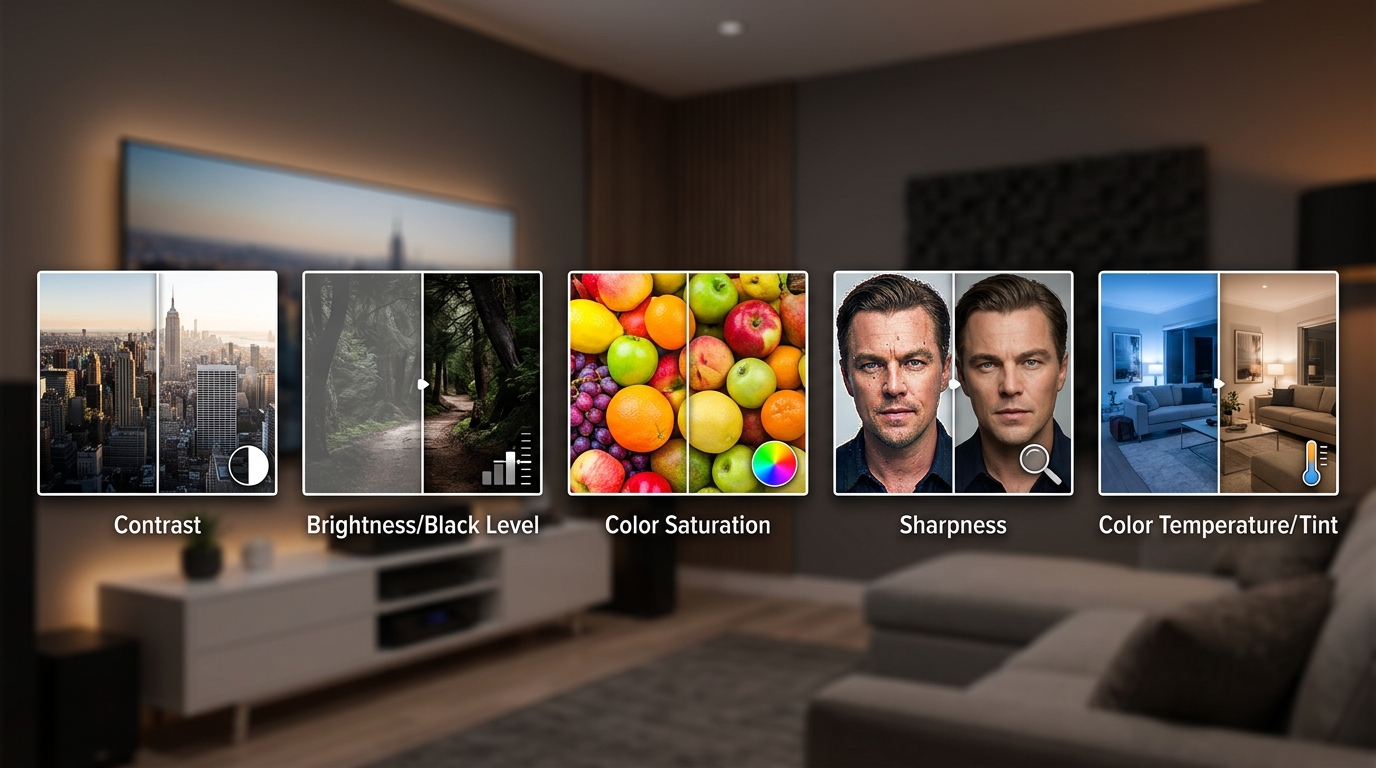
Picture Controls: User picture adjustments abound on these Samsung LCDs and apart the usual standard adjustments, these TVs come with four adjustable picture modes - Dynamic, Standard, Natural, and Movie - with independent memory inputs. This greatly eases picture optimization for different connected devices. There are also five selectable settings for color temperature that can be further fine tuned via the 'White Balance' menu.

Additional picture adjustments are also available under the 'Advanced Settings' menu. These include a black level adjustment that affects shadow detail; a gamma adjustment to control the progression from dark to light; three varieties of digital noise reduction, including an automatic setting; a film mode to engage 2:3 pull-down and that works also with 1080i sources; and three Auto motion plus settings apart from a custom setting which include the separate blur and judder reduction controls already referred to above.

These sets come with six aspect ratio settings - including a 'Wide Fit' mode to display the picture over the entire screen and a 'Screen Fit' mode to display 1080i and 1080p content on a 1:1 pixel mode without any cutoff (i.e. zero overscan).

And like the high-end Samsung LCD TV series, all Series 6 LCD HDTVs come with a Blue Only Mode setting - available under the Picture Options menu to help you adjust the color and tint to the preferred values by switching off the red and green colors. For an explanation of how to adjust the color and tint using the Blue Only Mode feature, please refer to our Samsung LED TV review.

Energy Saving Options: These 2009 Samsung LCDs come with four presets termed 'low', 'medium', 'high', and 'auto', apart from an 'off' setting. These settings mainly affect the TV brightness level to reduce the set power consumption.

E-Manual: With its 2009 line of HDTVs, Samsung is no longer supplying a printed manual. Instead, you will get your respective Series 6 manual on a USB stick in the form of an E-manual which you can view direct on your TV screen. Interesting is the customer care screen that includes the firmware version of your HDTV - useful should you need to call the company for support.

Menu and Remote: The menu on Samsung Series 6 LCDs is the same as that provided with 2008 Series 6 HDTVs. As expressed elsewhere on this site during our 2008 Samsung LCD HDTV product evaluation, the Samsung menu system is surely one of the best - with big, highly legible text. Navigation is easy and intuitive while helpful explanations are available along the bottom of the menu screen.

In a similar manner, the included backlit remote control is almost the same as 2008 HDTVs but without the scroll wheel. Overall, this is a functional and easy-to-use remote with big bottoms that are easily identified by their shape and size even in a dark environment.

Audio: As with the rest of 2009 Samsung LCD TVs, Series 6 HDTVs come with down-firing speakers and include SRS TruSurround HD for a virtual three dimensional sound-field over the set stereo speakers. Total audio power is 10W per channel.


Note: As already indicated in this article, all models in the series - except for 19-inch and 22-inch B650 sets, come with practically the same picture related specifications. This means that while the different Series 6 lineups come with different features, we still expect very similar picture quality from the different Series 6 Samsung LCD HDTVs.


Series 6 Samsung LCD TVs Performance

We did not carry a hands-on review on Series 6 LCDs. But expert reviews of Samsung Series 6 B650 LCDs appearing on various authority sites agree that while picture performance is not up to that of Samsung high-end Series 7 LCDs, Series 6 Samsung LCD TVs are still capable of solid picture quality. Primary and secondary colors are highly accurate, with colors that are bright and rich but not over-saturated. Cnet adds that color decoding is also spot-on, but then complains of a rather bluish cast in dark areas that is further worsened with off-angle viewing. This is typical of many LCDs but according to Cnet, the B650 set under review did exhibit the worst bluish cast in comparison to Sony's XBR9 and V5100, and Samsung B750 LCDs.

Professional reviewers say that these Samsung LCD TVs are capable of relatively deep blacks, blacks that according to the LCD-TV-Buying-Guide website are further enhanced by the B650 ultra-clear display panel. We have to add that a deep level of black is an extremely important picture deliverable of any HDTV as it helps render colors better under all light levels. This in our opinion also explains the rich colors reported by both experts and consumers alike.

Expert reviews indicate that shadow detail in dark areas is not ideal but still does not tarnish an otherwise overall very good picture performance; proper gamma adjustment will help bring out shadow detail better. Video processing is also clean and free from artifacts.

Samsung's main feature with its video processing is its adjustable dejudder processing. From what we have seen on other 2009 Samsung LCD HDTVs, Samsung's Auto Motion Plus is one of the best dejudder implementations mainly because it separates blur reduction and judder control. Increasing the blur reduction slider towards the maximum increases the number of lines of motion resolution while increasing the Judder reduction leads to more action smoothness - making 24Hz content more video like. However reviewers agree that too much judder reduction will introduce artifacts. The recommended setting here is to set the blur reduction towards maximum and reduce judder control towards the minimum. And if this extra smoothness is not for everyone, you can always set the judder slider to zero.

We have stated that increasing the blur reduction increases the maximum supported number of vertical lines. Cnet here reports a maximum vertical resolution of 600 lines as against the close to 1000 lines of the 240Hz B750 Samsung LCD. 240Hz is partly the reason for the added vertical resolution on Samsung Series 7. But we say that with normal broadcast content, you would not be able to discern any difference between the two. These differences in vertical resolution performance would become visible only with the use of the appropriate test patterns.

All reviews agree that these Samsung LCD TVs are capable of resolving every single detail of 1080i and 1080p sources while properly de-interlacing both video and film based content. Standard definition material also looks very good on these Samsung LCD HDTVs while diagonals do not show any jaggies.

Cnet reports solid screen uniformity and average off-angle viewing performance that is mainly in line with other displays. Off-axis performance is unfortunately an area where the three professional reviews we consulted do not agree. While Cnet refer to average performance, TVBuyingGuide.com state that off-axis viewing for the B650 is very good with contrast and blacks that remain correct even at 45 degrees. This 45 degrees represents very good performance for an LCD considering that the average for the later is just above 40 degrees. Instead, TelevisionInfo.com reports a rather sub-average off-axis performance of no more than 38 degrees. But the TelevisionInfo.com reviewer adds that despite the rapid fall in contrast with off-axis viewing, colors do not deteriorate or fade.

And what do customers had to say?

Customers at both amazon and Best Buy were generally extremely satisfied with their purchase and often assigned a five star rating to Series 6 Samsung LCD HDTVs. In fact, more than 80% of all customers who purchased a Series 6 LCD at amazon assigned a 5-star rating, averaging a 4.5 star rating overall. In addition, sets such as the 52-inch Samsung LN52B630 and the 40-inch Samsung LN40B650 got a five star rating over more than 90 reviews. Similar customer ratings were also assigned at Best Buy.

We believe that customer feedback is an extremely important factor to consider when planning an HDTV purchase. There is no better way to test a product than in everyday use. Lab testing is important to help assess product performance, but no matter how stringent it is, lab testing may still fail to capture important functional issues.

On analyzing customer reviews, it is clear that very few had really technical issues with Series 6 Samsung LCD TVs. Often the problem is mainly due to a lack of understand of the various user picture controls - which on Samsung HDTVs abound. In some cases, it was obvious that the user did not go through the user manual! While a few cases had to do with delivery of a TV that was defective in the first place, and TV sound quality.

The TV sound quality issue is to be expected from down firing speakers though Samsung bottom speakers tend to deliver quite acceptable performance with sound that does not deteriorate with an increase in volume. That said, if you want to enjoy the best sound to match the picture quality that these Samsung LCD HDTVs are capable of, you definitely need to hook up your TV to a proper sound system.


Conclusion

Series 6 Samsung LCD HDTVs represent a most compelling 120Hz HDTV option to those in the market for a mid-tier HDTV from a top brand. Approximately $200 to $300 less expensive than corresponding Samsung Series 7 LCDs, Series 6 delivers a performance that is definitely close to that of Samsung's premium series - with B650 LCDs sharing basically the same specs sheet - including full interactive content - as their more expensive brethren. The only difference being the 240Hz technology present on Series 7. But as we have stated, it is not possible to perceive the added benefit of 240Hz over 120Hz with normal broadcast content.

Even B630 Samsung LCDs TVs represent an interesting option - despite the lack of full Internet-enabled content and DLNA support found on the more expensive Series 6 B640 and B650 sets. But you will still get Samsung's InfoLink feeds on B630 HDTVs apart from practically the same picture related features. In this respect, B630 matte screen may represent a better option if your TV will be set in a brightly lit room. B640 and B650 glossy ultra-clear panel - while extremely effective in maintaining blacks even under bright lighting, will also pick up reflections of bright objects in the room especially when displaying dark content; this can turn out to be annoying.

Pros: Deep blacks and accurate colors; clean video processing with separate blur and judder reduction adjustment; plenty of connectivity; matte screen on B630 Series Samsung LCDs represent a great option for a better bright lighting performance; full interactive features on B650 HDTVs; 'Movie' picture mode delivers a relatively accurate out-of-the-box picture settings with accurate natural looking images.

Cons: Styling especially on the B650 lineup is not for everyone; glossy screen on B640 and B650 may be an issue in bright lighting; shadow detail in dark areas is not ideal; too much judder reduction will introduce video artifacts.

The bottom line: At the present reduced online prices, Series 6 Samsung LCD TVs represent a most interesting 120Hz HDTV option from a top brand - offering one of the best feature packs to price deal.


Reference Material

Cnet Reviews: Review of the LN46B650 by D. Katzmaier, June 26, 2009; Cnet is in our opinion one of the best online sources for professional TV reviews.

LCD TV Buying Guide: Short technical review of the LN46B650 by Jack Burden.

TelevisionInfo.com: Review of the LN40B650 by Alfredo Padilla, May 08, 2009; this is a highly technical review with possibly too much info for the average HDTV buyer, but definitely a very good source for videophiles.

Customer feedback at amazon and Best Buy

Samsung USA website for the latest technical specs and product manuals covering Samsung 2009 LCD TV lineup.


LCD and LED HDTVs at amazon

If you are in the market for an LCD or LED TV, we advise to visit the amazon storefront; the vast choice of products and available buying options are among the best online. However, prior to any decision do some research of your own. Look at what other customers had to say about their LCD TV purchase. This will give you extensive insight about the product of interest; a good starting point is the customer feedback posted on the amazon site. 

You can search the amazon storefront for HDTVs without leaving our site by using the amazon search box below; your search results will appear here under.


A large selection of LCD and LED HDTV sets is also available from amazon UK


2011 LCD TV Reviews and Product Guides

Featured product reviews on PHTG

new

Sony LED TVs - 2011 Product Guide:
Sony LED TV line for 2011 is among the most interesting thanks to the extensive features, refined styling, solid picture and a price that is more within reach of the average household budget.

This Sony LCD TV review discusses the features on offer, review entry-level and premium Sony LED TVs, and pick the best Sony HDTVs at the different price brackets.

Note: You may join our Sony LED TV discussion by submitting your comments here.

2011 LG LED TVs - Full Product Guide:
The latest LG LED TVs are among the most in demand thanks to a slim attractive design, extensive features, and a price that is often below that of the competition.

We review the 2011 LG LED TVs to see what's on offer, from entry-level sets to Infinia HDTVs. In the process, we highlight the pros and cons of each LED TV series. In the final part of this review, we pick the best LG LED HDTVs at the different price brackets.

Note: You may join our LG LED TV discussion by submitting your comments here.

2011 Samsung LCD TV Product Review:
Samsung HDTV lineups have always been characterized by one of the largest range of models available from a single brand; this year lineup is no exception, with forty-six different LCD/LED TVs.

Check our Samsung LCD TV review to discover more and see which are the best Samsung HDTVs for 2011 at the different price brackets.


LCD HDTV nstallation Guides

For a professional installation job!

LCD Television Installation Basics:
Thanks to the use of LCD mounts, installing an LCD TV should be a fairly straightforward task, but... Help is on the way. This installation guide looks at various installation issues from placement to running cables and safety considerations.

Guide to Choosing the Right LCD Mount:
The different types of LCD TV mounts give rise to mounting options undreamed of with CRT and RPTVs. In this second part of our TV installation guide, we discuss the various LCD mounts - identifying their pros, cons and use.

Installing an HDTV over the Fireplace
Mounting a flat-panel HDTV over the fireplace is a great way to display your new flat-panel TV. Discover more in this Plasma TV Installation Guide.


For additional information on how to install a flat-panel TV mount the professional way, please check also our guide to Installing a Plasma TV Wall Mount. The information contained in this guide applies to both plasma and LCD HDTVs.


Use of Wiring Channels for flat-panel TV Installations: Designed for the home installer with basic DIY skills, wiring channels make for ease of TV installation and a professional looking job.

TV Viewing Distance Guide: Discover how the TV screen size and image resolution relate to your viewing distance for a truly immersive viewing experience.

Note: This guide deals with 2D TV viewing; for 3D HDTVs, please refer to our article 3D TV Viewing Explained.

 Home Theater Guides:

Recommended Technical Guides 

LCD/LED HDTV Guides:

Developments in LCD flat-panel Technology:
Discussing some of the latest advancements in flat-panel display technology - including improved CCFL backlights, LED LCDs, and Color Field Sequential technology.

The LCD Display Panel: How-it-works
What is LCD Display technology? How does LCD panels work?

LCD Response Time, Image Lag and 240Hz/480Hz LCD HDTV Sets:
The latest LCDs claim 1msec LCD response time.  Is this fast enough to display fast-action content? Is faster always better? How does this compares with plasma TVs? Is it possible to compare LCD TV response times between different TV manufactures? What about 240Hz and 480Hz LCD TVs - are these really better at eliminating motion blur?

Image Sticking in LCD Televisions: 
Image sticking is surely one of the least known phenomena associated with the use of TFT LCD panels, yet image retention is not just an issue with plasma televisions. Discover what causes image retention in LCD and LED TVs. What can you do to avoid it?

Plasma vs. LCD vs. LED TVs:
A detailed 3600 comparative guide to choosing between plasma, LCD and LED TV display technology.

Miscellaneous Articles

The Smart TV Guide:
Smart TV promises a whole new experience in the world of TV entertainment. But what exactly is smart TV? Is it really more than just a PC experience over a big screen? Discover more in this guide to smart TV.

HDMI Cable Guide
An easy-to follow guide that explains all you need to know about HDMI.

3D Television FAQs
Questions always crop up with a new technology. We do our best to answer most of the common questions in this FAQ.

AV Equipment Racks for the Home Theater:
AV racks range from industrial style EIA 310-D compliant 19-inch rack enclosures to the more decor friendly rack solutions.

Understanding HDTV formats
Discover the strengths and weaknesses of the different HD formats - 720p, 1080i, and 1080p - in this HDTV Guide.

Contrast Ratio Explained
To what extent high contrast ratios affect the performance of a home theater projector or an HDTV?

 HT Books and Magazines

Recommended Home Theater Reading

Sound & Vision

Provides good reviews on the latest home theater gear.

Practical
Home Theater
Well-written home theater guide - a useful reference to anyone interested in home theater.

Featured 2011 LCD and LED HDTVs

Check out for the latest offers on LCD/LED TVs at amazon

Sony

Samsung

LG


Would you like to get the best out of your HDTV?

There is no better way to make the most out of your new HDTV then to invest in a set-up DVD.

A great calibration disc is the Avia II Home Theater Set-up DVD, an exceptional AV calibration tool for both the novice and the expert.

Other interesting calibration discs worth considering include Digital Video Essentials HD Basics and Spears & Munsil High-Definition Benchmark, both of which come in Blu-ray edition.

For more information, please check our Guide to HT Set-Up DVDs.

Suggested TV Mounts & AV Cabinets

LCD Mounts and Media Cabinets Solutions for your HDTV

Find us on Facebook

Follow us on twitter


Subscribe To This Site [?]

XML RSS

Add to Google

Add to My Yahoo!

Add to My MSN

Subscribe with Bloglines


Please Note:

Double-underline links represent additional info related to the page content supplied by Kontera. To view this info, place your cursor over these double-underline links.


Return from Series 6 Samsung LCD TV Review

LCD TV Guide

LCD TV Reviews

Home Page