High Definition Audio Formats for Music Listening - SACD (3)
Playback Setup and Content
Protection
To make the
very best out of SACD music, you need to
have the right gear that can deliver the same subtitle detail
and dynamic range as supported by this high definition audio
format. At the same time, you need to be aware that because of content protection issues, there are some
restrictions on interconnectivity. More in this guide.
Connectivity Requirements
for High-Resolution SACD Playback
In order to enjoy the high resolution sound
found on Super Audio CD discs, you need a
compatible DVD player that can handle SACD
discs.
You also need a preamplifier or AV receiver, with either six
analogue inputs or an encrypted digital
interconnect.
Basically, the situation here is similar to
DVD-A requirements in that while DVD-Video audio formats such as
Dolby Digital and
DTS, can be sent via a player's unprotected digital
o/p to a receiver for conversion to analogue
form, this is not the case with DVD-A and SACD
content.
Like their DVD-A counterpart, SACD compatible
players are not permitted to send DSD digital
content
over an unencrypted digital
audio link; if you do, the content protection mechanism
will force the SACD player or compatible
DVD-player to downgrade to ordinary CD audio quality due to concerns
about digital copying.
At present there
are two main standard digital connection methods
capable of carrying DSD in encrypted form:
i.Link
and HDMI
(version 1.2 or later).
i.Link is generally found on high-end equipment.
HDMI is more
common in consumer applications, being the standard digital connection method for high-definition video
and audio over the same digital interconnect. Still, at the time of this
write-up, there are only a few compatible players and A/V receivers
capable of carrying raw DSD over their HDMI connection. Instead, some would
simply convert DSD to PCM and then carry the PCM encoded signal.
It should be noted that when working with an
encrypted digital interconnect like HDMI with
HDCP, all devices in
the playback chain will have to be equipped
with a valid decryption key, otherwise, it
would not be possible to play the high
resolution audio. More on HDMI
and HDCP can be found
under the respective sections of the site.
Copy Protection
Many have argued that DVD-Audio
and SACD are more of an attempt to add
copy-protection rather than anything else. We believe this is not
the case, and with the appropriate playback setup, once you hear the
high definition multi-channel sound supported by these high resolution
audio standards, you will never want to turn back!
SACD employs several copy
prevention features at the physical layer, which - up to now - have succeeded
in making it impossible to copy SACD content without resorting to the analog
hole. It makes use of an active copyright management system (ACMS), a
copyright identification system, and both visible and invisible digital
watermarking of the audio content itself.
In particular, interesting
is the use of physical pit modulation, which is extremely effective
against mass illegal copying. It makes use of a new technology called Pit
Signal Processing (PSP) in order to modulate the width of the pits on
the disc.
This is actually a form of
'Digital Watermarking' that is different in concept to the digital
watermarking used in DVD-Audio to prevent copying along the analog path.
The Digital Watermarking
technology as used in SACD discs stores the required copyright data as a
modulation of the width of the injection molded 'pits' on the disc
substrate itself. Hence, copyright data cannot be replicated without the
glass mastering equipment used to make the original disc stampers.
Furthermore, the modulation of the pit's width can be synchronized on
consecutive turns of the disc in order to form visible patterns on the
recorded side of the disc itself in the form of faint text or graphics;
hence the name 'Watermarking'.
Beside the visible Watermark on the playing surface of the disc, PSP can
also be used to store additional information like the country of origin,
mastering house, and other identification codes.
If a disc with no or altered copyright information is inserted in a SACD
player, play-back will start for a few seconds, and then the disc is simply
ejected from the player. For this purpose, all hybrid players have to be
equipped with suitable PSP detection circuitry.
In addition, audio data blocks are also encrypted using an
80-bit encryption
algorithm with a key encoded on a special area
of the disk that is only readable by a licensed SACD device.
This renders the high
definition (HD)
layer of an SACD disc unplayable on standard computer CD/DVD drives, or
in that case on any non-compatible licensed player, nor can SACD discs be created except by the licensed disc replication
facilities.
It is thus clear that SACD
seems to have managed to come with an efficient copyright protection
system that is most appropriate for use with high-definition audio, since it
does not alter the high definition sound in any way. Therefore, the
Super Audio CD disc can be used to reproduce the original high definition
music in all its subtle detail.
Audio Playback Setup for Super Audio CD
As with all high definition audio, having an SACD player or compatible universal DVD player
and an AV receiver, is only part of the game. If you
want to get the very best out of your SACD listening, then there is the need for more.
As indicated earlier on in our discussion, SACD
supports a much wider dynamic range than CD sound.
In other words, if you want to get the very best in
music quality when listening to SACD, you need
to have the appropriate setup,
In particular, if you really want to appreciate this
format's potential, a good quality
preamplifier/surround sound processor with a signal-to-noise ratio of at least
-110dB/-120dB is desirable.
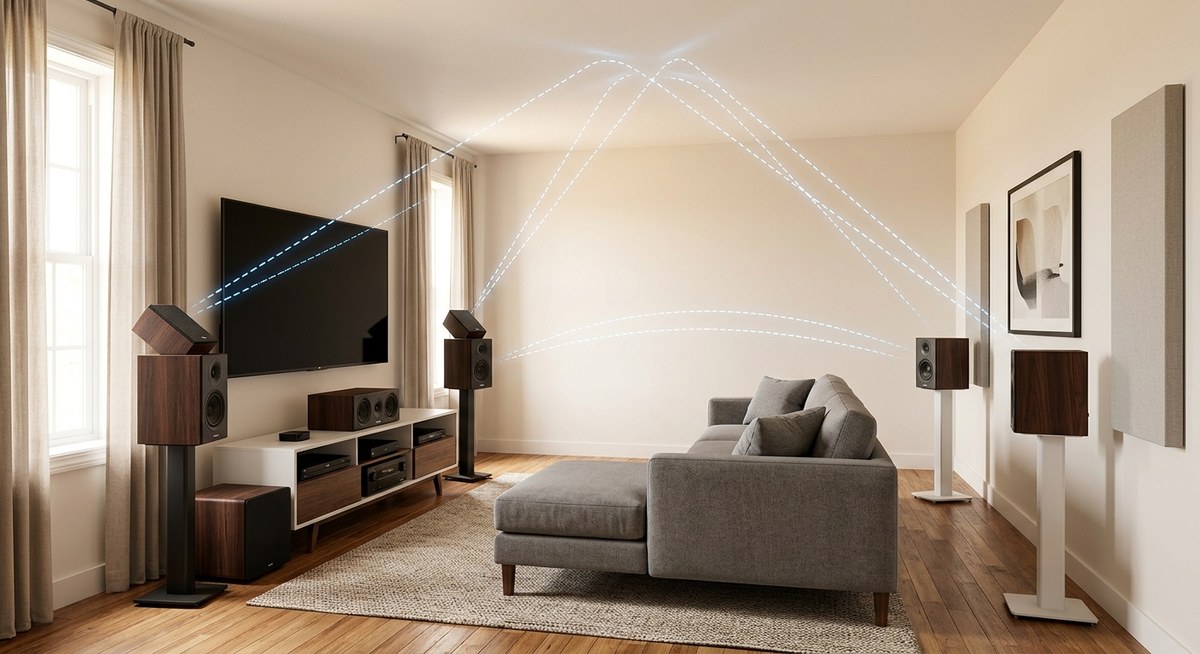
Further more, as with DVD-Audio, if you plan to take
your SACD seriously, you will also need to
consider investing in five identical full-range
speakers. The problem is that from a practical
perspective, it is difficult to make use of a
floor-standing speaker for the center channel if
your audio system also serves as part of your home
theater setup. This in view that in a home theater implementation, the
center speaker is usually placed horizontally
orientated just under or above the TV. This problem
would not arise when making use of a front projection setup and an
acoustically transparent projection screen, in which
case a floor standing center speaker placed
centrally just behind the screen would do a nice job
for both music listening and movie viewing.
However, more important than the center speaker is
having four identical speakers for the left/right
front speakers and the left/right surround speakers.
We are not saying that making use of the same audio
setup used for a home theater implementation would
not suffice; it is just that it is not ideal speaker
setup for high resolution multi-channel SACD playback. At the same time, one
has to keep in mind that there is also a financial
implication to invest in four or five identical full
range speakers.
Another
issue is speaker placement. As pointed out in our
article on
speaker
placement in the home theater,
speaker placement for music listening differs from
that for movie viewing. We suggest going through our
speaker placement article for the relevant details.
If your audio playback setup is intended to serve
for both music listening and movie viewing - as is
the case with most home entertainment setups, the
best approach would be to opt for a flexible speaker
mounting solution that would enable you to easily
adjust your speaker placement to suit either purpose
when needed.
...Part 4:
Super Audio CD Music
...back
to
DVD-A/SACD Section Index
|