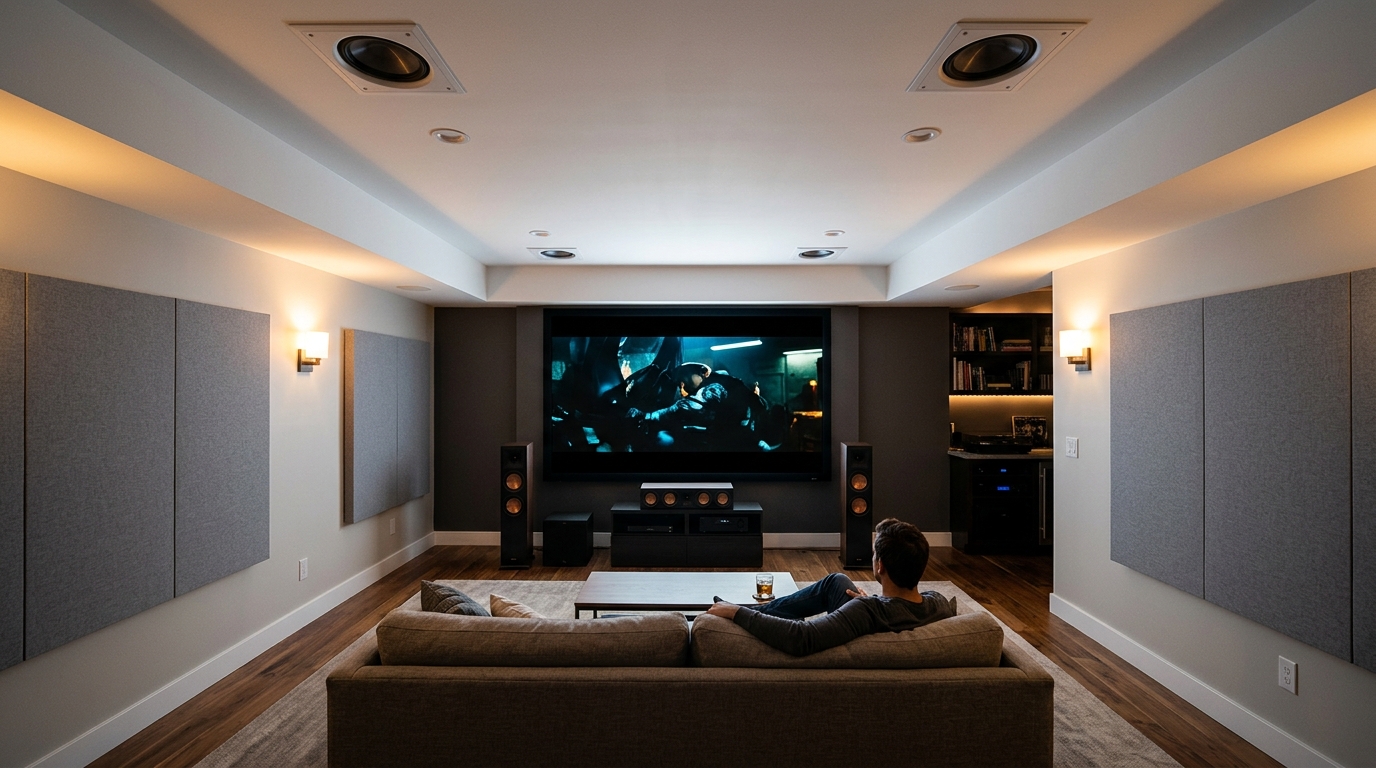
left image  
 

Home Page - Power Protection - Implementation Tips & Advice


Selecting Your Home Theater Power Protection Solution

Power Equipment Rating, 'What-to-look-for' tips, and 'before you buy' Check-List


Selecting the right power protection gear for a home theater setup is important as it will impact both equipment protection and system performance.

Unfortunately, many fail to follow through the right logic to come up with a most suitable solution to protect their equipment from power surges and voltage fluctuations as well as clean system inputs and ac supply rails from unwanted electro-magnetic and radio frequency interference. The result is often an inappropriate solution that leads to a false sense of security as in most cases, failure to install the right protection is equivalent to no protection at all!


A Quick Guide to Home Theater Design

Discover how to research, design, and build your own Home Theater.

Home Theater Design e-book

by Duncan McClelland
More information HERE.

Updated: 26th April 2009


But... coming up with the right solution should not be that difficult; all you have to do is to follow through the steps detailed in this guide!


Monster Signature Series MP AVS2000 SS

Monster Signature Series

Automatic Voltage Stabilizer
MP AVS 2000 SS

A Step-by-Step Guide

Selecting the correct power protection gear is in itself a process that should be done with due diligence.

Your choice will eventually determine the effectiveness of the selected protection/power conditioning gear with respect to your home theater setup.

Do not try to under-rate the importance of this process. Remember that the electricity in your house is not your friend - it’s dirty and often lacking in power when your amplifiers need it most.

Even more important is that any unconditioned supply might very well shorten the life-span of your electronics.

It is true that there is a price to pay for power protection, but...

Please do not be tempted to plug any part of your system straight into  the wall power outlet socket - or worse still, to plug your equipment into a cheap outlet power strip. Why?

'Dirty' power directly affects your components by starving them of the power they require to operate efficiently, and in a way they were designed to.

By choking a component’s power supply, you make it work harder to overcome the dips and sags in the AC line, thereby shortening its life-span and degrade system performance.

Insufficient power on the AC line will significantly degrade the video and sound quality. HDTVs and video projectors may fail to achieve the required level of brightness when handling predominantly bright scenes - thus producing a relatively dull image.

However, even more affected will often be power amplifiers especially when operating the system at concert volume levels and above.

At these relatively high volume levels of music, amplifiers demand instantaneous high currents especially when handling huge bass transients. If your power supply fails to deliver what your amplifiers are asking for, the result would be a sort of compressed response especially at the lower frequency extremes that leads to a loss in the much desired depth and dimensionality of the soundstage.

The use of complete home theater power plants, with elaborated line conditioners, separate noise reduction and protected connections for AC lines, phone and TV coaxial connections, is surely the ideal approach.

Unfortunately, these systems do not come cheap; typically, you should allow between 7% to 10% of your home theater budget for a suitable power conditioning solution.


Power handling requirements for your Protection Solution

If failure to supply the right power levels when needed most by your system leads to a deterioration of  both system performance and expected product life-span, then it is obvious that a most important first step towards designing a correct protection solution, is to determine the total power handling requirements to drive all your audio and video equipment.

Underrate your power protection gear solution and you would expect both deteriorated system performance with an AV system that would not deliver the peaks when needed, and frequent power tripping of your active protection gear whenever the power protection gear safety mechanism goes into operation. The latter would happen whenever your home theater equipment starts to demand more instantaneous power than that supported by your active protection gear - irrespective of whether this being a power line conditioner, automatic voltage stabilizer, etc.

At this point, it is important to realize that for an effective protection solution, you need to plug all equipment constituting your system. Do not reason out that if some piece of gear is not so expensive, you may leave out out of the power protection equation. Your power protection solution is as effective as its weakest link and any unprotected gear forming part of your home entertainment setup may eventually transform costly power protection into an ineffective solution.

How much power do you need? Determining Your Power System Rating

To be able to determine the total power rating for your protection solution, you first need to determine the total peak power requirements for each of your system components by looking at the respective components specification sheets and sum these together; the result would represent the minimum power handling capacity for your power protection solution.

A few words of caution here:

Discrete Blu ray/DVD players, pre-amplifiers and the like would normally consume insignificant power with respect to your power audio setup and video projector/HDTV; therefore, a marginal allowance of around 100W to 150W should normally suffice for the purpose. Ideally however, you should get these calculations right off the product specs sheets for each of the respective components.

In a similar manner, the power requirements as specified on HDTVs and video projectors specifications sheets can be taken to represent the maximum power when operating the TV or protector at typical high brightness levels (which is what consumes most electricity).

Unfortunately, the situation is not that straightforward when it comes to supply requirements for power audio amplifiers and AV receivers. Often, the AC power ratings as listed on amplifier specs sheets do not always reflect the total AC power required to handle sustained peak volume levels of music. A simple check if this is the case is to sum the maximum RMS rating for each of the amplifier audio channels and see if the result is significantly less than the AC power requirements detailed on the specs sheet. If so, then you may very well assume that the AC power requirements specified on your amplifier are correct for the purpose of this exercise.

If not, then you have to do your own calculations. Exact calculations are not required here and in any case, would be extremely mathematically involving. However, with a few approximations, it is possible to arrive at a result that should suffice for our requirements.

All you have to do is to take the computed sum for the maximum RMS audio output for all the different audio channels and then allow for enough overhead to allow for the added power lost due to the inefficiencies in the audio system. As a rule of thumb, if you multiply the computed total maximum RMS audio power for all channels by a factor of two to three, you should have sufficient power to handle most of your demanding music listening.

The factor of two should provide more than enough power to handle listening even at moderate volume levels for most systems. It also represents a practical compromise to help you determine your protection system power rating and power protection solution costs. If your music listening is often carried out at excessive high volumes, then we advice to use a factor of three instead of two.

The above recommendation is based on the fact that most audio power amplifiers are classified as Class AB; these achieve a typical efficiency of around 55% (despite a theoretical maximum of 78.5%), when operating at full power.

What-to-look-for when planning your Power Protection Solution

There are several 'power line conditioners' and 'automatic voltage stabilizers' to choose from that will clean up the AC power. The use of power enhancers or conditioners will surely bring about a more dynamic audio presentation and a significant improvement in video system performance.

Similarly important is that you’ll be protecting your equipment from electrical storms; in particular, you will be protecting your gear from the small daily surges that otherwise would make their way to your system components.

Selecting a power protection solution from the myriad of solutions available on the market is often far from being straightforward. We hope that this what-to-look-for checklist will prove to be of some assistance to you when planning to invest in a power protection solution for your home theater.

What To Look For: 

Blue bullet

Discrete Filter Sections

Look for power filters that isolate the different type of signal components from one another. In particular, high current devices should always be isolated from low current ones.

Blue bullet

Protection For Other Connections

Similarly important, choose a power conditioning unit that includes separate dedicated protected connections for off-the-roof antenna coaxial TV input, cable-TV and/or Digital satellite services, phone-line protection for pay-per-view broadcasts, and other modem-based services.

Blue bullet


'Spec' Grade AC Outlets

Spec-grade outlets feature large 24K gold-plated internal copper contact blades; these will ensure a reliable and improved long-term energy transfer.

Blue bullet

Fast-Acting Spike Protectors

Never try to operate your gear without some sort of surge protection - its cheaper than having to replace your home theater equipment. However...

Make sure the selected power protection unit employs fast-acting surge suppression circuitry to guard your equipment against harmful spikes, power surges, and lightning strikes.

Keep in mind that ordinary circuit breakers are too slow to protect your equipment from dangerous over-voltage events.

Beware of cheaply made power conditioners or protection devices, as their surge protection elements may end up to be a one time use only, leaving your system unprotected after a surge.

Remember that the quality of a surge protector is reflected in the price of the protection unit, but not only. Check the joule rating of the unit; this measures how much damaging energy the suppressor can handle. Ratings vary from a typical 500 joule up to 2000 and over - the higher the value, the better. For more inform on surge suppressor ratings, please check out Surge Suppressor Guide


Power Protection Gear

Before-you-buy Check-List:

Blue bullet

What equipment should be protect?

For sure, you need to protect all gear within the audio/video chain, but is there any other ancillary equipment worth protecting?

Blue bullet

What should be the power handling capacity of power protection equipment use as part of an active power protection solution?

This follows from our first part of the discussion in this article.

Blue bullet

'Do you need line protection for phones, coax and any other part of the network?

It is highly recommended that any inputs to your home theater system will find themselves in the power protection equation.

Blue bullet

Is there the need for a whole-house power protection solution?

This depends on how your entertainment setup is deployed around the house.

Blue bullet

How many outlets do I need?

Just count the number gear you will be plugging in; however, you need to differentiate between low power and high power system components since it is advisable that the latter be plugged into appropriate power sockets designed for the purpose.

Blue bullet

Is the AC line voltage stable or do I need to invest in AC line regulation?

If the AC supply is considered stable, voltage regulation is not mandatory, but it is till recommended since automatic voltage regulation ensures that your system components will get the AC supply voltage they were designed for.

Blue bullet

How much do I plan to spend?

This depends on what is your overall home theater budget; it is recommended to allow 10% of your total budget for power protection. Note however that when designing your power protection solution, do not plan for the short terms - especially if you are planning to complete your home theater setup over various phases of implementation. Therefore...

Plan your home theater to its completion and then design your power protection around your would-be complete home theater set-up - irrespective of the time plan you have setup to complete your full home theater setup.

Furthermore, keep in mind that unlike audio and video system components, you would not be replacing/upgrading your power protection gear that often; it would be cheaper to allow for extra power rating capacity for your protection gear when first planning your power protection solution than replacing later to cover future additional requirements.

Power Protection Solutions @ amazon.com

Amazon carry a vast range of power projection gear for your audio and video applications, including surge protectors, automatic voltage stabilizers, uninterruptible power supplies and power line conditioners from top brands like Monster Power, Panamax, Belkin, Tripp Lite, and APC.

You can search the amazon storefront without leaving our site by using the amazon search box below; your search results will appear here under.


Power Protection Guides

Related further reading 

Power Clean Up: Why invest in power line conditioning and overall system protection? 

Surge Suppressors (1) - A first line of defense

Surge Suppressors (2) - A word of caution

How-it-Works: Power Line Conditioners

Inexpensive Uninterruptible Power Supplies as part of a  home theater protection solution

 Home Theater Guides:

Related Technical Guides 

Guide to Wireless Headphones and Dolby Headphone technology
Ever told to turn it down? Combine a set of wireless headphones and Dolby Headphone technology for a great sound experience.

Surround Sound Formats
The never ending list of terms and brand names - Dolby, DTS, THX - associated with surround systems is starting to get a bit too complicated...

Speaker Placement in Multi-channel Audio
Correct home theater speaker placement plays a critical role towards achieving that seamless ‘enveloping’ sound so important in the overall home theater experience.

Time Delay Settings in Surround Systems
Directly related with your home theater speaker placement is a correctly set surround sound field in multi-channel audio playback systems.

Selecting and Installing Speaker Wire
A correct home theater wiring approach is important for your home theater sound. Poor workmanship and low quality speaker wire will surely impact...

Home Theater Design:
A series of articles covering all aspects of home theater - from design to implementation.

Set-up Discs and Video Calibration Solutions
Home theater setup DVDs and video calibration kits can help you squeeze a lot more out of your system.

The HoloVision Rak Master Pull-out/Swivel AV RacksEquipment Racks:
There is more to equipment racks than a storage space for your system components. More in this informative home theater guide. 

The HDMI Cable Guide
To many, HDMI is still an unfamiliar term. This easy-to follow home theater guide explains all you need to know about HDMI.

Quick Guide to DVI
DVI Cable Guide - explaining the different flavors of DVI interconnects.

TV Viewing Distance
Buying a big screen TV? Care should be taken as you may easily fall into the trap of buying a too large TV for your room.


Power Line Conditioners & Surge Suppressors:

Featured power protection gear at amazon


To access the full range of power protection equipment available at amazon, please
click here.


Home
HDTV Guides CRT TVs
LCD TV Guide
Plasma TV Guide
Flat-panel TV Reviews Plasma TV Reviews
LCD TV Reviews
Best HDTVs
Projection Systems Projection TV
RPTV Reviews
DIY Projection TV
Projector Reviews
Projection Screens
Digital and Satellite Television Digital TV Guide
Satellite Television
Sound and Wireless Systems Surround Sound
Wireless Speakers
Headphone Guide
Media Players
Home Theater Guides Home Theater Design
Equipment Racks
HT Cables
HDCP
Set-Up DVDs
Power Protection
Refurbished Products
Movie Posters MoviePoster Guide
The Poster Store
Books and Magazines Books & Magazines
Catalogs
Home Theater Ideas! HT Pictures Gallery
Home Theater Sites
Useful Links
Find the Best Price Price Search
Store HT Online Store
Website Information About Me
About Site Built It!
Website Content
Site Use & Dislaimer
Privacy Policy
Advertise on this Site
Site Search
Contact  Form
Site BLOG
E-zine Subscription
-
[?] Subscribe To This Site

XML RSS
Add to Google
Add to My Yahoo!
Add to My MSN
Subscribe with Bloglines


Subscribe to our free e-zine to remain abreast with the latest additions to our website. 

Click here for details.


back to Power Protection - Section Index

Home Page