|
|||||||||||||||||||||||||||||||||||||||||||||||||||||||||||||||||||||||||||||||||||||||||||||||||||||||||||||||||||||||||||
|
Home Page - Plasma TV Reviews - 2009 Panasonic Plasma HDTV Reviews (3) 2009 Panasonic Plasma HDTV Sets - Part 3Entry-level
Panasonic 1080p Plasma HDTVs
|
Quick Guide to Home Theater Design An easy-to-follow e-book on how to design and build your Home Theater
by Duncan McClelland
Article Date: 18th July, 2009 Update: 5th Feb. 2010 |
||||||||||||||||||||||||||||||||||||||||||||||||||||||||||||||||||||||||||||||||||||||||||||||||||||||||||||||||||||||||||
|
|
|||||||||||||||||||||||||||||||||||||||||||||||||||||||||||||||||||||||||||||||||||||||||||||||||||||||||||||||||||||||||||
Panasonic Viera 1080p Entry-level HDTVs: TC-PS1, TC-PS14, and TC-PU1 SeriesAffordable 1080p plasma TVs from Panasonic...As with its 720p lineup for 2009, Panasonic is also offering three entry-level series of 1080p plasma HDTVs. These are the S1, the S14, and the U1, also referred to as TC-PS1, TC-PS14, and TC-PU1. Yet the most extensive and innovative of the three is the S1 series of HDTVs being reviewed here. The S1 Series comprises six different screen sizes - 42-inch, 46-inch, 50-inch, 54-inch, 58-inch, and the largest in this year lineup, the 65-inch TC-P65S1. Furthermore, the 65-inch S1 complements the only other 65-inch 1080p plasma HDTV within the 2009 Panasonic Viera lineup, the more expensive higher-end V10 series 65-inch TC-P65V10. The latter comes with significantly improved feature set - including THX display certification, something which S1 HDTVs lack. All screen sizes are readily available from major online stores at significantly reduced prices; the best-selling S-series Panasonic plasma HDTV is the 42-inch TC-P42S1 ($800). The 46-inch TC-P46PS1 ($1,200) and the 50-inch TC-P50S1 ($1,000) are also among the best-selling HDTVs at amazon, while the 54-inch TC-P54S1 is also doing well in sales thanks to a reduced price of around $1,260. The two bigger models in this series, Panasonic VIERA TC-P58S1 58-Inch 1080p Plasma HDTV and its bigger brother, the massive 65-inch TC-P65S1 are available online at $1,700 and $2,450 respectively. Definitely, at this price bracket, S1 Panasonic Viera HDTVs represent a most affordable 1080p option from a top brand. In particular, at under $1,300 the 54-inch in this series also represents the best screen-to-price deal at this HDTV category. And here we are not talking about any 1080p HDTV. Panasonic S1 Series HDTVs feature quite a few innovations. Top in the list is Panasonic NeoPDP energy-efficient plasma panel. As expressed in our introduction to this 2009 Panasonic Plasma HDTV product guide, the NeoPDP panel is capable of almost twice as much brightness level and significantly improved static contrast while using half the power of standard 1080p plasma display panels. It still consumes more power than corresponding LCDs, but with the new panel, Panasonic has managed to narrow the gap between these two display technologies to the point that difference in power consumption between LCDs and plasma is starting to become a non-issue. And this apart from the much-touted Panasonic first, the use of a 600Hz sub-field drive with its full 1080 lines of motion resolution. The other two entry-level 1080p series in the 2009 Panasonic lineup, namely the S14 and the U1 come with a reduced feature set. The most important difference is the use of standard G12 Panasonic 1080p HD plasma panels instead of the NeoPDP used on the S1 Series plasma HDTVs. Other differences include an additional picture mode - termed Game mode on the S1; this is not available on the other two series. S14 and U1 series HDTVs also come with a reduced supported number of shades of gradation, namely 5120 levels instead of the 6144 levels of the S1 Series, this apart from a slightly reduced native contrast ratio rating of 30,000:1 instead of the 40,000:1 for the S1, and a slightly reduced motion resolution of 900 lines. Interesting is that while connectivity can be defined as adequate on all three series, yet the only series from the trio that comes with an analog PC VGA-style input is the S14 series. Similarly, the S14 is the only series from Panasonic line of entry-level 1080p plasma HDTVs with an analog audio output. With the S1 and the U1 Panasonic plasma HDTVs, you only get a digital audio output. The S1 Series of 1080p Panasonic plasma HDTVs
|
|||||||||||||||||||||||||||||||||||||||||||||||||||||||||||||||||||||||||||||||||||||||||||||||||||||||||||||||||||||||||||
|
Design of the Panasonic S1 HDTVs is very much similar to that of the X1 series with an almost identical minimalistic look and feel that takes an all black glossy finish. It also features a similar slim strip of silver along the bottom of the frame that helps highlight further the curved bottom edge of the panel. |
![]() |
As with 2008 Panasonic plasma HDTVs, this year line of entry-level 1080p Panasonic Viera TVs come with a similar glossy black wedge-shaped pedestal stand that does not swivel.
Additionally, all front controls and inputs are positioned on the sides which make them completely hidden from the front. Similarly, these sets come with down-firing speakers positioned along the bottom - something which makes for a more compact design but that unfortunately does not help deliver the best sound.
|
To continue with these similarities, the S1 Panasonic plasma HDTVs also feature the same basic user menu and navigation structure as found on the cheaper 720p series. As stated in our X1 Panasonic plasma TV review, the new menu for 2009 includes a number of icons and a new Viera Tools menu that make it easier to select what you want. Overall it is intuitive and easy to navigate even though there is no on-screen help as is the latest trend with other manufactures. Directly associated with the menu is the set remote which is basically the same as the remote provided with the 720p series. It is similar to Panasonic 2008 version with the main difference being three additional keys labeled Viera Link, Viera Tools and SD Card, all positioned just around the central cursor control. The clicker does not come with illuminated buttons but the relatively large and differently shaped buttons still make for ease of identification in a dark environment. |
![]() |
What really differentiate the S1 from both 720p and the rest of Panasonic 1080p entry-level series is the new G12 NeoPDP Panasonic plasma display panel. As further detailed in part 1 of this series of 2009 Panasonic Plasma TV review articles, presently this is one of the most eco-friendly 1080p plasma panels around. This 1920 x 1080 pixel panel uses 40% less power than standard 1080p panels for the same brightness level - this apart from enhanced contrast levels.
These panels are built to resist shock, have a rated half-lifetime of 100,000hrs, and employ a new anti-reflective coating that is capable of doing a very good job under bright lighting.
S1 series Panasonic plasma HDTVs come with a 40,000:1 static contrast and 2,000,000:1 dynamic contrast rating, which is the same as that found on the more expensive Panasonic premium 1080p series. These excessively high contrast ratings do help deliver improved performance but... Keep in mind that the human eye would not perceive any difference between these mega contrast ratings and say a 100,000:1. As expressed in our contrast ratio article, this has become more of a number game by TV makers - originally started by Samsung - to help sell their products over that of the competition.
As one may expect, these 1080p entry-level Panasonic plasma HDTVs come with a rather reduced feature set. You would not get a USB port, PC input, or 24p cinematic playback to achieve a much better film-like reproduction than the included 2:3 pull-down method. Nor you would find a picture-in-picture or a frame-freeze function - something which we find extremely useful when say writing down a phone number or taking some other information during commercials.
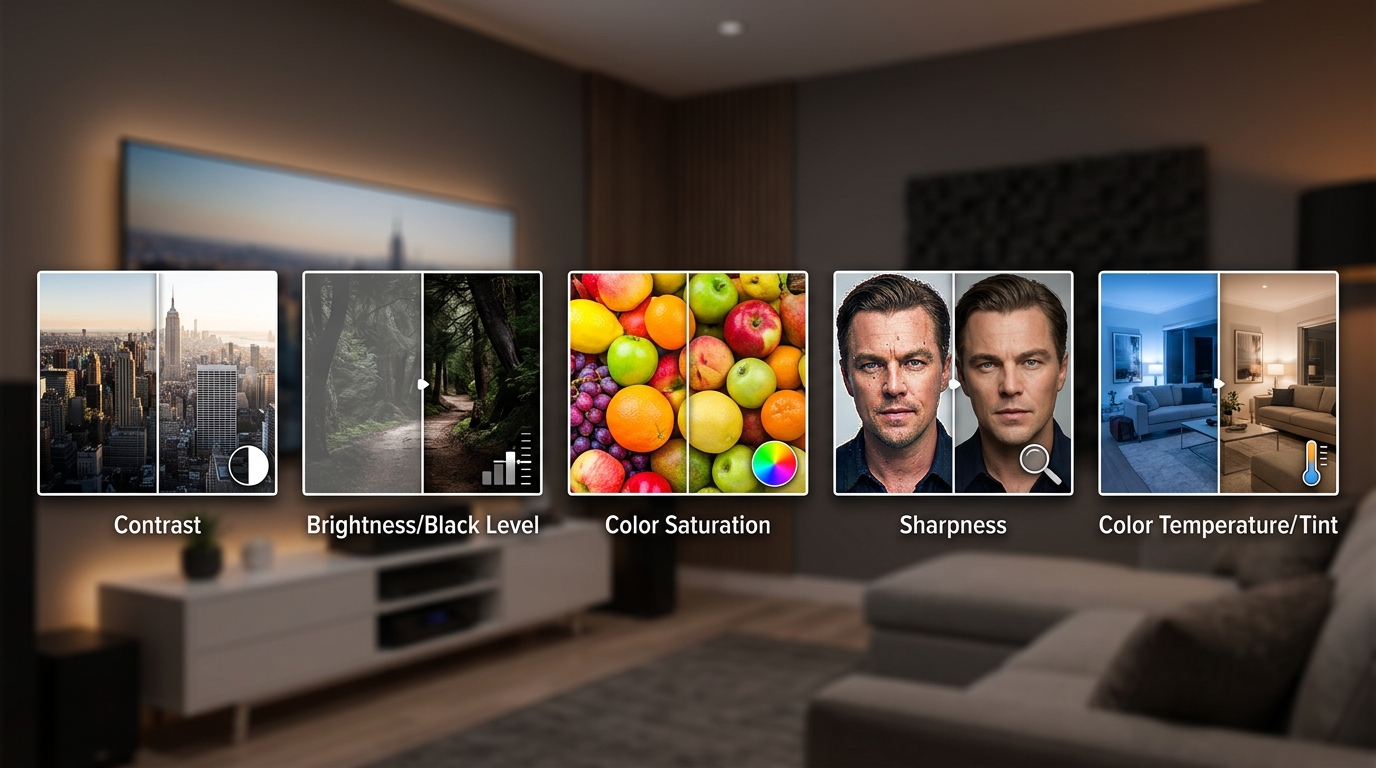
Furthermore, these sets also come with a rather reduced set of user-picture controls in comparison to similar sets from Samsung and LG. However, all basic picture controls - Contrast, Brightness, Color, Tint, and Sharpness - are there.
There are also four picture modes - Vivid, Standard, Cinema, and Custom - that are all user adjustable. In addition, the 'Custom' picture mode enables you to adjust the settings independent per input.
Si Series HDTVs also come with a Game mode, which according to Panasonic should help deliver quicker image response while also producing darker images more clearly. Selecting the game mode will also automatically select that input which has been labeled 'Game' in the input naming menu. However as already expressed elsewhere on our site, unlike other TV makers, the Panasonic game mode is just another picture mode. It does not eliminate any video processing to help minimize delays between the player and the action on the screen.
Apart from the above, there are three color temperature presets - Normal, Warm, and Cool - with the warm setting being the one closest to the D65 standard. There are also five aspect ratio or Format settings for SD and HD content, including a zoom mode that allows the user to adjust both the horizontal and vertical position of the displayed part of the image.
As for advanced features, these include a C.A.T.S. function, or contrast automatic tracking system function that senses ambient light and optimizes the contrast by adjusting the brightness and gradation on the fly to better match the ambient light level. Video and MPEG noise reduction settings come in the form of either on or off while a black level setting can be set to either light or dark - when viewing content carried over the HDMI inputs.
You would not get neither gamma adjustment nor color management support. However, these Panasonic plasma HDTVs include an on/off setting to activate 3D color management function - which use a three-dimensional color matrix to optimize hue, saturation, and brightness, and Panasonic Sub-Pixel control originally featured on 2008 Panasonic Viera HDTVs.
The latter is said to help improve picture clarity by eliminating jagged or blurred diagonal lines through contour correction at the dot level, i.e. by processing the red, green, and blue color sub-pixels separate rather than together, for a clear, more natural-looking image.
As with the rest of 2009 Panasonic plasma HDTVs, the S1 come with 600Hz sub-field drive technology for improved motion resolution supporting up to 1080 lines - which is the full supported motion resolution by the 1080p HD standard. This should help render sharper images when displaying fast action content. We have already discussed this 600Hz sub-field drive in the first part of this series of Panasonic Plasma TV reviews, and therefore we would not repeat the whole discussion here.
However, we have to point out that while this higher sub-field drive really results in improved motion resolution, yet you would not perceive the improved performance with broadcast program content. This is basically the same as with the 240Hz refresh rate in LCDs. We have arrived at a point that the resultant improvement is only detectable through the use of special test pattern. In other words, like the mega contrast ratings, these 'big' numbers are mainly there to help sell the product rather than to help you experience a significant difference in product performance.
Panasonic seems extremely mindful about avoidance of temporary burn-in, or as the company calls it, 'image retention' even though such occurrence with today's plasma display panels under normal viewing is no longer an issue. In the remote instance that such a need arise, you get a full menu that deals with burn-in in a similar manner to what you get with more expensive plasma HDTVs. There's a pixel orbiter that moves the entire image gradually around the screen, along with an option to set the 4:3 mode to include gray instead of black bars on either side of the picture. Gray has less chance of causing image retention. In the remote instance of a retained image, there is also a scrolling bar feature that sweeps a white bar across a black screen to help erase the retained image.
Connectivity is surely quite adequate for these relatively inexpensive 1080p HDTVs, with two component video inputs, two composite video inputs, and three HDMI ver. 1.3 (two on the rear panel and one on the side) complete with Deep Color (x.v.Color) support and HDMI-CEC via Panasonic Viera Link.
The Viera Link feature enables the TV remote to control other compatible HDMI devices with HDMI-CEC support connected to these Panasonic plasma HDTVs.
Unfortunately there is no dedicated VGA-type PC input on the S1 series HDTVs - yet available on the less expensive S14 series Panasonic plasma HDTVs. You can still connect your PC via one of the S1 HDMI inputs - in which case these SI Panasonic plasma HDTVs can perform extremely well. It resolves every single detail of a 1920 x 1080 PC image with extremely clear text and zero overscan when setting the aspect ratio to HD Size 2 under the Full mode option.
In a similar manner, you would not get an analog audio output on these HDTV - something which again is present on the less expensive S14 series of 2009 Panasonic plasma HDTVs - though you would still get a digital audio output.
Instead, you would get an SD memory card slot as standard to view JPG files on your big screen HDTV thanks to Panasonic Viera Image Viewer.
Audio output is 20W total power over the two down-firing speakers; there is no virtual surround sound but these 1080p Panasonic plasma HDTVs will still output surround sound over the set digital audio output connection.
Power saver modes: These Panasonic plasma HDTVs do come with a few eco-friendly features like the eco/power saving option under the Viera link menu. A standby power-save setting will put all connected Viera link compatible devices in eco-standby mode when the TV is powered off. TV auto power off features will turn the TV off in case there is no signal for more than 10 minutes, or in the absence of activity either through the set remote control or set side panel for more than 3 hrs.
Furthermore, S1 Panasonic plasma HDTVs are all Energy Star compliant when engaging the Standard picture mode. But as with most TV makers, the default standard picture mode is too dim for viewing under normal ambient lighting to help ensure that these TVs qualify for Energy Star requirements.
The table below summarizes the main differences between the three entry-level 1080p HDTV Panasonic plasma series for 2009
| 2009 Series | S1 Series | S14 | U1 |
| Design |
Glossy black body with a 'wedge-type pedestal stand; stand does not support swivel action; a silver accent differentiates the S1 and the S14 from the U1 series. |
||
| Power (default) for 50" HDTV sets |
Rated: 584W Average: 269W |
Rated: 584W Average: 221W |
| Panel Type |
G12 1080p HD NeoPDP |
G12 standard 1080p HD panel |
| Native Resolution |
1920 x 1080 pixels |
||
| Contrast Ratio |
2M:1 dynamic 40K:1 static |
2M:1 dynamic 30K:1 stat |
| Shades of Gradation |
6144 levels |
5120 levels |
5120 levels |
| Moving Resolution |
1080 lines |
900 lines |
900 lines |
| Screen Coating |
New Anti-Reflecting Filter |
||
| Connectivity |
Three HDMI 1.3 compliant inputs (1 side), with CEC support via Viera Link and x.v.Color compatible; |
Three HDMI 1.3 compliant inputs with CEC support via Viera Link and x.v.Color compatible; | Three HDMI 1.3 compliant inputs with CEC support via Viera Link and x.v.Color compatible; |
|
2 component video, composite video, S-video, digital audio out |
2 component video, composite video, S-video, digital and analog audio out, PC input, |
2 component video, composite video, S-video, digital audio out | |
|
Not included: USB, PC input, audio analog o/p |
Not included: USB | Not included: USB, PC input, audio analog o/p | |
| SD Memory Card | Yes for playback of JPEG files using Viera Image Viewer | ||
| Other Main Features |
Viera Link Viera Image Viewer 600Hz Sub-field Drive Game Mode |
Viera Link Viera Image Viewer 600Hz Sub-field Drive |
| Anti-Burn In Support | Yes - pixel orbiter | ||
| Picture-in-Picture | No | ||
| Audio | Power: 10W x 2 channels at 10% THD; 2 down-firing speakers | ||
| Surround Sound: Yes | |||
| Virtual Surround: No | |||
| Set Depth | 4.2" | 4.2" | 4.2" |
| MSRP | 42-inch: $1,100 | 42-inch: N/A | 42-inch: $900 |
| 46-inch: $1,300 | 46-inch: $1,100 | ||
| 50-inch: $1,600 | 50-inch: N/A | 50-inch: $1,400 | |
| 54-inch: $2,000 | 54-inch: N/A | ||
| 58-inch - N/A | |||
| 65-inch - N/A | |||
| Best Selling Price at amazon for 50" sets | $1,000 | N/A | $1,200 |
| Models in the series |
42" TC-42PS14 50" TC-50PS14 54" TC-54PS14 |
||
Update - Feb. 5, 2010: According to a thread on the AVS Forum site, some Panasonic plasma TV owners have experienced a sudden unexplained lowering in the black level performance of their Panasonic plasma TVs. Click here for more information.
Like the X1 720p Panasonic plasma HDTV entry-level series we reviewed as part of this 2009 Panasonic product guide, S1 HDTVs are also capable of very deep black levels. These by far exceed those found on most plasmas and significantly more expensive LCDs.
Directly related to a set's ability to display deep black levels is the rendering of shadow detail especially during predominantly dark content. In this respect, S1 HDTVs are also capable of delivering that much desired subtle detail especially during dark scenes.
What is a problem with these Panasonic plasma HDTVs is their color accuracy, with a somewhat inaccurate green and slight red push in the color decoding. This is the same as with the X1 HDTVs.
Due to the lack of user-adjustable picture settings, there is not much one can do here though backing the color slider to reduce saturation helps minimize the red push. Luckily, thanks to the set deep blacks, colors would still look rich and with a lot of pop despite the reduced saturation setting.
Unfortunately, reducing the color control does not help with the green. As Cnet points out in their TC-P42S1 review, the inaccuracy in the primary color of green leads both to an inaccurate secondary color of cyan (which in itself is a mix of green and blue), and to a greenish grayscale. However, Cnet adds that overall grayscale remains consistent - even in dark areas - something in which most HDTVs fail.
Video processing performance is similar to that on Panasonic X1 HDTVs, with the S1 suffering from the same basic issues. In fact, while S1 Panasonic plasma HDTVs can de-interlacing 1080i video-based content correctly, they fail with 1080i film-based material; much of an issue if your HDTV source can be set to output content directly in 1080p. Similarly, these HDTVs do not perform well with standard definition material due to jaggies along the edges of diagonals.
Instead, motion performance is superb - delivering sharp clear images during fast action content such as during sports events and games. Cnet's review of the 42-inch S1 HDTV confirms Panasonic claim that these plasma HDTVs are capable of delivering the full 1080 lines of motion resolution supported by the HD standard.
Glare: As we have stated in our X1 review, Panasonic new AR (anti-reflective) coating can do a good job in minimizing reflections off the screen even under a brightly lit environment. Darker parts of the image on these Panasonic plasma HDTVs however tend to wash out somehow when bright lighting shines direct on the screen.
Power consumption: Definitely, the new NeoPDP Panasonic plasma display is capable of delivering brighter images at significantly lower power consumption. Average power consumption for the 50-inch within this series is in the region of 270W. While still not exactly in line with similar size LCDs, yet Panasonic has surely managed to close the power consumption gap between these two display technologies.
These 1080p Panasonic plasma HDTVs are relatively inexpensive with an online price that hovers between $800 for the 42-inch TC-P42S1 and $1,300 for the bigger 54-inch TC-P54S1. Even the 58-inch and 65-inch are presently selling online at a price that up to not long ago, corresponded to that of 50-inch HDTVs! Definitely, at this price bracket, these Panasonic plasma HDTVs represent an excellent affordable plasma TV option for those HDTV buyers looking for an 1080p HDTV with the best performance to price deal.
Overall... These sets are capable of solid black levels and good shadow detail. The slight color inaccuracy represents the S1 weakest point, but as with the X1, nothing that would spoil an otherwise overall excellent picture. Rather, these greener 'budget-class' 1080p plasma HDTVs from Panasonic just strike the right balance between affordability and performance.
Note: All prices quoted in this 2009 Panasonic Plasma HDTV Guide were correct at the time of this write-up. Prices of HDTVs change continuously; we therefore advise to check the respective amazon links for the latest price updates and online offers.
Prior to any decision, we recommend to do some research of your own. In particular, look at what other customers had to say about these Panasonic plasma HDTV sets following their purchase. This will give you extensive insight about the product of interest.
A good starting point is the customer feedback posted on the amazon site. Just click on the links below to access the respective Panasonic Viera plasma HDTV product page at amazon.com; then follow through the 'Customers Reviews' on the same page:
Panasonic Viera 42-inch TC-P42S1
Panasonic Viera 46-inch TC-P46S1
Panasonic Viera 50-inch TC-P50S1
Panasonic Viera 54-inch TC-P54S1
Panasonic Viera 58-inch TC-P58S1
Panasonic Viera 65-inch TC-P65S1
|
Plasma Televisions |
Featured Reviews and Product Guides
Panasonic Plasma TVs: Are these having a
problem with their black levels? ![]()
Some Panasonic users have reported that the black level performance of their
plasmas have all of a sudden deteriorated. Are Panasonic having a problem with
their much acclaimed deep blacks?
2009 Samsung plasma TV Reviews:
Samsung
Plasma Lineup:
A detailed product guide covering the full 2009 Samsung plasma lineup.
Samsung
Series 6:
Reviewing Samsung most affordable 1080p premium plasma series for 2009.
Samsung
Series 8:
Samsung's best plasma TV for 2009
2009 Panasonic Plasma TV Reviews:
2009 Panasonic Plasma HDTV Line-up - full product guide.
Review: X1 entry-level 720p HDTVs - covering also the X14 and the C1
Review: G10 THX-certified Premium 1080p HDTVs - covering also the G15 series
The Panasonic V10 in detail - Reviewing the best-rated Panasonic plasma TV for 2009
More 2009 Plasma TV Reviews
Cheap Plasma TV Reviews - 2009 Update:
Sub $1,000 name-brand plasma TVs within the 42-inch and 50-inch category.
2009 Best Plasma TVs
- Samsung B860 vs. Panasonic V10:
Which deserves the 'Best Plasma TV' title for 2009?
LG Plasma TVs:
Full 2009 product guide and detailed review of LG high-end PS80 plasma TV
series
|
Home Theater Guides: |
Recommended Technical Guides
The Complete LCD TV Guide:
LCD HDTVs are turning out sharper, bigger, better, and cheaper. Discover all you
need to know about LCD TV sets in this series of articles on LCD televisions.
Plasma Television
Discover all you need to know about plasma TVs - from the features to look for
when purchasing a plasma television, to installing and protecting your plasma TV
investment.
Digital TV
A complete guide to Digital Television - DTV converters, TV antennas, and DTV
transition.
Guide to Digital Satellite TV
Covering satellite TV basics - with a special emphasis on satellite TV decoder
choice and satellite dish installation.
Equipment
Racks:
There is more to equipment racks than a storage space for your system
components. More in this informative home theater guide.
The HDMI Cable Guide
To many, HDMI is still an unfamiliar term. This easy-to follow home theater
guide explains all you need to know about HDMI.
TV Viewing Distance
Buying a big screen TV? Care should be taken as you may easily fall into the
trap of buying a too large TV.
Should You Opt for a 1080p
HDTV?
Discover the strengths and weaknesses of the different HD formats - 720p, 1080i,
and 1080p - in this HDTV Guide.
Home Theater
Design:
A series of articles covering all aspects of a home theater from design to
realization.
|
Featured Panasonic 720p & 1080p Plasma TVs |
Check out for the latest offers on Panasonic Plasma TVs at amazon
Cheapest plasma TV from the 2009 Panasonic Plasma HDTV lineup
Best-selling Panasonic plasma HDTV for 2009
The most affordable 'slim' styled plasma from Panasonic at this screen size.
Rated as the best performing plasma in the post-KURO era
Expensive but extremely stylish - with an inch-thick profile, THX display certification, and wireless HD.
For the full range of
HDTV sets at amazon,
please
click here.
|
Suggested TV Wall Mounts & AV Cabinets |
Wall Mounts and Media Cabinets
|
More Buying Options... |
Search for the best offers on Panasonic Plasma HDTVs with Shopping.com
|
Please Note: Double-underline links appearing on this site represent additional information and special deals related to the page content; this added information is being supplied directly by Kontera. To view this information, please place your cursor over these double-underline links. |
Subscribe
to our free e-zine to remain abreast with the latest additions to our website.
Click here for details.
|
Looking for a Cheap flat-panel HDTV? Would you like to save anything between 50% and 80% on your HDTV purchase? Visit RefurbDepot.com to see their vast range of plasmas, LCDs, and Projection factory-direct refurbished HDTVs |
Would You like to get the best out of your HDTV?
There is no better way to make the most out of your new HDTV then to invest in a set-up DVD.
A great calibration disc is the Avia II Home Theater Set-up DVD, an exceptional AV calibration tool for both the novice and the expert.
Another
interesting calibration disc is the
Digital Video Essentials HD,
but this is more suitable for advanced users.
For more information, please check our Guide to HT Set-Up DVDs.
|
|
... next: 2009 Panasonic Plasma TV Guide - Part 4: G10 and G15 THX HDTVs
|
...back to Plasma TV Reviews ...back to Plasma Section - Main Index |
About
Me
|
About the
Site Content
|
Terms
of Use / Disclaimer
|
Privacy Policy
Contact Form
|
Advertise on this Site
|
Site Search
Information on this website represents the author's opinion and does not constitute professional advice; please read our terms of use and privacy policy before using this site.
Copyright © - Practical-Home-Theater-Guide.com All rights reserved.