![]() |
||||||||||||
![]() |
The PT-AE900U: An Overview Released in September 2005, the PT-AE900U is the latest in a series of budget LCD home theater projectors from Panasonic. Though not quite as impressive as some of the more expensive DLPs costing two to three times more, yet at around $2,000, this relatively inexpensive LCD home theater projector is proving to be a winner within its price range. It makes use of 3 native 16:9 high-definition LCD panels for true HDTV resolution. It has accurate color reproduction though its black-level performance is not exactly on par with the substantially more expensive DarkChip3 DLP home theater projectors. The PT-AE900U continues on the footsteps of its predecessor - the PT-AE700U (reviewed here). It is characterized by the same ease of setup, using the same front exhaust design approach, a long manual 2.0x zoom, and an extensive range of horizontal and vertical lens shifts. Collectively, these features make it easier than ever - even for first time users - to simply mount the projector on a rear shelf and project the image onto the opposite wall. This Panasonic home theater projector comes with a number of additional improvements over the pervious model, changes that are designed to deliver even greater performance. First and foremost, there is the use of the latest D5 LCD panels from Epson instead of the D4 used on the PT-AE700U. These panels have a higher fill factor than the D4 - hence pixels are closer together and the screen door effect - so much synonymous with LCD projectors, is a non-issue even at close viewing distances. Other changes include a boost in contrast ratio to 5500:1, an increase in average lumen output of about 10%, and improvements in the lens shift mechanism for a smoother operation. Changes have also been made to the cooling system to further reduce the fan noise. There is also a new and more sophisticated menu layout, while a learning remote control has been added as a standard feature. It also supports a wide range of connectivity options including HDMI - although the 12V trigger found on the PT-AE700U to facilitate the opening and closing of an electronic screen when you turn the projector on or off, has unfortunately been removed. Panasonic did not include any connecting cables except for the power cord. This may be one of the measures taken by Panasonic to cut costs and compete with cheaper products without compromising product quality. Still, we would like to see at least a few basic cables accompanying AV equipment - this would surely help facility the initial setup especially for first-time users. On the other hand, one has to keep the relatively low selling price in mind here. Taken that, this Panasonic home theater projector is a truly solid performer and a valid affordable big screen option for any home theater. In this review article, we take a detailed look at the PT-AE900U Panasonic Home Theater Projector to see what's on offer for the serious home theater user: The Panasonic PT-AE900U - Specifications Summary List:
Product Features and Performance:
Design: The PT-AE900U Panasonic home theater projector comes with a relatively basic design - a compact and lightweight rectangular shaped chassis with a metallic, dark-silver finish that is wider than it is deep. To the side of the 2X manual zoom, there is a small toggle for the lens vertical and horizontal shift control, while on the other side of the lens - again situated on the front face, are the air output grilles for the front exhaust system. The design of the exhaust grill have been further improved over the previous model to help expel the hot air further away from the light path, thus completely eliminating the possibility that the hot exhaust will interfere with the projected image. The included remote control is well designed. It is a universal-learning model with fully illuminated buttons. It can memorize the buttons of up to eight home theater components - irrespective of brand - so you can control your entire home theater with a single remote. Controls on the remote include - among others - input selection, adjustment to the input signal, aspect, color management, picture mode and vertical keystone distortions. Manual Zoom and Focus: This Panasonic home theater projector is one of the few video projectors that come with a full 2x optical zoom range. It supports a wide range of throw distances - 4 to 40 feet, and can project a 100-inch picture from as close as 10 feet and as far back as 20 feet. This means that no matter what is your room size, and what size of screen you want, this long zoom lens substantially improves the chances that the PT-AE900U can be installed on a shelf or in a bookcase on the rear wall, and still gives you the image size you want on the opposite wall. Horizontal and Vertical Lens Shift: The lens shift feature on this Panasonic home theater projector provides added flexibility that further simplifies the set-up process when the projector support is not quite square on to your screen. It gives you the possibility to move the image on the screen without moving the projector by moving the lens assembly inside the projector housing. Horizontally, the image can be moved by up to a maximum of 24 percent of the width of the screen on either side of the center line; vertically, the image can be displaced by up to 64 percent of the height of the screen above or below the center line. As indicated earlier on, the shift is accomplished through a small joystick on the front side of the projector.
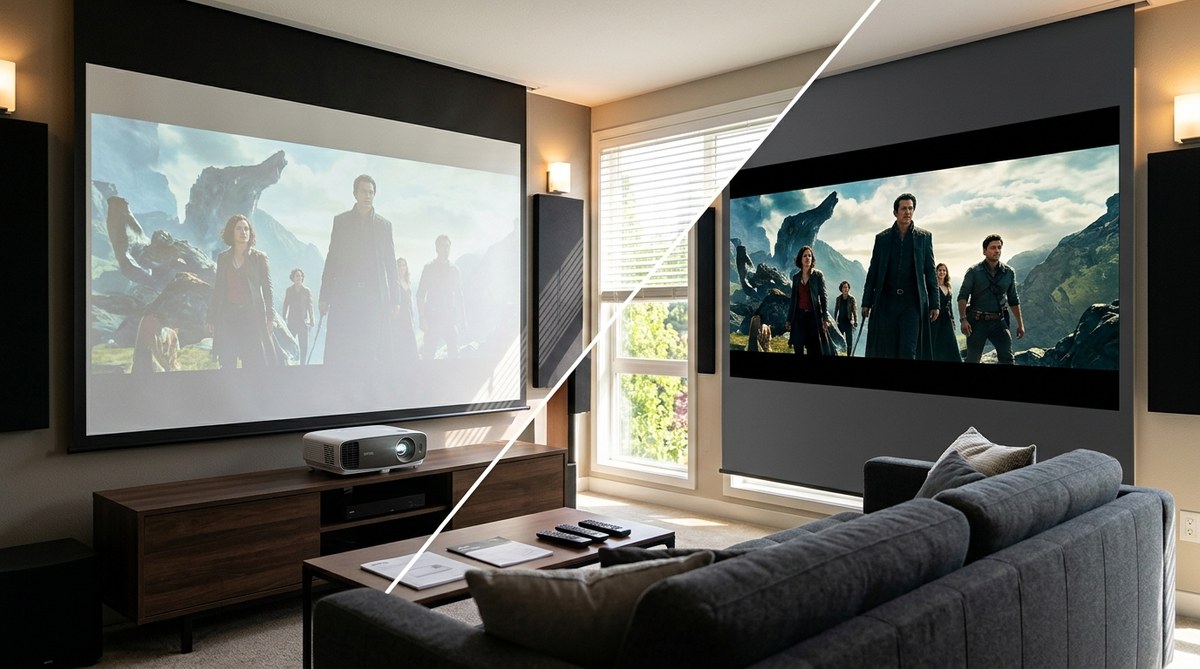
The PT-AE900U also supports Digital Keystone Correction of up to ±30° (vertically) of the angle of tilt. Keystone Correction is a useful feature that comes into play when you have to tilt the projector to position the image onto the projection screen. However, this feature is more of use on business video projectors rather than in home theater applications. Though handy, digital keystoning results in loss of resolution and detail and should be avoided at all cost if you want the best picture. Use the lens shift instead - no distortion will result in this case since it is the lens assembly itself that is moved inside the projector housing to adjust the image position. Alternatively, relocate the projector. Brightness and Contrast: This Panasonic home theater projector is rated at a maximum of 1100 ANSI lumens and 5500:1 contrast ratio. The 5500:1 contrast ratio represents an impressive boost over the PT-AE700U. This is partly the result of the new D-5 LCD panels as well as improved dynamic lamp iris and gamma control; these are reconfigured on a frame by frame basis depending on the light level of the material being displayed. Remember however that the 5500:1 is the theoretical full on/off measurement. In a real life setup, the achieved contrast ratio will be much lower. Further more, while a higher contrast ratio implies whiter whites and darker blacks, yet the eye cannot perceive such a high contrast values. (Check our contrast ratio article for more information). More important is gray-scaling performance; this that determines the projector's ability to display subtle detail in all bright or all dark scenes. The PT-AE900U Panasonic home theater projector is capable of doing a very good job here - though admittedly, it is not exactly on par with the substantially more expensive DarkChip3 DLP projectors. Note also that the 1100 ANSI lumens rating is again, the theoretical maximum; in an actual setup, brightness would be substantially lower (typically 50%) than the stated manufacturer ratings. In practical terms, this means that this Panasonic home theater projector is capable of projecting bright images up to 150" diagonal in a darken room. You can always try and push the image up to 200-inch diagonal but image brightness and contrast will suffer - especially if the room is not completely dark. For best results, limit the image size to no more than 120-inch diagonal. At smaller image sizes 65 to 90 inch diagonal, this LCD Panasonic home theater projector will deliver beautiful, brilliant projections that can be viewed even under low indirect ambient light; these smaller size projections can easily serve as a possible replacement to more expensive medium size plasma TVs.
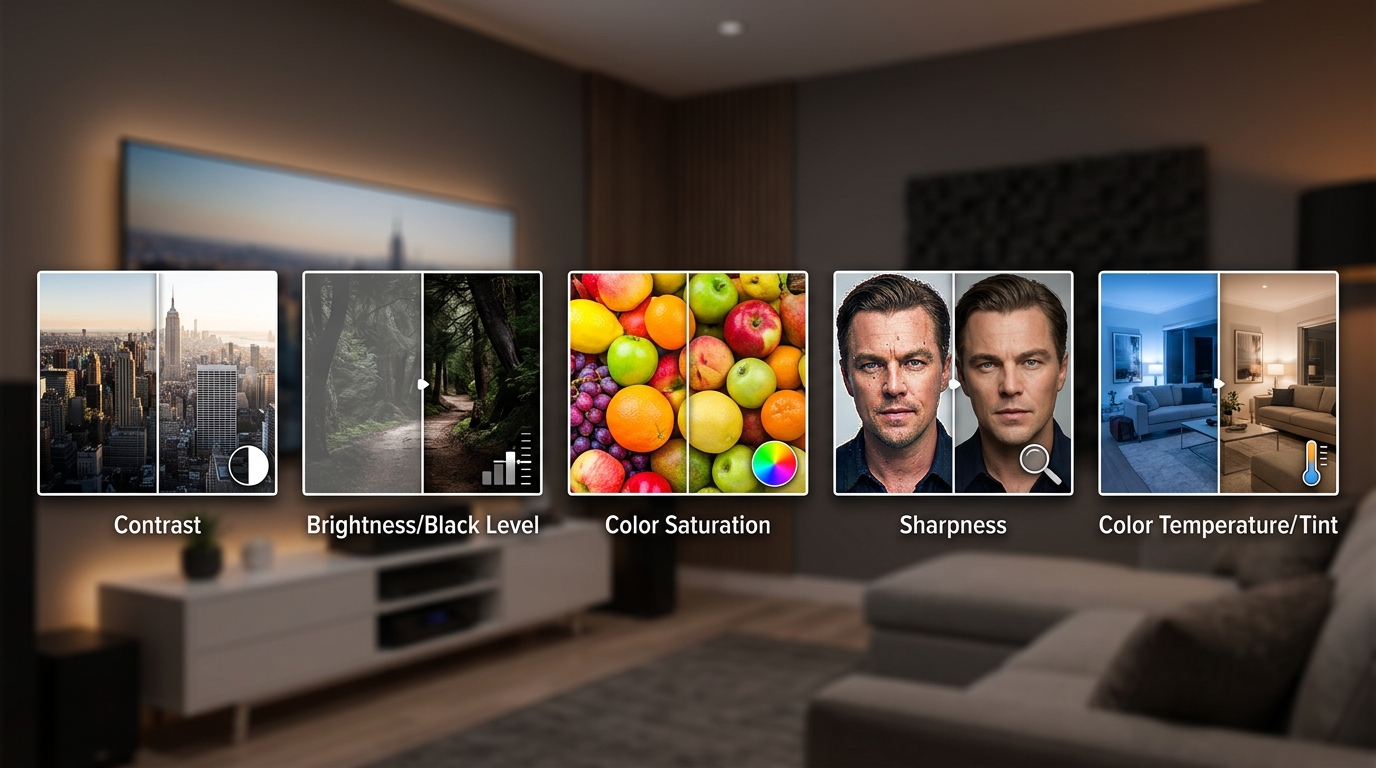
Dynamic Iris and Dynamic Gamma Control: These Panasonic proprietary features are mainly responsible for the significant boost in contrast ratio from earlier LCD projectors. This dynamic picture control incorporates AI technology to constantly adjust its light volume - including the lamp power, and gamma curve - in real time on a frame by frame basis, as determined by the material being displayed to make dark scenes deeper and bright scenes brighter. The combination of these features works remarkably well, rendering amazingly smooth and natural transitions between scenes, and subtle detail even in monochromatic scenes. Color Management: The PT-AE900U Panasonic home theater projector Cinema Color Management (CCM) is designed to deliver as much as possible, the same on-screen color quality one enjoys at the movie theater. It is an extremely powerful system that allows the user to select practically any point on the screen to change the color, tint, and brightness of the selected area without affecting the rest of the image. CCM technology also lets users choose from among seven preset picture modes: Dynamic, Normal (the factory preset), Cinema I, Cinema II, Cinema III, Video, and Natural - in which the contrast, brightness and gamma levels are user adjustable; this makes it easier to select the optimal settings for different source material. The PT-AE900U also includes 12 preprogrammed user-selectable color temperature settings - may be a bit to much in terms of choice! The interesting issue here is that this Panasonic home theater projector has continued on the PT-AE700U footsteps in having also a number of warm settings as well. Smooth Screen Technology: This is a Panasonic proprietary feature originally introduced on the PT-AE700U, designed to render more natural looking images by reducing the visible pixelation and the screen door effect. These two problems have been partly regarded as weaknesses in LCD technology. On the PT-AE700U, the screen door effect was eliminated entirely from any normal viewing distance; on the PT-AE900U, the screen door simply isn't there any more - even at close viewing distances. Partly, this improvement is the brought about by the new D-5 LCD panels used on this Panasonic home theater projector. The end result is more than just impressive. De-interlacing: De-interlacing of standard definition component video is very good, and 3:2 pulldown compensation is excellent. However, the ultimate strength of the PT-AE900U Panasonic home theater projector manifests itself with HDTV. Feed the unit a 720p signal via either antenna, or satellite/cable box, and this Panasonic home theater projector will produce a brilliant, crystal clear image that few projectors anywhere in its price class can achieve. Connectivity: This Panasonic home theater projector comes with a standard array of terminals that are well spaced out and much easier to connect to than most other projectors. Connections include an HDMI port, a VGA 15-pin PC input, an analog RGB video, and a separate component video input (3-RCA) for HDTV and component video. It also has an S-video and a composite video input for use with VCRs, laser disc players, and any sources for which component outputs are not available. Comments and Analysis There is no doubt that the PT-AE900U Panasonic home theater projector delivers improved performance over the previous model when it comes to black level performance, contrast, color reproduction, and pixellation. The previous model was, and still is a solid performer, yet the overall improvements brought about by Panasonic in LCD projection technology with the release of the PT-AE900U are to say the least, impressive. In particular, Panasonic proprietary 10-bit digital processing, gamma correction, and dynamic iris control, accurately reproduce subtle changes in brightness and hue. Panasonic Cinema Color Management system is another powerful yet amazingly easy-to-use tool for the user who places a premium on color accuracy. In fact, calibrating this Panasonic home theater projector turned out to be relatively easy. Couple all this with Panasonic proprietary image processing technology, and the end result is that this Panasonic home theater projector is capable of rendering more faithful color reproduction with more realistic cinema-like images. The only negative comment we have here is that color decoding seems to push red slightly - other than this, color reproduction is highly accurate. But then this is where the provided gamma controls come into play - just take your time to tweak performance for improved results. After calibration, the Panasonic PT-AE900U under review exhibited impressive color reproduction. We also see a slightly softer image on the PT-AE900U Panasonic home theater projector than on the previous model; this becomes evident mainly on a side-by-side comparison with the PT-AE700U. Standing on its own, this subtle softness is hardly noticeable. Still, we would have wished the image was a little bit sharper. More to the Point: With the PT-AE900U, Panasonic is now challenging the more expensive single-chip DLP projectors head to head - not just on price, but even more so in terms of performance. This new Panasonic home theater projector is as good as most of the DLP projectors of the same 720p resolution. The PT-AE900U excels in color accuracy, color saturation, and a smooth, film-like image that is totally lacking in pixelation. Certainly, the more expensive DLP video projectors still hold their own in contrast and black-level performance, but the overall difference between LCD and DLP, is no longer what it used to be. And for a high performance high definition home theater projector that is selling online at under $2,000, there are surely a lot of reasons for consumers to consider this Panasonic home theater projector as a possible relatively inexpensive big screen option for their home theater. Our Best Advice The Reality: This Panasonic PT-AE900U is one of the most affordable high-definition home theater projectors presently available from one of the leaders in the field. Like its predecessor, this new Panasonic home theater projector is designed to make it easier than ever - even for first time home theater users, to set it up and get the very best results in no time at all - simply set it up on a rear shelf and project the image onto a screen on the opposite side. Our suggestion at this point is to take a look at what other customers had to say about the PT-AE900U Panasonic home theater projector following their purchase. All you have to do is to click on the following link to access the respective product page at amazon.com; then follow through the 'Customers Reviews' section on the same product page:
Interesting in buying online? Click on the following link for immediate unbiased price comparison and product availability information from all major online stores; this information is being provided in collaboration with PriceSCAN.
|
Copyright © - Practical-Home-Theater-Guide.com All rights reserved. |
||||||||||