![]() |
|||||||||||
![]() |
Released during last quarter of 2004, the Panasonic PT-AE700U high definition home cinema projector still represents one of the best ever built LCD home theater projectors within its price range. When originally released over a year ago, this LCD projector represented a breakthrough in price/performance terms - incorporating a whole set of improvements that led to a level of performance only achievable by units costing two to three times more. This Panasonic projector is turning out to be a top-seller and a real favorite among home theater enthusiasts. This comes to no surprise - though at around $1,600 it is not one of the cheapest available online, yet it is surely one of the most affordable high definition widescreen video projectors presently available on the market. In this review article, we take a detailed look at the PT-AE700U Panasonic Home Theater Projector to see what's on offer for the serious home theater user: The Panasonic PT-AE700U - Specifications Overview:
Product Features and Performance:
General: This Panasonic home theater projector is relatively compact and light - meaning that it can be easily moved around. Unfortunately there is no accompanying carrying case, while HDMI cables are also extra. The included wireless remote is quite small and comes with fully illuminated buttons. Controls on the remote include - among others - adjustment to the input signal, aspect, color management, picture mode and vertical keystone distortions. Design: The PT-AE700U Panasonic home theater projector doesn't really stand out when it comes to style; its only design motive is the silver colored vertical air output grilles on the left side of the lens on the front face. However, its relatively clean silver look would surely appeal to those who like this type of simple no-fancy approach. Front Exhaust Grilles: As already indicated, this projector utilizes a front exhaust system for cooling purpose. The exhaust grill is uniquely designed and one of the best ever implemented for the cooling of a projector intended for rear shelf-mounted use. It is designed to expel air at an angle of 45-degreee from the corner of the unit and away from the light path, thus eliminating the possibility that the hot exhaust will interfere with the projected image. The front facing fan-outlet means that the projector can be placed on a narrower support taking even less space when in use than those with side vents. It also simplifies the mounting of the projector on a rear-shelf as it would help expel the hot air in front of the unit rather than around the unit, which would otherwise be the case with side and rear vents when the projector is mounted in an enclosed bookcase. Ease of Set-up: It is clear that this Panasonic home theater projector is designed to make it as easy as possible for first-time users to set it up - simply place it in a bookcase on a rear wall and project the image onto a screen on the opposite wall. This ease of installation is brought about not only by the front exhaust design, but also by a long optical zoom and an extend lens shift range. It is one of the few projectors that come with a full 2x optical zoom range. It supports a wide range of throw distances - 4 to 40 feet. It can project a 100-inch picture from as close as 10 feet and as far back as 20 feet. Further more, the vertical and horizontal lens shift control on this Panasonic home theater projector provides added flexibility that further simplifies the set-up process when the projector support is not quite square on to your screen. It gives you the possibility to move the image - horizontally up to a maximum of 25 percent of the width of the screen and vertically up to 63 percent of the height of the screen - through a small joystick on the front side of the projector without moving the projector.
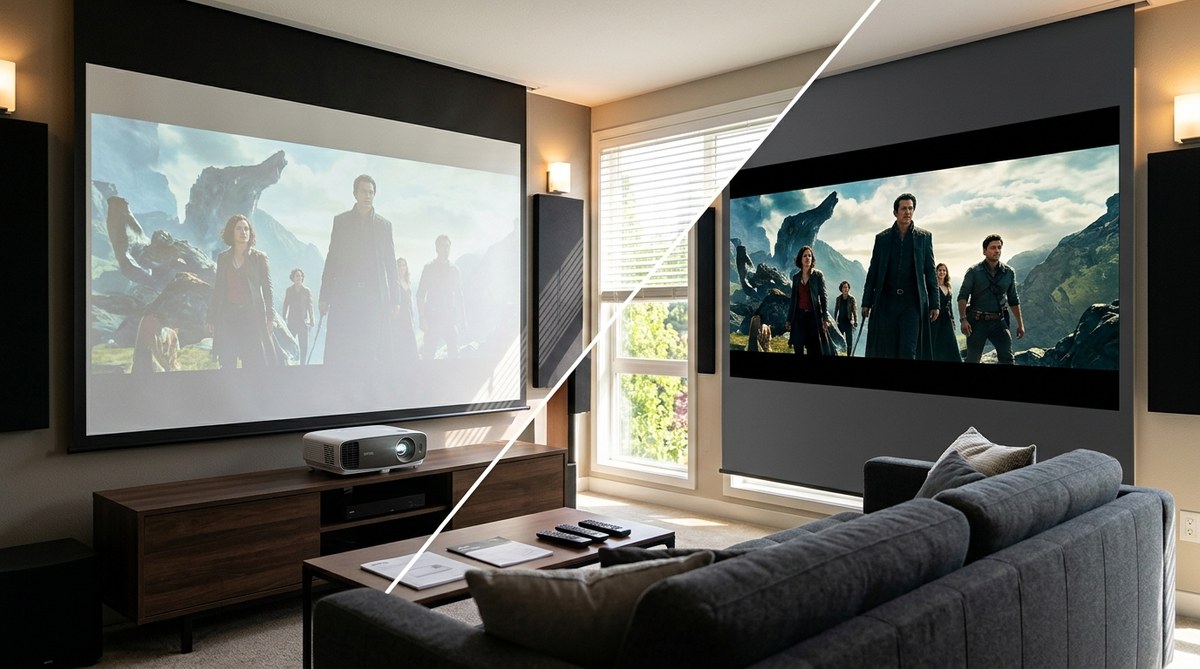
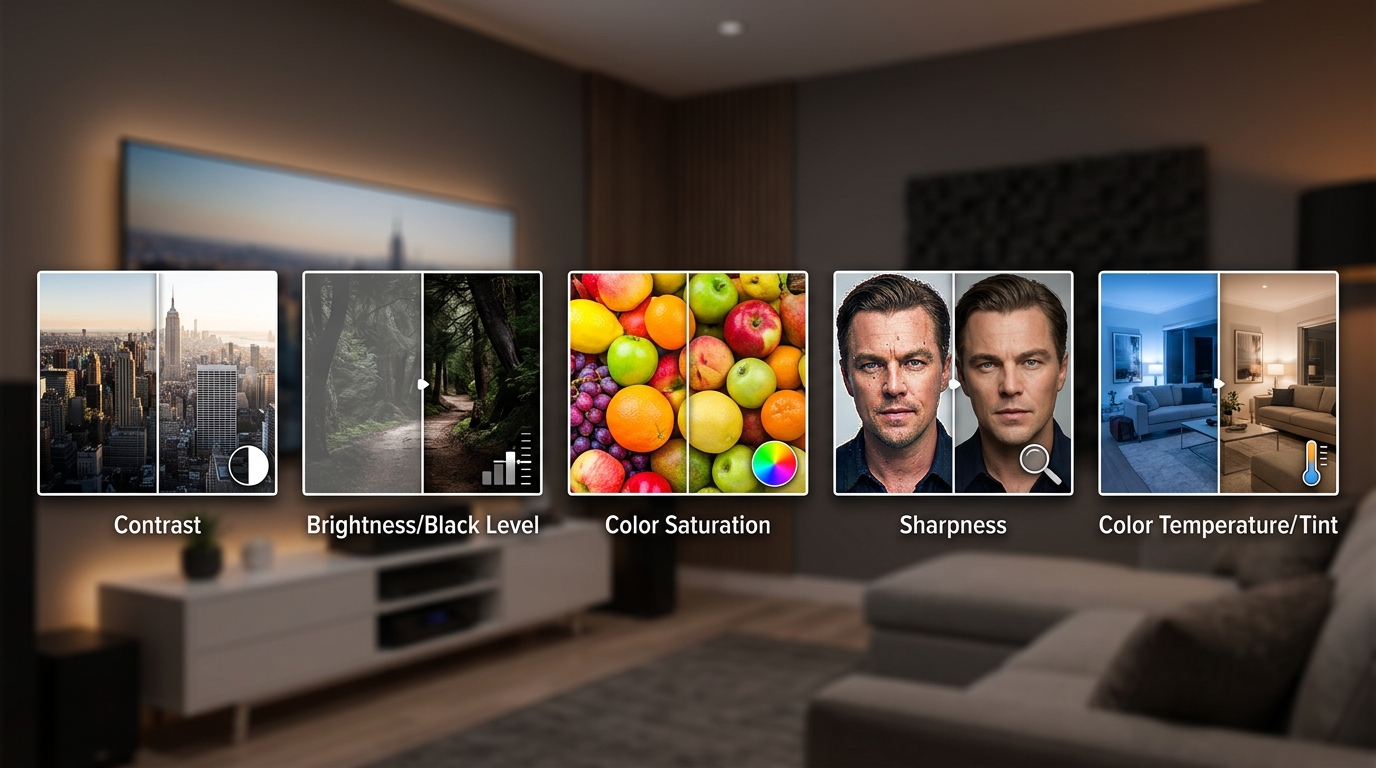
The PT-AE700U also supports digital keystone correction of up to ±30° (vertically) of the angle of tilt. Keystone Correction is a useful feature that comes into play when you have to tilt the projector to position the image onto the projection screen. Unfortunately, digital keystoning - though handy, results in loss of resolution and detail and should be avoided. Use the lens shift instead - no distortion will result in this case since it is the lens assembly itself that is moved inside the projector housing to adjust the image position; alternatively, relocate the projector. Brightness and Contrast: This Panasonic home theater projector is rated at a maximum of 1000 ANSI lumens and 2000:1 contrast ratio. It is capable of projecting bright images up to 150" diagonal in a darken room. You can also try and push the image up to 200-inch diagonal but image brightness and contrast will suffer - especially if the room is not completely dark. For best results, limit the image size to no more than 120-inch diagonal. Further more, for a more pleasing film-like viewing, limit your viewing distance to no closer than 1.8 the screen width provided your image source is a HDTV - otherwise you will have to increase the viewing distance. Though this Panasonic home theater projector do not exhibit any screen door effect, yet at very close viewing distances, any image processing artifacts and the digital image build-up structure, will become more visible and distracting especially at big projections. For more information, check our TV Viewing Distance Guide. For those who have a smaller room or prefer a smaller screen size, a 70 to 90 inch diagonal image might be right. At these image sizes, this LCD Panasonic home theater projector will deliver beautiful, brilliant saturated projections that can be viewed even under low indirect ambient light; these smaller size projections can easily serve as a possible replacement to a more expensive medium size plasma TV. Dynamic Iris and Dynamic Gamma Control: These Panasonic proprietary features are mainly responsible for the significant boost in contrast ratio from earlier LCD projectors. This dynamic picture control incorporates AI technology to constantly adjust its light volume and gamma curve in real time - on a frame by frame basis as determined by the material being displayed. The combination of these features works remarkably well, with an overall improvement in contrast performance and with blacks that are deep and bright, even in dark monochromatic scenes. Color Management: The PT-AE700U Panasonic home theater projector includes an innovative color correction system that aims to deliver the same on-screen color quality one enjoys at the movie theater. In addition to basic controls that include brightness and contrast for red, green, and blue, this Panasonic home theater projector color management system lets you individually adjust the saturation, hue, and brightness of up to eight selected colors and save them in one of three user defined settings. Note however that you can only adjust the color; it is not possible to use the color management system to adjust black, gray, or white. Playing around with these settings may improve as much as distort the end result. The good thing is that experimenting with this Panasonic projector would not do any harm - you may always resort to the default settings. The PT-AE700U also includes five preprogrammed user-selectable color temperature settings. The innovation here is the introduction of two warm settings that are best suited for classical black and white film. These settings are not normally found on video projectors. Smooth Screen Technology: Another Panasonic proprietary feature designed to render more natural looking images by reducing the visible pixelation and the screen door effect (visible spacing between pixels); these two problems have so far been partly regarded as weaknesses in LCD technology. Thanks to this new feature, this Panasonic home theater projector can deliver high-definition pictures that are remarkably smooth, while pixelation has been suppressed to the point that it is not visible except from very close viewing distances. Aspect Ratio Management: Since this is a native 16:9 format widescreen projector - it can display correctly a 16:9 signal from HDTV or DVD - without any distortion. At the same time, the PT-AE700U Panasonic home theater projector allows you to change the aspect ratio to match the type of input signal. Options include: 4:3, 16:9, 14:9, Just (this stretches a 4:3 image to fit a widescreen display without distorting the centre of the image), three zoom options, and VScroll (PC images projected without expansion or reduction). Toggling between these different settings is a simple push of a button on the remote. When set to 'Auto', the projector switches the aspect ratio automatically if the input signal has a detector signal. De-interlacing: De-interlacing of standard definition component video is very good, and 3:2 pulldown compensation is excellent. However, the ultimate strength of the PT-AE700U manifests itself with HDTV. Feed the unit a 720p signal via either antenna, or satellite/cable box, and this Panasonic home theater projector will produce a brilliant, crystal clear image that few projectors anywhere in its price class can achieve. Lamp Life: Panasonic says the intended lamp replacement interval is 3,000 hours in high light output mode. In low power 'eco-mode', (image brightness is reduced by about 20%), lamp life is substantially longer - no specified lamp life here but the eco-mode helps to drive down the cost per viewing hour. Fan Noise: One would expect that with a front exhaust design, the projector would be a bit noisy in comparison to rear or side vented systems ' This is not the case. The fan noise on this Panasonic home theater projector is very low, even when operated in high power lamp mode; in eco mode, noise is just 26dB. Connectivity: The PT-AE700U comes with a standard array of terminals; these include an HDMI port, a VGA 15-pin PC input, an analog RGB video, and a separate component video input (3-RCA) for HDTV and component video. It also has an S-video and a composite video input for use with VCRs, video game boxes, laser disc players, and any sources for which component outputs are not available. A screen trigger terminal is also available to facilitate the opening and closing of an electronic screen when you turn the projector on or off. Projection Screen compatibility: Any white or high-contrast gray screen will do; however, the choice of screen surface has more to do with the room than the projector. In the dedicated home theater room with dark walls, carpets, ceilings, etc., the best choice is a white screen. In a room where you do not have total control over the ambient light and room outfit, a high contrast gray screen will be the better choice since it will absorb reflected light and give you better black level performance. For more information on projection surfaces and available screens, please check our Projector Screen section. Comments and Analysis There isn't much to complain about - this is surely one of the best video projectors we have ever come across at under $1,600. OK, the PT-AE700U is not the latest in the line of Panasonic home theater projectors; in September 2005, Panasonic released the PT-AE900U Home Projector. Yet the PT-AE900U is more or less, an improvement over what has already been achieved by the PT-AE700U. It is the PT-AE700U Panasonic home theater projector that has really brought about a significant jump in price/performance terms. Panasonic's achievements with LCD technology - both in improved contrast, improved black level performance, and reduced pixelation, are truly impressive. In particular, Panasonic proprietary digital processing gamma correction and dynamic iris control accurately reproduce subtle changes in brightness and hue. Couple all this with Panasonic proprietary image processing technology and the overall result is that the PT-AE700U is capable of rendering faithful color reproduction with more realistic cinema-like images. A word of caution: The PT-AE700U has go its limitations as well - limitations that arise as a result of the video projection technology in use. LCD panels cannot produce contrast ratios anywhere near that high as DLP, at brightness levels supported by this Panasonic projector, nor is it possible for LCD to match the same black level performance achievable with the latest DLP technology. But there again, Panasonic innovative use of AI technology and the implementation of a variable Iris, which adjusts the image on a frame by frame basis, meant a significant improvement towards minimizing these technological differences. The end result is that this Panasonic home theater projector is capable of producing very good 'black levels' and impressive dark scenes.
Vertical banding: This is another technology-related issue. One or two review sites complained that the PT-AE700U exhibited subtle vertical banding. This was not the case with the Panasonic home theater projector on review here. Vertical banding consists of subtle vertical bands, evenly spaced across the entire picture that may appear on some LCD projectors; DLP systems don't have this problem. It is not an automatic byproduct of the technology, but a flaw in the manufacturing process of the LCD panels themselves. Normally, panels that have the most visible problems do not pass through QC; however those with a slight hint may make it through. This is similar to the issue of death pixels. Manufacturers would not discard all parts that exhibit flaws which may have no practical impact on picture quality otherwise the production process would become prohibitively expensive. This means that vertical banding can occur on any LCD projector. The good news is that we are seeing less of it these days than we did before. But the risk of vertical banding on LCD projectors is always there in as much as rainbows may occur on any DLP projector. In these circumstances, the best way to manage your risk is to buy from a dealer with a good return policy. The bottom line: The PT-AE700U is a strong product release by Panasonic that continues the company's line of affordable, high performance video projectors. For its impressive image quality, ease of set-up and high definition widescreen capabilities, the PT-AE700U Panasonic home theater projector is definitely a viable alternative to DLP projectors costing twice as much. What's more, cheaper alternatives lack either the physical resolution, or the contrast, clarity, and image sparkle that this Panasonic home theater projector can deliver. Our Best Advice No doubt, this Panasonic home theater projector is one of the best in its class. However, prior to any decision, we suggest you take a look at what other customers had to say about the PT-AE700U. All you have to do is to click on the following link to access the respective product page at amazon.com; then follow through the 'Customers Reviews' section on the same product page:
Interesting in buying online? Click on the following link for immediate unbiased price comparison and product availability information from all major online stores; this information is being provided in collaboration with PriceSCAN.
Finally, we suggest investing in some good setup DVD to make the most out of
your Panasonic home theater projector purchase. A
must have is the
AVIA (Audio Visual Interactive Aid) Home Theater Setup DVD ...or check our Guide to Home Theater Set-Up DVDs for more information of Set-Up Discs and possible alternatives that may be more suitable for your needs.
|
Copyright © - Practical-Home-Theater-Guide.com All rights reserved. |
|||||||||