site logo    

Home
E-zine Subscription
CRT TVs
LCD TV Guide
LCD TV Reviews
Plasma TV Guide
Plasma TV Reviews
Projection TV
DIY Projection TV
RPTV Reviews
Projector Reviews
Projection Screens
Digital TV Guide
Satellite Television
Surround Sound
HT Cables
HDCP
Set-Up DVDs
Home Theater Design
HT Pictures Gallery
Equipment Racks
MoviePoster Guide
The Poster Store
Headphone Guide
Wireless Speakers
Media Players
Books & Magazines
Catalogs
Power Protection
Home Theater Sites
Useful Links
Refurbished Products
Price Search
HT Online Store
Advertise on this Site
About Me
Contact Form
Privacy Policy
Site Search
Site BLOG

XML RSS
What is this?
Add to My Yahoo!
Add to My MSN
Add to Google


More Mitsubishi rear projection TV reviews will follow soon.


Subscribe to our free monthly e-zine to remain abreast with the latest additions to our website. 

Click here for details.


side navbar picture

Mitsubishi Rear Projection TV Line-Up - Product Guide
733/734 Series 1080p DLP Mitsubishi HDTV Sets - Part 2


In this second part of our Mitsubishi rear projection TV product guide, we continue by taking a detailed look at the enhanced feature set on the midlevel WD-734 Mitsubishi HDTV series.

We conclude this discussion with a performance analysis of the 733 and 734 1080p DLPs, and then wrap up with our concluding remarks.


Mitsubishi WD-73734 73-inch 1080p DLP

Mitsubishi WD-73734 73" 1080p DLP HDTV

Mitsubishi WD-734 DLP Series

The 734 series of Mitsubishi rear projection TV sets represents an upgrade over the 733 entry-line.

It is also the most popular among the present Mitsubishi DLPs line-ups, with the 73-inch WD-73734 being among the best-sellers in rear projection HDTVs.

Models:

57-inch WD-57734 ($1450 - $2000)

65-inch WD-65734 ($1620 - $2200)

73-inch WD-73734 ($2500 - $3400)

Among the most interesting additional features found on 734 series of Mitsubishi rear projection TVs, there are two Mitsubishi exclusives - PerfecTint and NetCommand.

PerfecTint is designed to provide additional customization of the display setting, while NetCommand gives the user full control of connected A/V gear through the TV remote in a similar manner to a universal remote.

However, there is no doubt that the most important upgrade with the WD-734 is the presence of a fourth HDMI port - installed on the front panel.


Details of the actual differences between the WD-734 and the entry-level 733 series of Mitsubishi rear projection TV sets, are given below:


Design: The WD-734 series shares the same minimalistic look-and-feel of the WD-733 series, except for the presence of a brushed black metallic accent.

Other than this, sets of the same screen size under both series of Mitsubishi rear projection TVs come with the same overall dimensions, weight, and even power consumption ratings.

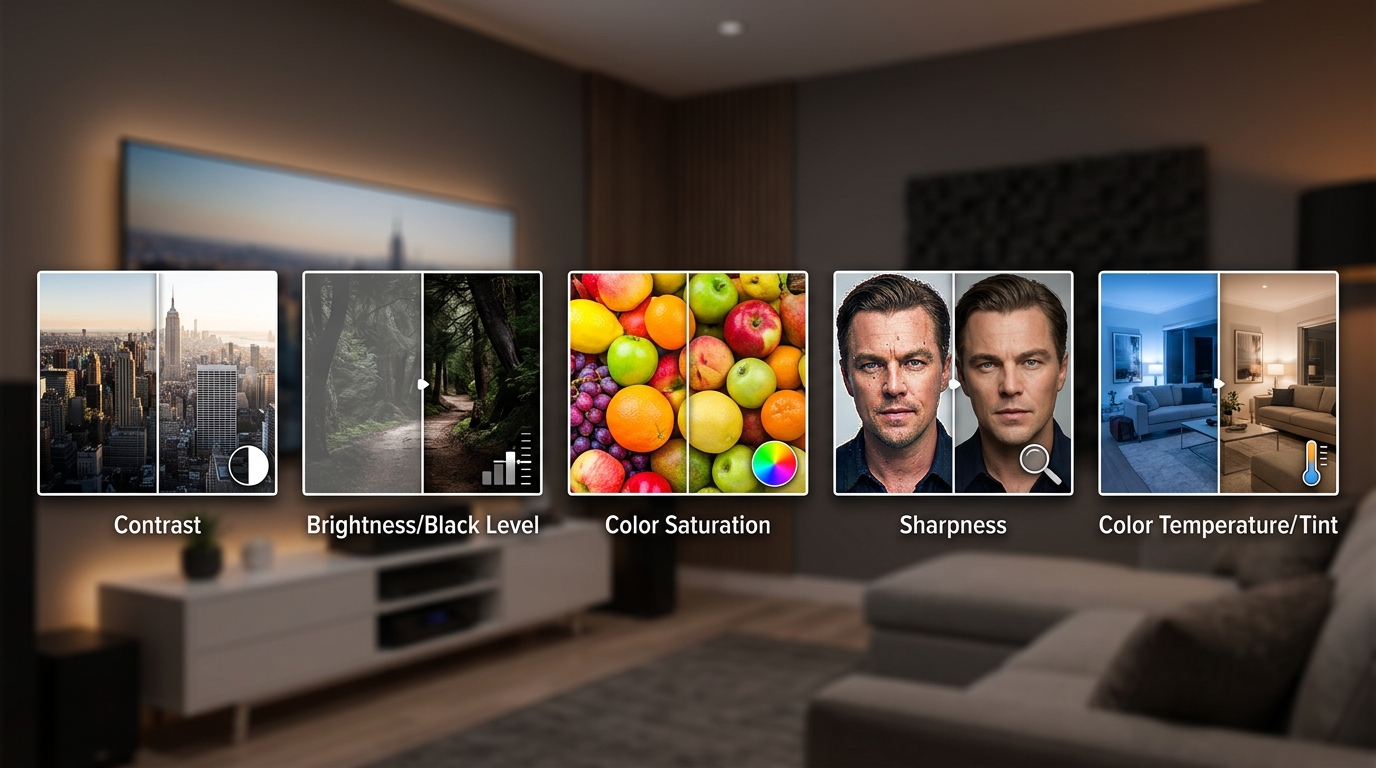
WD-734 Enhanced Video Feature Set: The main enhancements over the basic specifications set of the 733 series include a set of picture enhancement features that are designed to enable the user further fine-tuning of the picture settings.

PerfecTint™ is an exclusive Mitsubishi feature that provides the user with the ability to adjust the tint of the six basic colors in the set light-engine, independently of each other and separately for every input. Combine this feature with PerfectColor™ referred to under the 733 series - and there you have full control over the image color.

DeepField™ Imager is designed to adjusts brightness and contrast on-the-fly for optimum settings in all areas of the picture. It analyses the different sections of the image in real time to determine the optimum levels for contrast and brightness, thus improving picture detail in an all dark or all bright content.

SharpEdge™ enhances horizontal and vertical edges for a crisper, sharper image.

Features like PerfecTint and PerfectColor as found on these Mitsubishi rear projection TVs would surely serve a purpose in the hands of knowledgeable individuals to tweak the picture settings for best performance.

Yet features that adjust the picture basic parameters like brightness, contrast and sharpness on-the-fly according to the image content, may lead to unnatural result. This to a certain extent depends both on image source quality and personal preference. At the same time, we feel that picture features like the Mitsubishi DeepField Imager and SharpEdge are best left off for a more natural looking image.

Conveniences: The main difference here is the presence of another Mitsubishi exclusive feature, termed NetCommand®. This is an onscreen home theater control system with a simple icon-based control interface. It enables the TV to control other AV devices. This is done using either an included two-unit IR emitter that you connect to the respective input on the Mitsubishi rear projection TV back panel, or via the HDMI link using the Consumer Electronics Control (CEC) channel on the HDMI interface.

CEC is an HDMI functionality rather than an exclusive Mitsubishi feature. CEC support allows the user to control multiple CEC-enabled gear with one remote control; CEC also allows CEC-enabled boxes to control each other, without user intervention. CEC support is available on all Mitsubishi HDTVs - including the 733 series.

The NetCommand with Infra-red link has a library of codes to control other devices. It can also learn the IR codes from any IR-based analog component. This ‘learning feature’ allows the TV system to learn the IR codes of other remotes through a rather straightforward process. Thus, it is possible to control say a Satellite STB and an AV receiver in a seamless manner via the TV remote and the Mitsubishi rear projection TV onscreen interface. Be prepared however to experience a slight but noticeable delay between each button-press on the TV remote, and the response of the additional gear you are controlling. This is typical with systems using this type of set-up to replicate IR messages via a blaster to control additional gear.

Though this delay can be annoying at times - such as when shifting between TV channels on a cable or satellite STB, yet this set-up gives you the possibility to hide your gear out of sight while still being able to control it.

Connectivity: As already mentioned, the already excellent array of connectivity options on the 733 is further enhanced on the 734 series of Mitsubishi rear projection TVs by the presence of a fourth HDMI port. This is placed on the set front panel for even greater versatility.

While features like NetCommand and PerfecTint are nice to have, yet in our opinion, it is this fourth HDMI port on the Mitsubishi front panel that represents the extra feature on the WD-734 series that is of real value.


Most of today 1080p HDTVs are capable of doing a very good job in delivering a great picture irrespective of their brand. It is therefore no surprise that many of us would first go for the brand of their choice when opting for a new rear projection HDTV set.

But irrespective of how much you are tide up to your brand, it is always important to look at what professional reviewers are saying about your soon-to-be purchase. Equally important, check what customers are saying about the product of interest. After all, not all 1080p HDTVs are capable of delivering the same level of picture performance. In other words, not all 1080p HDTVs are created equal.


Performance Issues - WD-733 and WD-734 Series

Apart from the enhancements found on the 734 series described above, there are no other differences between the 734 and the 733 series of Mitsubishi 1080p DLP HDTVs; this applies also to the sets power requirement, dimensions, and weight.

Even more important, all 734 Mitsubishi HDTV sets share the same 6-color light engine with all the video features found on the entry-level range. We therefore expect 733 and 734 Mitsubishi rear projection TVs to perform very much the same - except for the presence of the PerfecTint feature on the WD-734 series, which may help further fine tune the set color.

Thus when it comes to product reviews, it is fairly correct to assume that what applies to the 734 series would basically apply to the entry-level 733 series as well.

For our professional review, we decided to consult a top HDTV review site - Cnet Reviews, and see what they had to say about the 65-inch WD-65734 1080p DLP Mitsubishi rear projection TV.

According to Cnet, once the set brightness is properly adjusted, the Mitsubishi is capable of delivering a deep shade of black while still retaining good shadow detail in predominantly dark content. The Mitsubishi deep black-levels compare favorably with similar sets - including the Samsung LED-based HL-T87S series reviewed on our site.

Color temperature adjustment however leaves much to be desired since all you have are two settings - a High and a Low. The Low setting is the closest to the D6500 standard, yet it still proved to be relatively inaccurate, skewing overall colors towards red and green. No user-adjustments for grayscale are available - so all you can do here is to hire a professional.

Out-of-the-box colors were pretty inaccurate but the PerfectColor and PerfecTint features did a good job in adjusting the set color decoding to get relatively accurate primary and secondary colors - though yellow still appeared a bit orange. Overall color performance was a mix-up, with accurate greenery, but slightly unnatural skin tones that turned reddish in dark scenes.

Detail looked sharp but the Mitsubishi rear projection TV under review at Cnet had some geometry uniformity problems which showed up during full-screen test patterns and onscreen graphics with straight lines like menus, and PC-based graphics. These distortions can normally be adjusted by a professional system calibrator. Still, these distortions were mostly unnoticeable during typical program content.

The Mitsubishi WD-65734 delivered every line of a 1920 x 1080 in 1080p material. It also passed the test for 1080i deinterlacing despite that deinterlacing of 1080i HD broadcasts can be tricky. In fact, most 1080p HDTVs would simply take the easy way out and discard every other frame to end with 50% of the vertical resolution.

However, like most HDTVs, it failed the test for film-based material; the result is a reduced vertical resolution when viewing 1080i HD film-based content from digital off-air TV broadcasts, cable and satellite TV programs. This deinterlacing problem when handling 1080i film based content is typical of most progressive scan displays. Note that this issue would not arise with Blu-ray and HD DVD content as long as you set the DVD player to output content in 1080p.

The Cnet review continues to state that brightness uniformity across the WD-65734 screen was solid for a rear-projection HDTV, with no hot spots or visible discoloration to the sides and edges. The Mitsubishi HDTV DLP also proved better than many others when it came to rainbows, though not as good as the LED-based Samsung HTDVs.

Handling of standard definition 480i content is not among the WD-65734 Mitsubishi rear projection TV best capabilities. While it is still capable of resolving every single detail, yet it did fail to smooth out jagged edges from moving diagonal lines. On the other hand, video noise reduction was found to be very good with each of the three settings progressively eliminated more noise.

And what are customers saying about these Mitsubishi Rear Projection TVs?

Customer reviews at Best Buy and Amazon for the 65-inch models under both the 733 and the 734 series of Mitsubishi HDTV DLPs give an overall rating of 4-star out of a total of 94 customer reviews. This in our opinion represents a very good rating.

The majority of customers submitting their feedback said that they were more than impressed with the picture quality of their Mitsubishi rear projection TV; 83 percent of the customers at Best Buy would recommend this product.

Top complaints from customers mainly relate to noise from the set cooling fan and color wheel which apparently are quite noticeable close to the TV cabinet when the sound is either very low or muted. However most customers agree that from a normal viewing distance, the noise level is hardly a problem.

Other common complaints included blown-out bulbs during the warranty, incorrectly out-of-the-box color settings, poor TV sound quality, and not so crisp 480i content.

Unfortunately, poor TV sound is typical of most HDTV sets today. Rather, we say forget all about TV speakers and instead connect your surround sound receiver if you want to enjoy the best sound that matches the quality of your HDTV image.

And it seems to be the norm with 1080p HDTVs to display a rather soft image with standard-definition video content; so the Mitsubishi lack of performance with standard-def is to a certain extent, no surprise.

Similarly, there is always the probability that the HID lamp in traditional lamp based RPTVs burns out at any time - hence the lamp warranty.

The incorrect default color settings have already been highlighted earlier on in this article. These however are minor issues in that with some tweaking of the PerfectColor and PerfecTint (on the WD-734 series) controls, it is possible to get color on the right track. Admittedly, the customer should do away with all this tweaking and Mitsubishi should ensure that their quality control get this right in the first place.

One customer mentioned slightly noticeable picture uniformity problems, something which was also pointed out in the Cnet review. Other minor complaints referred no PIP, no VGA input, and to a long boot up (25 sec); the latter however is typical of traditional lamp-based RPTVs.

A Problem of Choice: WD-733 or the WD-734 series?

As argued earlier on, it is fairly correct to assume that sets from both the WD733 and the WD-734 series of Mitsubishi rear projection TVs should perform basically the same. Thus, whether it makes sense to pay an extra two to three hundred dollars for a Mitsubishi 734-series 1080p DLP instead of opting for the cheaper yet equally excellent WD-733 Mitsubishi HDTV DLP, depends on what are your exact requirements.

If you are after a 1080p DLP Mitsubishi rear projection TV, and you do not need a fourth HDMI, then 733 range should be the way to go. Otherwise the 734 represents the best value for money in the whole Mitsubishi DLP line-up.


Need help setting up your new 1080p Mitsubishi Rear Projection TV?

Set-up DVDs: There is no better way to make the most out of your new 1080p Mitsubishi rear projection TV then to invest in a good set-up DVD.

A great calibration disc we used to recommend is the AVIA Home Theater Set-up DVD, an exceptional AV calibration tool for both the novice and the expert. This disc is being replaced by the Avia II, an updated version with dozens of new calibration tools and additional information on the latest HD technologies.

Another interesting TV calibration tool that comes in an HD version is the Digital Video Essentials HD, but this is more suitable for advanced users.

For more information on set-up discs, check our Guide to Home Theater Set-Up DVDs.

Conclusion

The good: Deep black levels, uniform brightness across the screen, excellent connectivity, and fine-tuning controls for color and tint (734 series only) that would surely enable you to set the color of your Mitsubishi HDTV to your liking.

The bad: Inaccurate color temperature that is not user-adjustable, relatively noisy cooling system, minor uniformity artifacts with the set geometry, and a standard definition picture that is a bit dull for an HDTV.

Overall: The WD-733 and WD-734 series of Mitsubishi rear projection TVs - while not among the top performers in 1080p rear projection televisions, yet the majority of customers agree that these Mitsubishi HDTVs can deliver a great picture once properly adjusted.

Furthermore, their excellent feature set, highly adjustable picture settings, ease of use, excellent connectivity, and a great price tag, surely make up for some of the minor deficiencies highlighted in this article.

Equally important, the affordable 73-inch DLP giants in the Mitsubishi rear projection TV line-up represent two of the few immediate big screen options available at this screen size.

And as one customer puts it, these 1080p DLP Mitsubishi rear projection TVs can deliver a lot of 'bang for the buck'.

Despite that we tried to be as factual as possible in our analysis, yet we advise that prior to any decision, you do some research of your own. In particular, look at what other customers had to say about these Mitsubishi HDTV sets following their purchase.

A good starting point is the latest customer feedback posted on the amazon site. Just click on the links below to access the respective Mitsubishi rear projection HDTV product page at amazon.com; then follow through the 'Customers Reviews' on the same page:

733-Series


734-Series


More Mitsubishi HDTV Reviews will follow soon.


Return to Mitsubishi Rear Projection TV - Product Guide: Part 1


 Copyright © - Practical-Home-Theater-Guide.com  All rights reserved.


Search
Practical HT Guide
 in collaboration with

Google

Web

Practical HT Guide

Review Date:
6th March, 2008


Lots more info at

Practical Home Theater Guide


Suggested Further Reading:

Projection TV
A series of guides covering both front and rear projection TV systems.

Guide to Rear Projection HDTV Technology
Pros and Cons of the different rear projection technologies: CRT, DLP, LCD, and LCoS

Rear Projection TV Facts
Discussing the advantageous and disadvantages of rear projection TV.

LCD TV Guide
A series of articles to help you better understand all you need to know about LCD TVs.

Choosing a Plasma Television
Features to look for when buying a Plasma Television.

TV Viewing Distance
Buying a big screen TV? Care should be taken as you may easily fall into the trap of buying a too large TV.

The Contrast Ratio Game!
Contrast ratio ratings affect the performance of a display device, but to what extent?

Should You Opt for a 1080p HDTV?
Discover the strengths and weaknesses of the different HD formats - 720p, 1080i, and 1080p - in this HDTV Guide.

Quick Guide to DVI
The DVI Cable Guide - explaining the different flavors of DVI interconnects

HDMI Cable Guide
A short guide explaining all you need to know about HDMI cables & connectors.

HDCP and HDTV:
What is HDCP, and why it impacts HDTV viewing? What about HDCP strippers as a solution to non-compliant devices?

Home Theater Set-Up DVDs
Discover how these calibration discs can come in handy during equipment setup.

Home Theater Design:
A series of articles covering all aspects of a home theater from design to realization.

Audio Video Equipment Racks
There is more to equipment racks than a storage space for your home theater gear. More in this info guide. 


A Quick Guide to

Home Theater Design

A complete e-Book on how to research, design and build your own Home Theater.

Home Theater Design e-book

by Duncan McClelland

More information HERE.


Featured
1080p DLP Mitsubishi HDTV Sets


Check out the latest special offers on 1080p DLP Mitsubishi Rear Projection  TVs
@

Amazon.com

Mitsubishi 733 and 734
1080p DLP Series

Mitsubishi WD-833
1080p DLP Diamond Series


Mitsubishi
Rear Projection TV Stands


Mitsubishi MB-65PB Matching Base for WD-65734/WD-65733

Mitsubishi MB-73PB Matching Base for WD-73734/WD-73733