|
A 100W RMS powered subwoofer coupled with the added convince of wireless audio connectivity. Available from Amazon US and Amazon UK |
Home Theater Subwoofer Basics
What you need to know
There is no doubt that subwoofers are becoming more crucial to the demanding home theater enthusiast looking for the best home entertainment experience.
As stated in our introduction, it is unlikely that your home theater speakers will be able to deliver the desired level of bass on their own to create a sufficient low frequency impact during movie watching and music listening. Only full-size floor standing tower speakers are able to deliver solid bass performance.
It is here that home theater subwoofers come into play; these can make a real big difference to your overall entertainment experience in the home.
These come in to two basic types passive subwoofers and powered subwoofers.
|
|
Home Theater Subwoofers: First things first: What qualifies as a subwoofer?
The subject of subwoofers is a rather complex topic in that these can range from simple small 8-inch passive units to complex powered (active) subwoofer designs with drivers reaching up to 18 inches.
Speakers smaller than 8-inch diameter do not qualify as subwoofers since these generally do not support the desired very low frequency response. For this reason, speakers that are smaller than 8-inch are referred to as woofers. Woofers are generally associated with low-end compact home theater speaker systems.
The larger the subwoofer driver, the deeper is the bass. But the main problem with very large subwoofers - 15-inches and above - is that these require really good amplifiers with ample power. Subwoofer amplifiers have to be specially designed to handle the subwoofer low frequencies as otherwise, the amplifier will have trouble starting and stopping the subwoofer driver in time.
Passive or Powered Subwoofers?
Passive Home Theater Subwoofers: These are basically much the same as the rest of your home theater speakers, powered by an external amplifier. This can be your home theater receiver or a dedicated low frequency amplifier.
However, what differentiates a home theater subwoofer from the rest of your speakers is that it presents a much more demanding load on your amplifier since it takes more power to reproduce the extreme low bass frequencies associated with subwoofers. In other words, ensure that your AV receiver has ample power to drive your home theater subwoofer. How much power you need is another issue. As we explain in our article on Amplifier Power, the required amplifier power depends on a number of factors, including your room and home theater subwoofer size, as well as your personal preference.
Powered Subwoofers: It is here that the powered home theater subwoofer comes in since it solves the issue of amplifier power requirement - ensuring that you always have adequate power by providing an all-in-one speaker/amplifier single box solution where the amplifier and the subwoofer are optimally matched for the best sound performance.
The result is that all you need to connect a powered subwoofer is a line output from your home theater receiver. This leaves all of your amplifier power in your AV receiver available to power the much easier mid-range and tweeters. The result is a more accurate sound response. But...
As with other speaker specs, you have to be very careful when selecting a powered home theater subwoofer. In particular, some speaker manufactures tend to specify the peak power rather than the more important continuous power rating when it comes to powered subwoofers. Unfortunately, built-in power amps in subwoofers are not covered by Federal Trade Commission regulations. So be careful with powered subwoofer ratings as these can be misleading.
If in doubt, it is best to opt for smaller powered subwoofer with 8 or 10-inch drivers, and with at least one of the drivers facing the listener as these deliver more accurate bass response.
Which is better: Passive or Powered Subwoofer? A powered home theater subwoofer does not necessarily deliver a better bass than a passive one. If your home theater receiver has more than adequate power to drive your subwoofer, there is no reason why a passive subwoofer should not deliver a realistic bass-shaking experience. In other words, theoretically, all things being equal, both passive and powered systems should be able to deliver the same result.
However, if your AV receiver comes with a line output for a subwoofer connection, then opting for a suitable powered subwoofer would in most circumstances deliver better overall home theater sound.
Subwoofer Design: Choosing Home Theater Subwoofers: Front-firing, Down-firing, Ports and Passive Radiators
![]() |
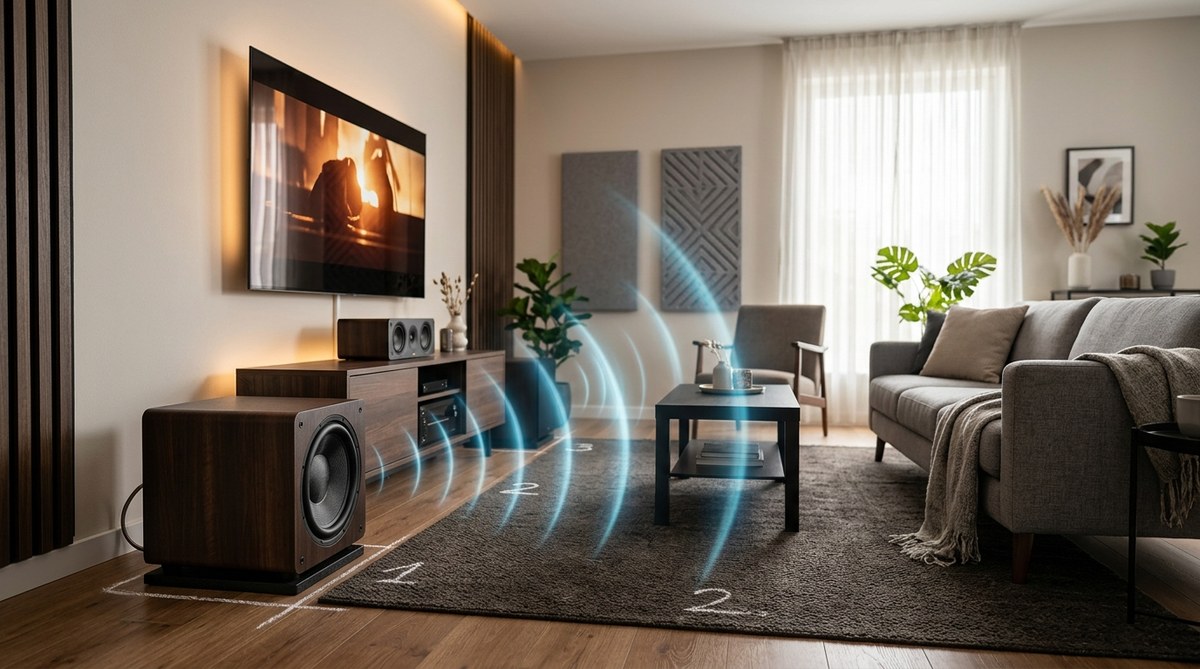
As highlighted earlier on in this discussion, subwoofers with one of the drivers facing the listener deliver more accurate bass response. Yet, home theater subwoofers come in two major differing design concepts: front-firing and bottom-firing, with each having its pros and cons. Front-firing subwoofer designs employ a speaker driver mounted on one of the sides or front. These yield the most accurate bass - throwing really deep bass waves towards the listener, leading to a better feel of the subwoofer sound. |
|
Polk Audio PSW505 12-Inch 300W Cont. Powered Home Theater Subwoofer |
Instead, bottom-firing home theater subwoofers use a speaker driver mounted in such a manner as to radiate sound towards the floor. These also produce a similar effect but not to the same extent as front-firing subwoofers. However, down-firing subwoofers make it possible for the listener to better feel the shake from the bass during your movie-watching or music listening.
Some home theater subwoofer designs use ports in the enclosure through which they forces out more air to further enhance the low frequency response of the subwoofer. The main scope is to try to improve or extend the lower frequency response of the subwoofer unit - this explaining why these units are generally capable of producing some really deep bass. But in general, overall response of ported subwoofer units is not as clean and accurate as fully enclosed units.
A compromise in between ported and fully-enclosed home theater subwoofer designs is the use of passive radiators instead of vented ports to enhance the bass response accuracy of the unit while improving its efficiency. A passive radiator can be either a flat diaphragm or a speaker-shaped diaphragm but without the voice coil.
Other Home Theater Subwoofer Characteristics: Crossovers and Equalization
Most subwoofers include a high-pass and a low-pass filter. The high-pass filter is used at the speaker level connection - thus enabling the subwoofer to pass the rest of the high frequencies to the satellites, while the low-pass is used with line-level connections. The latter is variable and limits the subwoofer to frequencies below the selected cross-over frequency.
Note that most surround sound processors found on today's AV receivers incorporate the necessary low-pass filtering on the LFE (low frequency effects) or subwoofer output - rendering the low-pass filter on the subwoofer unit redundant.
Ideally, your selected home theater subwoofer should therefore allow to by-pass its internal low-pass filter for a cleaner and more accurate bass; using multiple filters in tandem leads to a less accurate sound.
![]() Infinity Classia PSW310BK 10" Powered Subwoofer with Dual 10" Passive Radiators One of the best powered home theater subwoofers capable of excellent bass response that comes with the added convenience of wireless audio connectivity. (Buy from amazon US) Alternative buying option with similar features and performance is the less expensive Infinity PS210WBK - available from B&H |
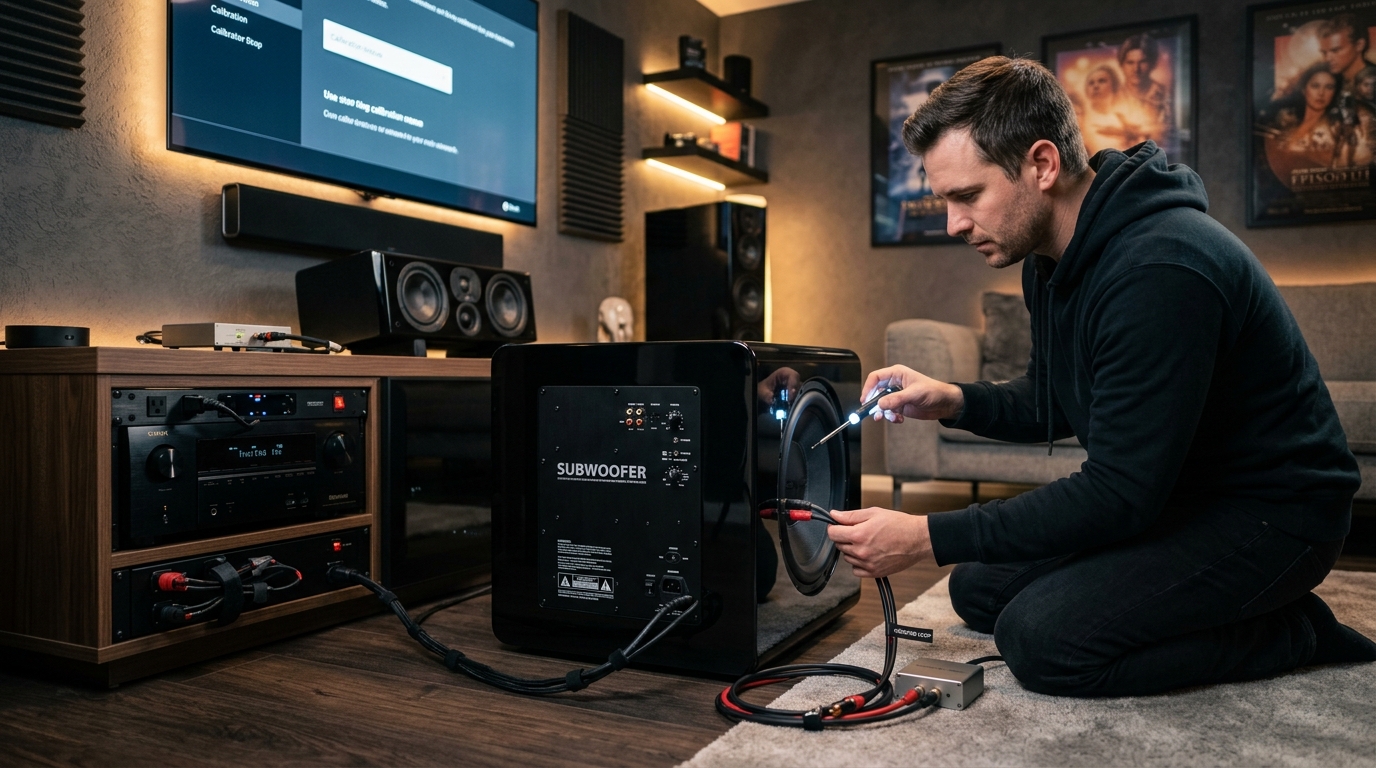
One final feature worth considering when purchasing a high-end powered subwoofer is equalization. A case in point is the Infinity Classia PSW310BK 10" Powered Subwoofer with Dual 10" Passive Radiators by Harman and which Infinity calls 'Room Adaptive Bass Optimization system' or R.A.B.O.S. This functions like a multi-band tone control similar to the equalizer found on some advanced amplifiers systems -adjusting the response of your overall sound by taking the interactions of the sound produced by your speaker within your room environment. The main difference here is that the equalizer in a home theater subwoofer operates on variable frequency bands (parametric type) within the subwoofer range rather than fixed bands as is the case with graphic equalizers. Adjusting the built-in equalizer in a subwoofer unit calls for the use of a calibration CD and a sound meter, with the main requirement being to adjust the equalizer for a flat response over the subwoofer frequency range. |
For this reason, high-end home theater subwoofers such as the Infinity referred to above, come with a test measurement kit to allow you to optimize its overall low-frequency response to match your unique room environment.
High-end powered subwoofers do not come cheap. The Infinity Classia PSW310BK is selling online at a reduced price of around $700. However, apart from its excellent bass performance, the Infinia also comes with the added convenience of 2.4GHz wireless audio.
At the same time, keep in mind that if you are on a low budget, you can still enjoy some really good bass even with budget-class systems that does not come with a built-in equalizer; simply playing around with your subwoofer placement as further detailed in our speaker placement guide can do a lot towards achieving a more balanced bass response.
Home Theater Subwoofers Buying Tips: What to look for
Go for a large 10-inch or 12-inch driver powered subwoofer if you are after room-shaking power.
But even smaller multiple 8-inch subwoofer driver units can represent a great option in the medium size room. In a similar manner, built-in multiple 8-inch subwoofer drivers in floor standing tower speakers can also deliver deep, good quality bass.
Convenient options to look for with powered subwoofers - apart from some form of build-in equalization - is a remote control option; this helps you adjust your subwoofer for best performance within the listening area from your seating position.
Wireless audio connectivity is also worth considering; it makes your home theater subwoofer placement less of an issue as it enables you to place your subwoofer practically anywhere it suits you best (as long as you have mains power outlet) without having to think how to get your audio cable around the room.
Worth taking note that a way to complement
your subwoofer and enhance the bass feel without annoying your neighbors is
through the use of tactile transducers - like the
Aura Bass Shakers
and the interesting line of
Buttkickers
.
Tactile transducers add a whole new dimension to your home entertainment, making for a more complete experience especially during movie watching. You get easier immersed into every movie action by combining the sense of touch with your sight and hearing. For more information on tactical transducers, refer to our article: Bass Shakers, Buttkickers… now you can feel the shake!
Looking for affordable Home Theater Subwoofers?
Amazon offers an extensive range of passive and powered subwoofers at significantly reduced prices. However, prior to any decision, we advise to do some research of your own. Look at what other customers had to say about their purchase especially with respect to product quality and manufacturer customer support. A good starting point is the customer feedback posted on amazon.
You can search the amazon storefront without leaving our site by using the amazon search box below; your search results will appear here under.