![]() Klipsch HD Theater 1000 - 5.1-channel home theater speaker system - 700 Watt (total) |
Home Theater Speaker Placement: A few basics
Home theater is not just watching movies - it is the experience of being immersed into the movie action itself.
This would not be possible without the enveloping atmosphere created by surround sound.
Home theater sound systems require at least five speakers - front left and right, and the center channel speaker, and two surrounds; an optional sixth speaker is the sub woofer, hence the reference to a 5.1 setup.
More advanced audio playback systems may feature six in a 6.1 setup, or even seven (7.1 setup) full-range audio channels for greater realism.
Note: More information on the different audio setups is available in our guide to surround sound formats.
Surround sound requires that the various sounds produced by the different speakers originate from specific positions within your home theater room. Knowing these requirements will help re-create the sound producers intended it to be. But...
Keep in mind that there are too many variables for there to be a single magic spot for your home theater speaker placement. Different speakers have different response characteristics, while room acoustics differ from room to room.
Thus, while knowing the basics of home theater speaker placement is important, yet feel free to experiment - after all, what really matters in the end is how it sounds to you!
In this article, we show you how to best place the respective speakers for optimum home theater sound. We also explain the different home theater speaker placement requirements between movie watching and multi-channel music listening.
In the process, we also touch lightly upon the role of the different speakers in a multi-channel audio speaker setup. However, more details in this respect follows in our article Speakers for Multi-Channel Audio; the latter discusses in substantial detail the different types of speakers, the role of the different channel speakers, as well as the speaker requirements associated with the different audio channels in a multi-channel speaker setup.
Home Theater Speaker Placement - Article Index:
Front Left and Right Speaker Placement
Surround Speaker Placement for Movie Watching
Editor's note:
Home theater speaker placement is an integral part of any home theater room design. We therefore advise to check also the rest of a series of home theater design guides appearing on our site.
Furthermore, keep in mind that some manufacturers do offer model-specific recommendations; this home theater speaker placement discussion should be taken in parallel with the information provided by the respective speaker manufactures.
A First
Step in Home Theater Speaker Placement:
The Center Channel Speaker
The first step when planning your home theater speaker placement is to identify the position for the center speaker. The role of this speaker is to anchor the dialogue and other on-screen sounds to the screen; hence, its position is completely dependent on your TV or projection screen position.
In other words, once you decide on your TV placement, you do not have much choice; rather what you will be doing is adjust the position of your front left and front right speakers such that the sound originating from these speakers will blend better with that originating from your center channel speaker.
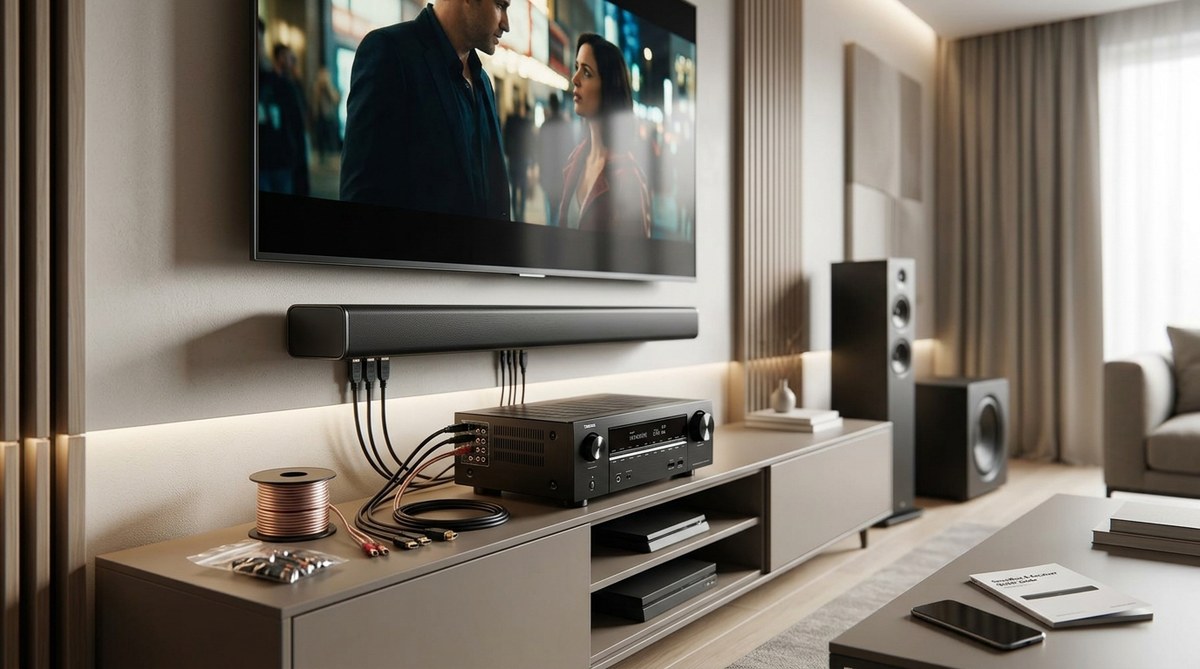
Correct home theater speaker placement for the center channel speaker requires the latter to be placed either centered on top of your TV or just below the TV screen in the case with direct view and rear projection Televisions.
This implies that speakers used for the center channel should be magnetically shielded when used with CRT TVs to avoid any magnetic interaction with your TV display.
A better placement is possible with a front projection set up; in this case, the center speaker may be placed just behind the projection screen - some 6- to 12-inches away from the screen - as long as the screen is made from acoustically transparent fabric. This represents the ideal position for the center channel speaker and is the position adopted in movie theaters. Such a placement would yield better spatial sound definition.
Acoustic transparency implies that the projection screen fabric should incorporate micro perforations to allow sound from the center channel speaker to pass through without any restrictions.
For more information on acoustically transparent projection screens, please check our Projector Screen Fabrics article appearing under the Home Theater Screens section of the site.
The following center channel speaker placement guidelines apply:
The center speaker tweeter should be at ear level when seated. This implies that with a direct view or rear projection TV, the best placement is normally on top of your TV screen.
When mounted directly on top or just beneath the screen, ensure that the speaker's front edge is precisely aligned with the front edge of the TV. This will avoid undesirable sound reflections from the TV cabinet.
Aim your center channel speaker directly at your primary listening area.
The center channel speaker should be precisely the same distance from your listening position as your front left and front right main speakers.
Front Left and Front Right Speakers:
The front left and right speakers carry the bulk of the music and sound effects. Their main job is to provide a detailed focused sonic image. Correct placement of these speakers is particularly important to help create the widest, most realistic soundstage possible for your room.
The following home theater speaker placement guidelines apply:
The main front left and front right speakers should be placed equally distant on either side of your TV; for best performance, these speakers should be at least 6 feet apart.
Adjust your front left and front right speakers such that all three front speakers - left, right, and center channel speakers - are at exactly the same distance away from your main seating position.
If you are placing your speakers mostly for solo viewing, the three front speakers should fall on an arc whose center is your main viewing position.
If on the other hand, you are planning your home theater speaker placement mostly for group viewing, all three front speakers should be positioned in a straight line parallel with your front row of seats.
Note: This is different from speaker toe-in referred to further on in this article; toe-in refers to the 'set-angle' of the speakers towards the listening position. Here we are only dealing with the positioning of the front left, right, and center speakers with respect to the listening position in terms of distance.
Avoid having the front center channel speaker closer to your main viewing position than the left and right speakers; this will unbalance the inter-mix between the different sound channels.
For correct home theater speaker placement, the front left and right speakers should enclose an angle of 45 to 60 degrees with the center-most viewing position. Expressed differently, the center-most viewing position should represent the vertex of an angle whose sides - one joining the front left speaker and the other the front right speaker, enclose an angle of 45 to 60 degrees.
The 45o angle is preferred when planning your home theater speaker placement if you mostly watch movies; this angle re-creates better the circumstances under which film soundtracks are produced.
Click on Image to Enlarge
The 60o angle is preferred if you are mainly after music listening; this wider angle mimic the conditions set by the mixer at music recording studios.
As far as possible, the main front home theater speakers should be set with their tweeters at approximately the same height as the tweeter on the center channel speaker and at or near ear level when seated; differences in this respect should not exceed 12 inches (30 cm).
Speaker Toe-in
Directly related with the positioning of the main front speakers is the issue of speaker toe-in or the 'set angle' towards the listening position. This means that independent of the speakers position already referred to above, each of the main front left and right speakers would normally be set at an angle such that it directs more sound towards the prime listening position. In general, some toe-in would yield better results but...
There is no 'general' home theater speaker placement rule in that this depends on a number of factors. In particular, the required toe-in - if any - depends on the sound dispersion pattern of the speakers in question.
In other words, not all speakers require toe-in; some speakers are designed to sound their best when facing straight forward, while others are best angled slightly towards the listening position.
The best way is to consult the manufacturer literature accompanying your speakers for any recommendations on home theater speaker placement issues. If the accompanying manuals do not provide any guidance in this respect, simply listen to the speakers both when facing straight forward, and also when angled-in; then choice the position that sounds best to your ears!
Remember: The key to arriving at the right amount of toe-in in any home theater speaker placement is experimentation: listen, move the speakers, and listen again; repeat the process as necessary.
Finally, keep in mind that speaker toe-in becomes less of an issue as your listening position moves further away from the main front speakers. In addition, if your seating caters for group listening, the best way is to leave the front speakers facing straight towards the front row of seats rather than angled towards the center listening position. This would help create the widest most realistic sound stage possible for your audience.
Preferred Surround Speakers Placement:
Unlike the three front speakers, the job of the surrounds in a home theater is to create a cloud of non-localized sound that envelops the viewer. It is the integration of this diffused rear sound field with the rest of the sound coming from the fronts that makes you feel like you are in the middle of the movie action.
Though preferred surround speaker positioning is very much dependent on personal tastes, yet there are a few home theater speaker placement issues worth taking note of.
The following surround speaker placement guidelines apply:
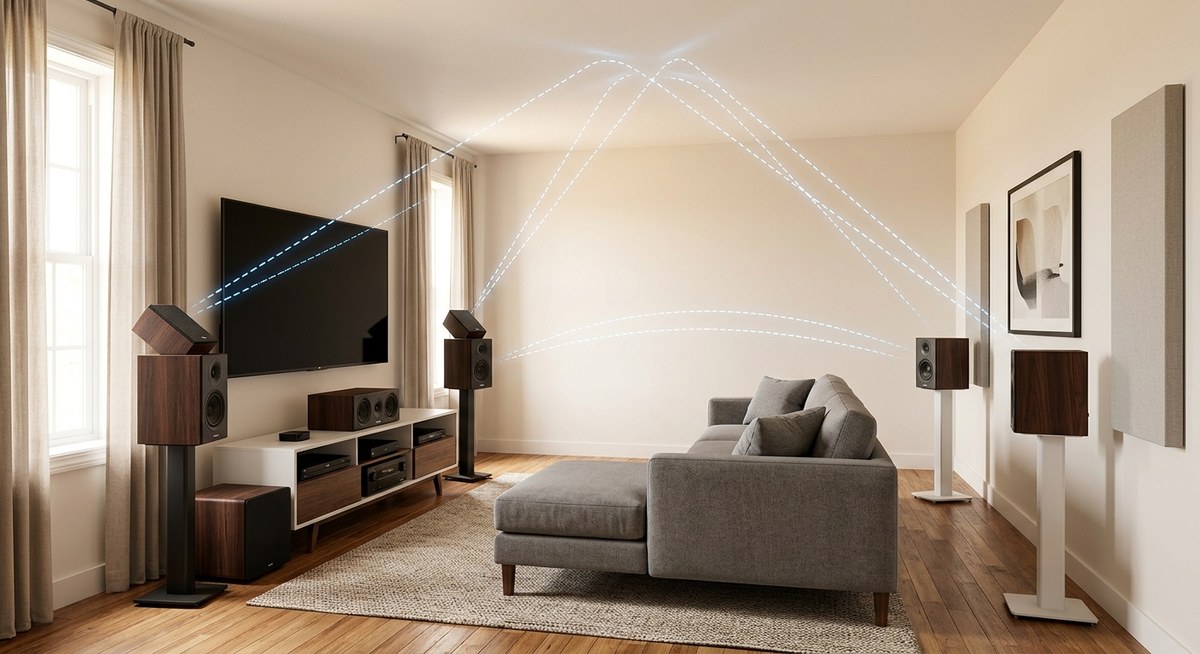
Surround speakers should ideally be placed alongside and slightly to the rear of your main seating position. This will help mimic the sound field as originally recorded in dubbing theaters when mixing movie soundtracks.
Sidewall placement is preferred; this helps create a seamless, enveloping soundstage over the whole listening area.
If sidewall placement is not possible, try to make use of appropriate speaker stands.
Position the speakers two to three feet above your seated ear level; this helps create the most diffused enveloping sound field in the listening area.
In the case of 6.1 and 7.1 home theater surround sound systems, distribute the surround speakers such that these are preferably wall mounted on the sidewalls and the back wall. This kind of home theater speaker placement would further enhance the enveloping effect.
|
|
Home Theater Speaker Placement diagram for 6.1 and 7.1 (Dolby Digital EX and Dolby Pro Logic IIx) audio setups. Click on image to enlarge |
Avoid:
Placing surround speakers too far forward of your main seating position; doing so will lead to insufficient sound fill at the back.
Similarly, do not place your speakers too far back. This will result in voids in your listening area; you may lose the enveloping effect so important in surround sound.
When side mounting the surrounds, avoid having these speakers firing directly in your ears. This will lead to localized instead of diffused surround sound direct towards the listener's ears. Direct sounds from the surround speakers can be extremely annoying especially if the sound from your surrounds overpower the main speakers, throwing off the balance between the different channels.
Surround Sound for Multi-channel Music programs:
There is some difference in surround speaker placement between movie watching and multi-channel music listening.
Mixing conditions in film dubbing theaters and music recording studios are different. While in the case of home theater movie sound, the surrounds should help recreate a diffused non-localized sound, multi-channel music listening requires five main identical channel speakers (excluding the subwoofer), all placed at ear level with their tweeters pointing towards the listener.
The correct surround speaker placement for music listening requires that each rear speaker is placed at exactly an angle of 110 degrees with the center speaker when measured from the center-most listening position. More specifically, the center-most listening position should represent the vertex of an angle whose sides - one joining the center speaker and the other the surround speaker, enclose an angle of 110 degrees; (refer to the speaker placement diagram for Dolby Digital and Dolby Pro Logic II 5.1 audio setup above).
Together with the 60-degree angle requirement for the main front speakers already referred to above, these settings represent the optimum speaker placement for multi-channel music listening.
What if you cannot play around with speaker placement?
Well, the chances are that you will still be happy with the sound of multi-channel audio with your home theater speaker placement optimally set for movie playback. But a possible solution to make up for the difference in height requirement between multi-channel audio listening and movie watching is to mount the surround speakers on adjustable-height speaker stands.
However, a functional compromise is to use wall-type swivel speaker brackets mounted at a reduced height; simply split the difference in speaker height required for a more diffused soundstage in movie playback as against the more directional radiation preferred for multi-channel music listening.
Subwoofer Placement:
The least demanding of all in home theater speaker placement is the subwoofer as low frequency sounds are non-directional.
This means that in a correct home theater sound set up, the ear should not be able to detect from where the bass sound is originating. If you can pick your sub woofer position when listening to music or watching a movie, it simply means that, your sub woofer sound level is too high.
There are no fixed home theater speaker placement rules here other than subwoofers should be placed directly on the floor.
However, the following subwoofer placement tips may help improve the bass in your home theater room:
The amount of bass delivered by a subwoofer is very much dependent on the placement of the subwoofer within the room. Placing the subwoofer close to a wall or near a corner will enhance the overall bass response. This may help improve the response with bass-shy systems.
At the same time, a subwoofer placed close to a wall or corner may produce a less controlled bass response. Hence, the ideal position is one that leads to a compromise between the quantity of bass output and quality of the bass sound.
In the case of larger home theater rooms, the best approach is to use two powered sub woofers placed one in the front and one in the back.