![]() |
||||||||||||||||
![]() |
At the same time, few realize that these are very much dependent on the shape, size, and layout of your room - a fact often overlooked by many to the detriment of an enjoyable home theater experience. The truth is that when it comes to home theater room design, the room characteristics and available lighting, affect just about every aspect of your home theater experience - from picture quality and acoustic performance, to overall comfort and movie enjoyment. Improving Acoustics & Enhancing LightingThis is a two-part article that discusses in substantial detail the issues of acoustics and light and how these impact your home theater room design. The first part deals with the basics of room acoustics. It then shows you how to proceed to improve the sound performance at the early stage of your home theater room design. In the process, we discuss the issue of soundproofing - when it is necessary to soundproof a wall and when it is not. In the second part, we discuss home theater lighting, ways of enhancing light and home theater lighting control systems. The article touches upon the use of X10 based control systems to create that unique touch in your home theater room design; these systems can make automation and lighting control in the home theater, a real fun. Part 1 - Home Theater Room Design - Acoustics & SoundproofingThe acoustical performance of your home theater room represents an important element for a clear and optimal home theater sound. No matter how good your home theater sound system is, if the environment within which it is operating is not geared towards good quality sound, it will simply sounds terrible. This in itself is dependent on the nature, as well as on the overall area of the different surfaces within your home theater room. In particular, the room's construction, furnishings, widows, and wall surfaces, all have a massive impact on the acoustic performance of your home theater. Unfortunately, many would-be home theater rooms are less than ideal for the purpose from an acoustics perspective. Sound reflections as a result of the different surfaces and refractions as sound travels through different materials, lead to server sound distortions. Further more, there is also the issue of noise transmission both from within the home theater as well as from outside. One has to look at ways on how to stop sound crossing the room boundary, more specifically, to soundproof the home theater room. It is not the scope of this home theater room design article to go into the details of soundproofing. Soundproofing is best carried out by a professional as if it done wrongly, it can make things sound worst ...and that would surely turn out to be an extremely expensive mistake! Yet, there are a few basics about soundproofing which if followed carefully by the DIY enthusiast at the early stages of any home theater room design, may help avoid wasting thousands of dollars in creating a 'room-within-a-room', which is in essence, the basis behind sound isolation and sound control techniques. Reflective Surface and Noise Absorption: On one extreme, one finds those 'hard' reflective surfaces that render harsh echo-filled sound, versus the 'soft' very absorptive type that leads to a dull lifeless sound. A room with all hard surfaces such as wooden or ceramic tile flooring, gypsum partitioning and concrete ceilings, etc., represents the ideal environment for a high level of sound reflections leading to echo and extremely poor sound quality. This echo or reverberation level increases with an increase in the sound level. The solution is to introduce an adequate amount of soft furnishings to absorb some of this echo. The other extreme is a room with all soft furnishings such as fitted carpets and wall to wall curtains - leading to an acoustically 'dull lifeless' room.
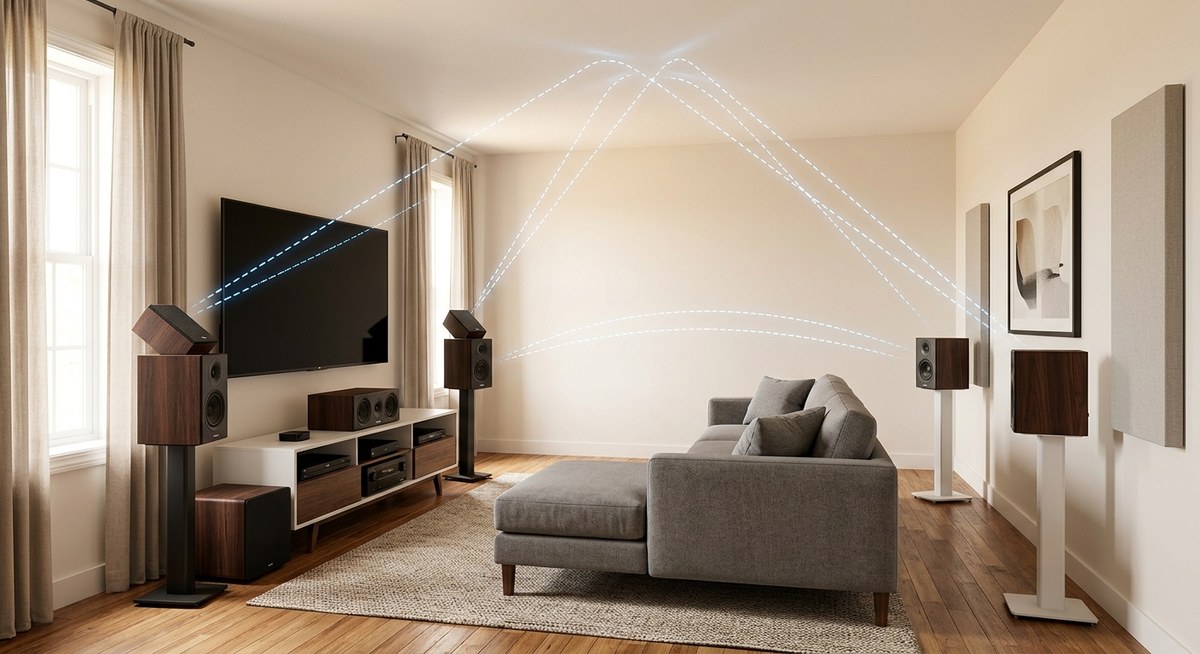
Sound absorption control is achieved by changing the characteristic of the sound within your home theater room. Stop it from echoing, control the reverberation. Stop the noise reflections. As already indicated, for this type of sound control, you will use carpets, upholstered furniture, acoustical ceiling tiles, soundboard, etc. However, there is even more to just striking a balance when it comes to home theater room design. The position of these absorptive and reflective surfaces with respect to your speaker placement plays a critical role towards achieving a pleasing overall acoustical home theater result. The following are just a few practical guidelines that should prove useful to help you improve your home theater room acoustical performance, and which you should consider during your home theater room design process:
How can you strike this much-desired balance in your home theater room design?One needs to experiment with the positioning of any soft furnishings around the room - an essential approach for an effective home theater room design. The end result however is more a question of personal preference. Soundproofing and Noise Transmission: Indirectly related to your room acoustic performance is noise transmission between adjacent rooms in your house. Neither you will want to disturb others with your home theater sound, nor will you want to be disturbed during a good movie with undesirable noise from outside. In other words, you may have to create a 'room-within-a-room' to isolate the inside walls, ceiling and floor, as much as possible from the rest of the house. In this manner, you will be able to control the impact of the sound system on the room itself as well as stop the transmission of sound from both within as well as from outside. While soundproofing a room can turn out to be an expensive and a huge project in itself that is best done by a professional, yet it is possible to soundproof a room without spending big money. The reason is that when it comes to the transmission of sound between adjacent rooms, the worst contributors are windows and doors rather than walls, ceiling and flooring. In other words, your first approach in your home theater room design effort should be to soundproof the windows and doors of your room before proceeding with the much bigger investment required to soundproof the rest of the room. If you do not proceed in this direction, you may end up wasting thousands of dollars in unnecessary soundproofing. At this point, it is important to realize that noise absorption is different from noise reduction, and therefore what holds good for one, would have very little impact - if any - on the other. As indicated earlier on, noise absorption is used to control the quality of sound within a room; on the other hand, noise reduction techniques are used to control the flow of sound energy from one room to another. Thus, while the use of insulating material between double drywall panels can effectively help to stop the noise from crossing the room boundary, it would not help to control the reverberation level of the sound within the room - unless the outside surface of the drywall panels is treated with the appropriate material. When it comes to soundproofing a home theater room, there are three things that can help you stop noise from crossing the room boundary:
Reducing Noise: You can adopt various approaches to reduce noise. These have to be taken care of at an early stage of your home theater room design as these often imply substantial re-construction effort. These all rely on the use of mass and space to maximize the dampening of sound as it travels through the room structure. As indicated earlier on, your effort should first focus on the openings in your room - doors, windows, etc. To this effect, you have to ensure that any doors and windows within your room should have a solid core structure with a tight rubber seal to reduce noise transmission. Increasing the space in between your double-glazed windows should help reduce noise. Only once you have completed this step that you should consider additional soundproofing of your walls, ceiling and flooring if your first attempt was not enough. When it comes to soundproofing walls, you have to avoid studs of two adjacent walls from touching each other in order to cut the primary means for sound to travel between rooms. Usually, a second extra layer of drywall will further enhance the noise reduction effect. This adds more mass that will help dampen the noise vibration when traveling through the structure. To dampen further the sound, apply some appropriate insulation inside the wall cavity, while adding soundproofing material between the studs and the drywall will further block sound vibration. The use of special materials like 'Z-shaped' resilient steel channels to use inside drywalls and ceiling can help reduce large noise vibrations. Specialty Vinyl and other noise stopping materials like lead lined drywall all rely on the use of mass to dampen the sound energy and thus, to stop noise from crossing a structure. More information on soundproofing home theaters rooms can be found in the following soundproofing manuals published by Quiet Solution Inc: Some really interesting information on Room acoustics is also available at www.highend.nu under the Acoustics section of the site. Highend takes a practical approach to the subject and includes extensive DIY information on both room acoustics treatment and DIY speaker systems. For the technically minded, your aim should be to increase the 'Sound Transmission Coefficient' (STC) to around 55 or higher. This represents the ratio of the sound energy - for a given frequency range - typically between 125Hz and 4000Hz - transmitted through a surface, to that incident on it. Note that STC does not access the low energy sound transfer. On the other hand, the 'Noise Reduction Coefficient' or NRC, is a single-number index for rating how acoustically absorptive a particular material is. It is simply the average of the mid-frequency sound absorption coefficients (250, 500, 1000 and 2000 Hz). NRC gives no information as to how absorptive a material is in the low and high frequencies. Room dimensions: Directly related to your room acoustic performance are the room dimensions. Room dimensions should play an important role in any home theater room design. Ideally, the dimensions should be such that the room width, height, and length are not divisible by a common denominator. For example, a room that is square is not ideal for home theater use as this may lead to undesirable acoustic performance, which will be more difficult to control. Similarly, a rectangular room where the length is twice the room width is also not suitable. If your room is inadequately proportioned, do not move to the next steps in your home theater room design without first attempting to modify the room dimension accordingly. You can use say a drywall partitioning - e.g. by introducing a small projection booth at the rear of your home theater room, or a fitted wall-unit that you can use to house your big screen display and the front speakers, etc. Effort spent at this stage of your home theater room design will surely pay off later during your movie viewing and music listening, once your home theater masterpiece is complete.
Part 2: Home Theater Lighting
|
Copyright © - Practical-Home-Theater-Guide.com All rights reserved. |
Surround Sound
Formats
Choosing
a Plasma Television
The Complete LCD TV Guide
Projection Television - the center of attraction in home
entertainment
The
Contrast Ratio Game - Playing with Numbers!
Buying Refurbished Electronics - Is
it worth the risk?
Quick
Guide to DVI
The
HDMI Cable Guide
RGB & Component video, or DVI & HDMI - Which is
better?
HDCP and HDTV
Set-up Discs and video calibration solutions
Poster Light Boxes
More
Featured
Our discussion on Home Theater Room Design continues... Even though a lot of info is freely available on the net, yet it is recommend investing in a few home theater books and magazines. Books help you take a more structured approach in your learning process.
A relatively inexpensive book we highly recommend is Home Theater Design, an interesting e-book that takes a step-by-step comprehensive approach to the subject. by Duncan McClelland
Sound & Vision
Great Escapes
Practical Home Theater (2007 Ed.)
Home Theater for Dummies
|
|||||||||||||