Site logo    

Home
E-zine Subscription
CRT TVs
LCD TV Guide
LCD TV Reviews
Plasma TV Guide
Plasma TV Reviews
Projection TV
DIY Projection TV
RPTV Reviews
Digital TV Guide
Projector Reviews
Projection Screens
HT Cables
HDCP
Set-Up DVDs
Home Theater Design
HT Pictures Gallery
Equipment Racks
MoviePoster Guide
The Poster Store
Surround Sound
Headphone Guide
Wireless Speakers
Media Players
Books & Magazines
Catalogs
Power Protection
Satellite TV
Useful Links
Refurbished Products
Price Search
HT Online Store
Advertise on this Site
About Me
Contact Form
Privacy Policy
Site Search
Site BLOG

XML RSS
What is this?
Add to My Yahoo!
Add to My MSN
Add to Google

side image

Home Theater Room Design Basics (4):
Equipment Placement in the Home Theater


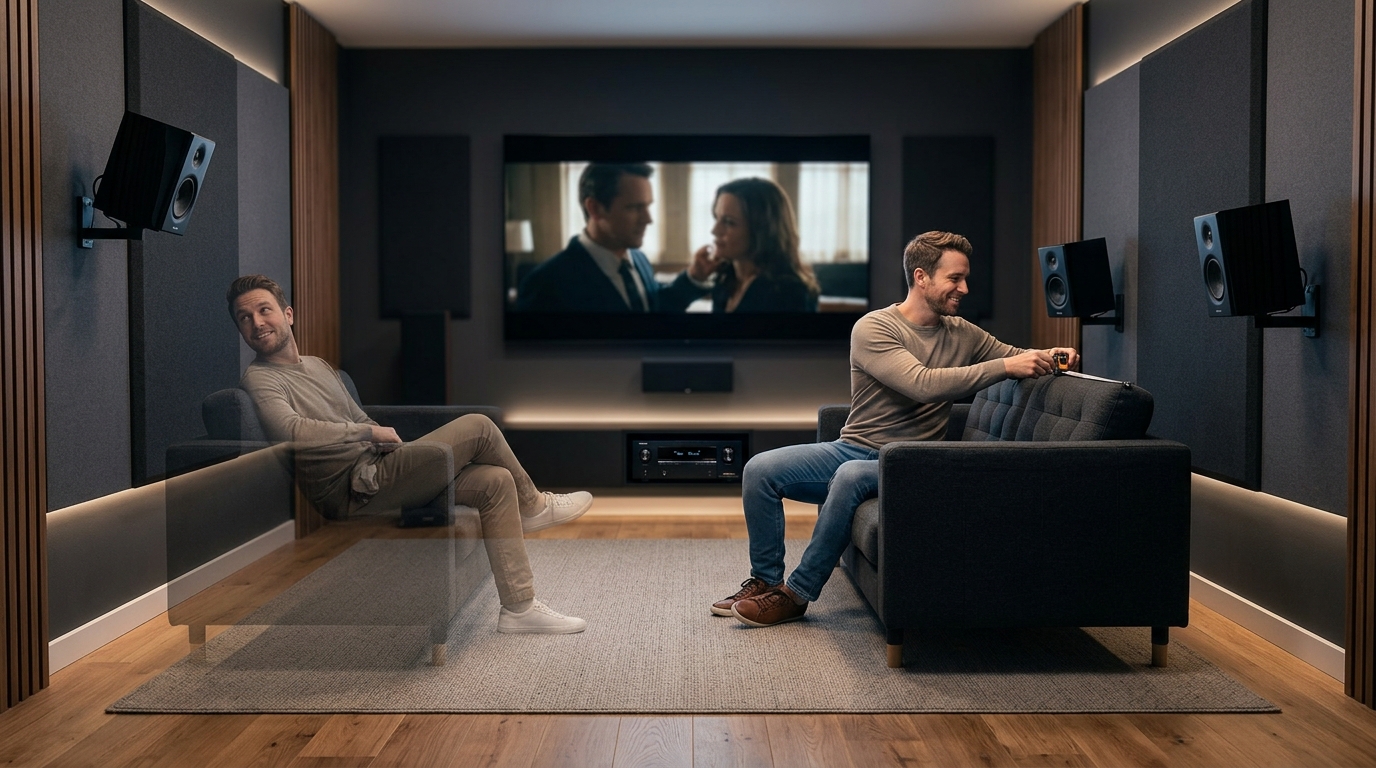
A primary consideration in any home theater room design is equipment placement. Yet, few realize that just as important as which components to buy, is deciding where to put them. 


The correct placement of system components is a major contributor towards achieving that much-desired immersive experience in the home theater.

This applies to all home theater equipment, not just the speakers or that big screen TV. Even a flashing LED from a DVD player or an AV receiver placed just under the TV screen can turn out to be distracting during movie watching.

Note: Though this article concentrates mainly on the dedicated home theater room design, yet most of the principles discussed still apply in a shared environment.

Main topics covered in this article:

Blue bullet

Correct Placement of System Components: Why is it important?


Blue bullet

TV/Home Theater Screen Placement


Blue bullet

Projector Location


Blue bullet

Home Theater Speaker Placement


Blue bullet

A/V Equipment location


Correct Equipment Placement - Why is it so important in any home theater room design?

As stated earlier on, the correct placement of the various home theater components with respect to each other as well as within your room, is a major contributor towards achieving that much-desired magical experience in home entertainment.

It is true that it is not always possible to opt for the best equipment placement. Under certain circumstances, e.g. when installing a home theater in a shared environment such as a living room, the respective room features will eventually dictate where the various home theater components can go. Yet knowing the basic requirements for an effective home theater room design is important as it can help improve the end-result in any home theater experience.

Detailed planning at an early stage of your home theater room design is essential. Do not be tempted to proceed with a home theater installation before having done so. Inappropriate planning will not only affect your home theater experience, it may even lead to costly mistake.

...back to page index


Home Theater Equipment Location

While the info detailed below applies irrespective of equipment brand, yet the discussion that follows should be taken in parallel with the information provided by the respective equipment manufacture.


TV / Home Theater Screen Placement:

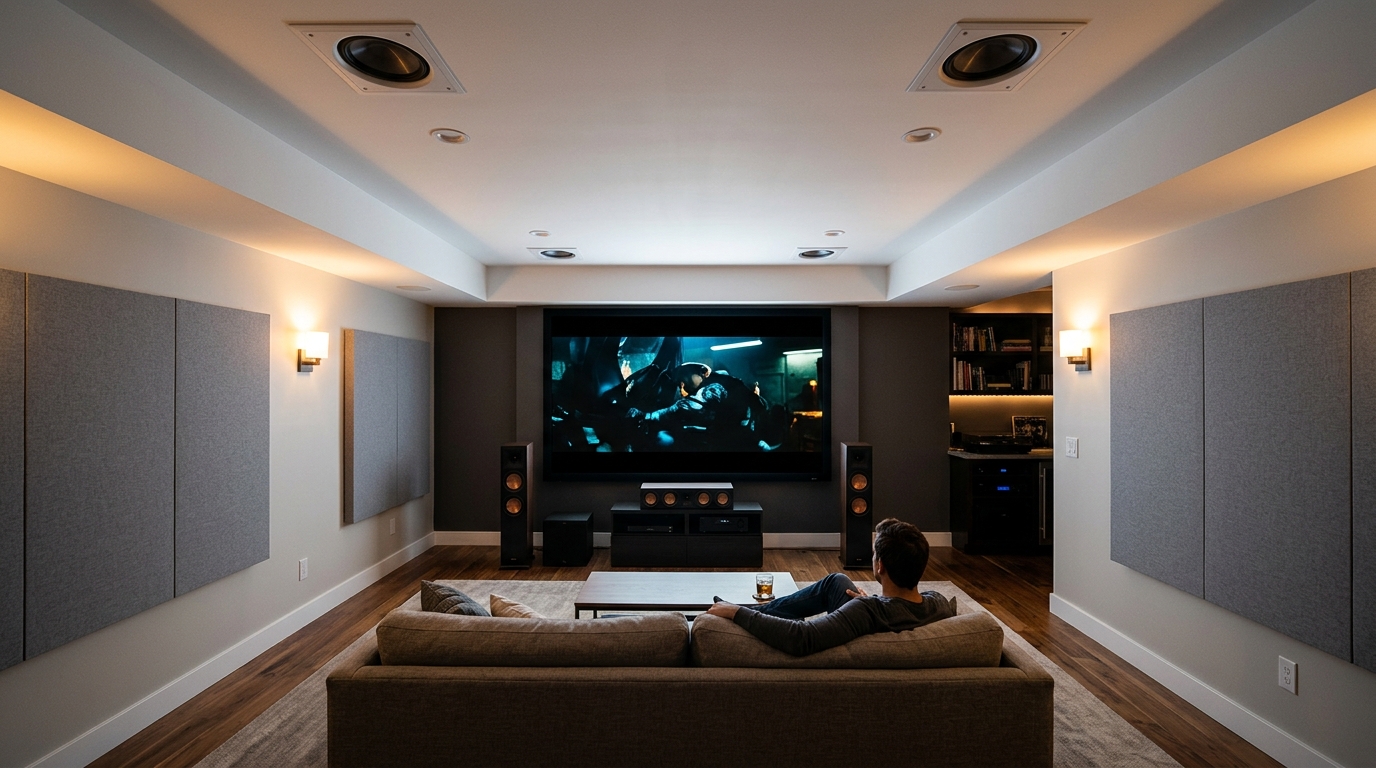
A first step when planning your home theater room design should be to identify the correct placement of your big screen TV - the main center of attraction in any home theater. The rest of the equipment should then follow.

Proper placement of a big screen television or home theater screen is mainly dependent on the screen size, available viewing distance, ambient light conditions, and the layout of your home theater seating. The relevant details are further discussed in the following home theater design guides appearing on our website: 

The principles discussed in these guides apply independent of whether your big screen display is a direct-view e.g. LCD or Plasma TV, or a projection display such as a rear projection TV. However, in the case of a front projection setup, there is a further point to consider. 

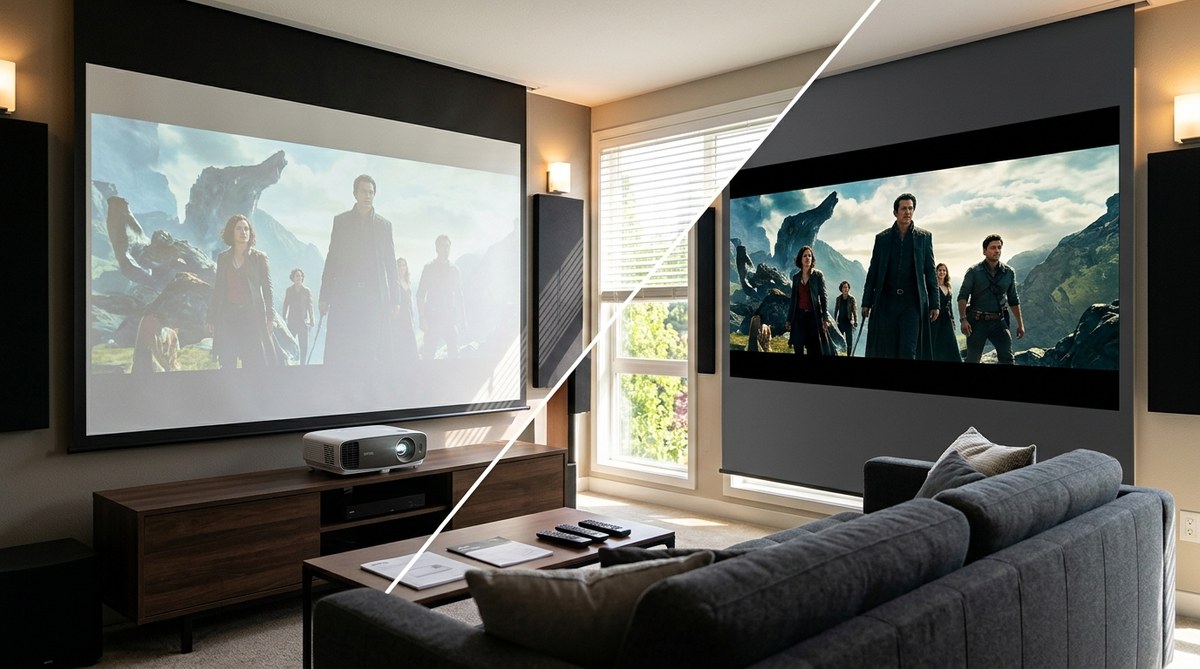
For the best results when planning your home theater room design,  the projection screen placement should be such as to allow for the positioning of the center speaker behind the projection screen. This will help to better affix the dialog with the movie action, while yielding better spatial definition in home theater sound.

As expressed in our Projector Screen Guide, one of the main functions of a good quality home theater screen is to support the sound within the home theater room. The ideal screen material is one that incorporates micro perforations to present an acoustically transparent surface for the center-channel speaker when the latter is placed behind the screen.

However, for this whole setup to work effectively, it is necessary to maintain the correct position of the center speaker with respect to the main front left and right speakers. This means the placement of the center speaker behind the screen should be such that the front right, front left and the center channel speakers should all be set at equal distance from the main viewing position. More information on speaker placement is available in our Home Theater Speaker Placement Guide.

...back to page index


Projector Location:

Modern LCD and DLP projectors employ zoom lenses, keystone image correction, and even vertical and horizontal shifts of the lens assembly itself inside the projector housing. These features give you a certain level of flexibility when planning the projector position during your home theater room design.

Zoom lenses allow you to adjust the image size to the required dimensions over a wider range of projector to screen distance.

The 'keystone image correction' gives you the possibility to project images with the correct geometry even when the projector is not in line with a normal drawn to center the projection screen surface. Keystone correction is measured as the number of degrees off center the projector can be positioned while still projecting an image with the correct geometry.

Most projectors use 'digital' keystone correction - meaning that geometric correction is achieved by manipulating the image. Unfortunately, this leads to loss of resolution and detail and should ideally be avoided at all cost if you want the best picture. Use instead the vertical and horizontal lens shift mechanism if available - no distortion will result in this case since it is the lens assembly itself that is moved inside the projector housing to adjust the image position. Alternatively, relocate the projector.

Possible projector locations include ceiling mounted, on a floor stand between the front row of seats, or in a cabinet at the rear. 

Should space allow, plan for a dedicated projection boot in your home theater room design; this would be ideal, as it will mask any annoying noise from the projector cooling fan during periods of silence.

Finally, ensure that you remain within the supported projector-to-screen distance range for the required screen size, and keystone image correction or lens tilt support; it would be difficult to relocate the projector once you complete the overall home theater room design.

...back to page index


Home Theater Speaker Placement:

Speaker placement is an integral part in any home theater room design process. The correct placement of home theater speakers plays a key role in creating a seamless 'enveloping' surround sound so important in the overall home theater experience. 

For the relevant details, please refer to our Home Theater Speaker Placement Guide. There you will find full details with respect to the different speaker placements for both movie watching and for music listening. The points listed below just highlight the main issues you need to take note of when planning your home theater room design:

  • Center Speaker: This mainly carries the dialog part. Hence it should be placed just behind but close to the center of the projection screen surface as detailed above. Alternatively, place on top or just underneath your TV in case of a direct-view or rear-projection television.

  • Front left and right speakers: The main speakers should be placed one on opposite side of your display and equally distant from your main viewing position. Furthermore, the distance between the viewing position and the main speakers should be equal to the distance between your viewing position and the center channel.

  • Surround speakers: These are best located on the sidewalls of your home theater room, just behind your main listening position. In the case of a 6.1 or 7.1-channel system, the additional back-channel speakers should preferable be wall-mounted on the back wall two to three feet above your ear-level when seated.

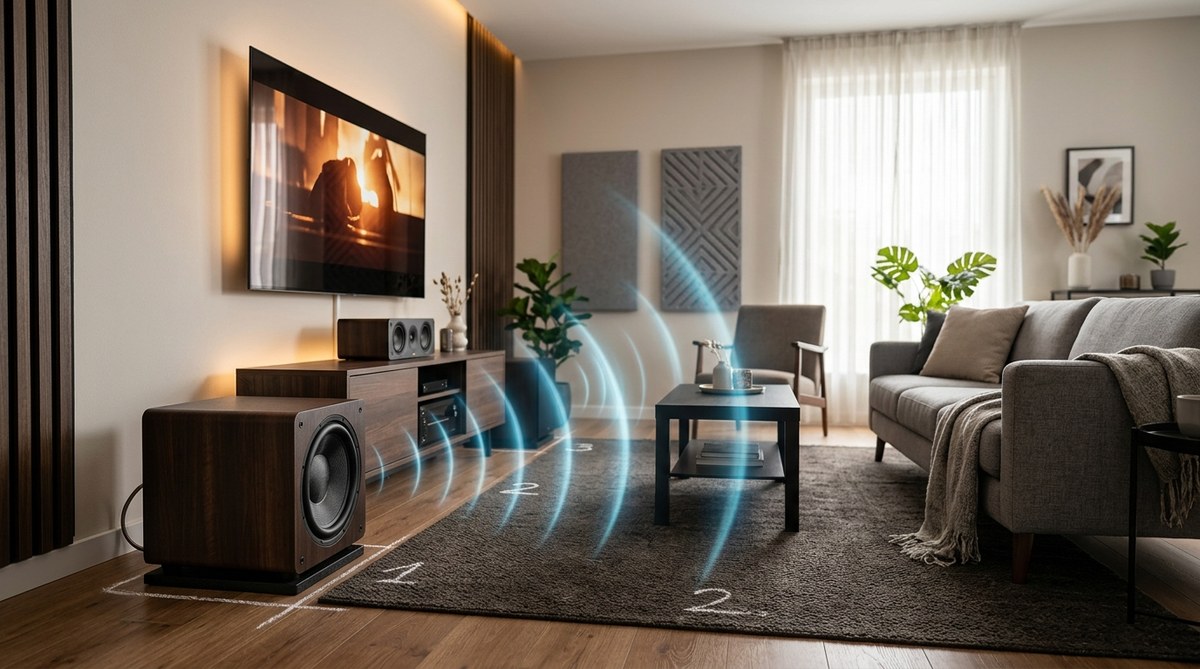
  • Sub-woofer: There is no fixed position here since low bass frequencies are omni-directional. However, it would be appropriate to experiment a bit to determine the best position since placing the sub-woofer near a wall or close to a corner will enhance the overall bass response. 

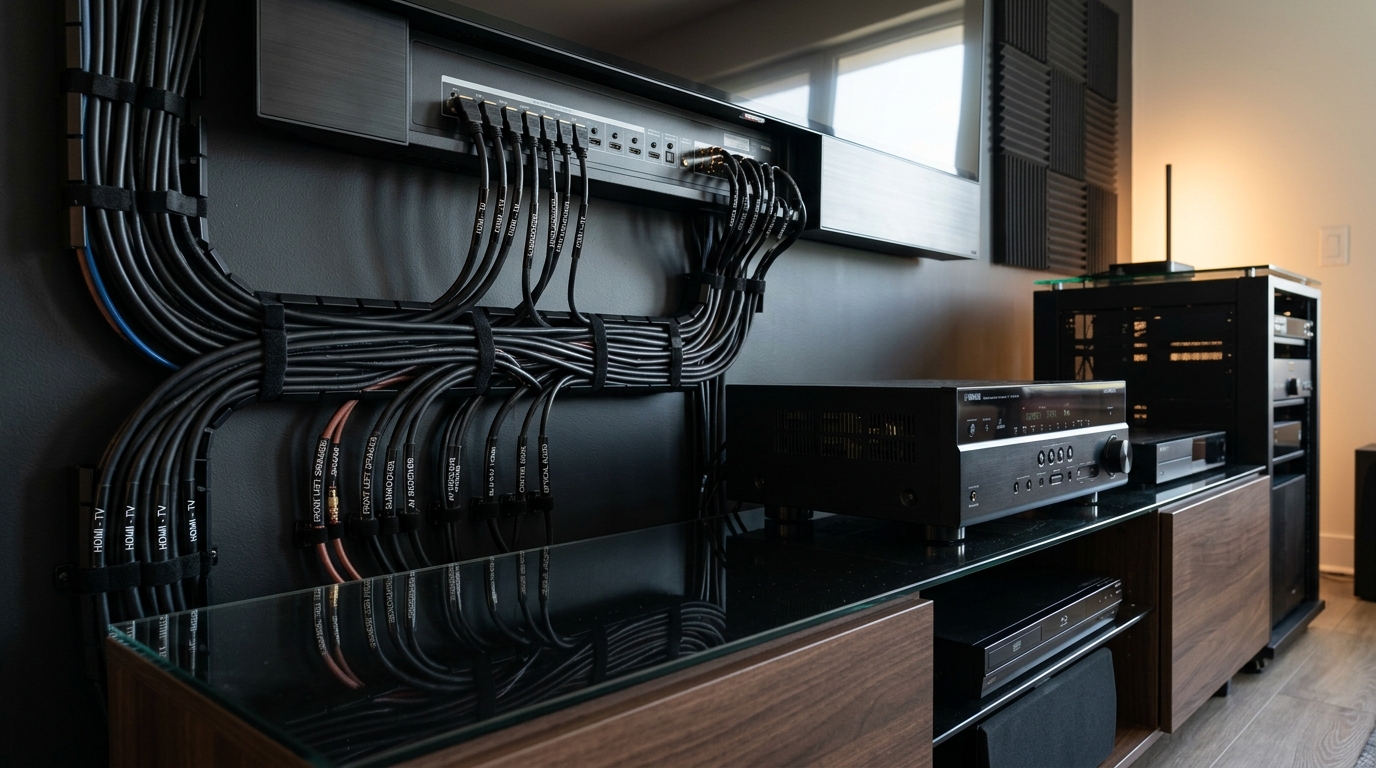
No home theater room design is be complete without planning the speaker wiring details. Once you plan your speaker placement, measure the distances - add some extra per speaker to allow a margin of error.  For more information, check our Home Theater Wiring Guide.  

...back to page index


A/V Equipment location:

This home theater room design article would not be complete without mentioning something on audio video equipment placement.

Home theater incorporates a full range of components - DVD player, Audio/Video receiver, satellite or cable TV set-top-box, cassette deck, power protection equipment/UPS, etc. These will also need a home.

Many would simply position their equipment close to their projection screen or big screen TV. This is a big mistake. Most of these components will have their front panels filled with led displays; the colored light from these displays can be distracting during a movie.

Equipment Racks: When planning your home theater room design, consider to mount your equipment on a suitable equipment rack either on the side or back wall. Whatever option you choose, ensure that you still have full remote control access to your A/V equipment from the main viewing position. This will enable you to adjust your home theater system for best performance.

Alternatively, if space permits, use a media closet to house your equipment rack and that possibly can also serve as a projection booth.

Logitech Harmony 890 IR/Wireless remoteIn this case, a remote with RF support such as the Logitech Harmony 890 may be required to control all your gear. A small LCD preview monitor may also prove useful in this case.


An inexpensive audio equipment stand from O'Sullivan

O'Sullivan - Audio Equipment Stand (Brushed Nickel)

For more information on audio video component enclosures and system racks, please check our Guide to AV Equipment Racks.


...back to page index


Last Updated on:

14th April 2007


 Copyright © - Practical-Home-Theater-Guide.com  All rights reserved.


Search
Practical HT Guide
 in collaboration with

Google

Web

Practical HT Guide


Red BulletRECOMMENDEDRed Bullet Home Theater Guides Suggested further reading:

Surround Sound Formats
The never ending list of terms and brand names - Dolby, DTS, THX - associated with surround systems is starting to get a bit too complicated...

Choosing a Plasma Television
Features to look for when choosing a flat-panel Plasma TV Set.

The Complete LCD TV Guide
Discover all you need to know about LCD TV sets.

Projection Television - the center of attraction in home entertainment
A complete guide to front and rear projection TV systems.

The Contrast Ratio Game - Playing with Numbers!
To what extent high contrast ratios affect the performance of a video display device?

Buying Refurbished Electronics - Is it worth the risk?
A way to a cheap LCD or plasma HDTV is to opt for a refurbished product, but how can you transform the risks into a smart buy?

Quick Guide to DVI
Too many DVI flavors? Help is on the way - our DVI Cable Guide explains it all!

The HDMI Cable Guide
To many, HDMI is still an unfamiliar term. This short guide explains all you need to know about HDMI interconnects.

RGB & Component video, or DVI & HDMI - Which is better?
Is digital always better?

HDCP and HDTV
Learn what HDCP is all about and why it impacts your HDTV viewing. What about HDCP strippers?

Set-up Discs and video calibration solutions
Home theater setup DVDs and video calibration kits can help you squeeze a lot more out of your system.

Poster Light Boxes
For that unique finishing touch to your home theater. DIY building tips included.

Poster light boxes from MovieGoods

More
Home Theater Guides

 appear under each section of the site.


Featured
Books
& Magazines


Our discussion on Home Theater Room Design continues...

Even though a lot of info is freely available on the net, yet it is recommend investing in a few home theater books and magazines. Books help you take a more structured approach in your learning process. 


A relatively inexpensive book we highly recommend is Home Theater Design, an interesting e-book that takes a step-by-step comprehensive approach to the subject.

Home Theater Design e-book

by Duncan McClelland

More information HERE.


Sound & Vision
 A good source of product reviews on the latest home theater gear - maintaining the right balance between high-end equipment and budget-priced products.

Great Escapes
Full of home theater room design ideas, and interesting designs, illustrated with over one hundred color photos.

Practical Home Theater (2007 Ed.)
A well-written reference guide to anyone interested in installing a home theater - in particular, to those who did not keep up to date with the latest developments.

Home Theater for Dummies
Do not be misled by the title; this 300 pager provides complete coverage and is ideal for anyone starting in Home Theater.


More informative
Home Theater Room Design
will follow soon.


Remember
to subscribe to our free monthly e-zine to remain abreast with the latest additions to our site. 


Click here for details.