left image


Home - Surround Sound - Home Theater Receivers Buyer's Guide

Date: 23rd April 2011


Comprehensive Home Soundproofing Guide

Comprehensive Guide to Soundproofing Your Home (e-book)

By Craig Williams.

Practical advice on soundproofing your home theater - with inexpensive DIY soundproofing tips for floors, ceilings, walls, windows and doors.

For more information,
click here.


Onkyo TX-NR709 3D-Compatible 7.2 Home Theater Receiver with Network Support

Onkyo TX-NR709 7.2-Channel 3-D and Network compatible THX-certified AV Receiver

Home Theater Receiver Basics Surround Receivers and system components

When it comes to home theater surround sound, you need not only the power amplifiers to drive the different speaker channels, but equally important, the necessary circuitry that switches and decodes the incoming audio signals from the different sources.

These can be your TV, satellite TV decoder, DVD or Blu-ray player, AM/FM Tuner, and anything else you can dream of, from game consoles to iPads and laptop PCs.

The best way for most people to enjoy surround sound is to invest in an AV receiver. This combines all these functions in one.

As one may expect, different A/V receivers vary in supported features and specifications, depending on model and brand. Equally important for the would-be buyer is that prices can range from just a few hundred dollars for entry-level models to a thousand dollars and more for higher-end units.

Some of the latest models include network support and 3D-compatibility; a case in point is the relatively affordable Onkyo TX-NR709 7.2 channel AV receiver picture above. However, what matters most for many people when buying an AV receiver is the output audio power. Partly the reason is that this is the most quoted spec by product makers and retailers in their efforts to impress.

Yet there are more important issues to consider when buying an AV receiver than just amplifier power. Having an understanding therefore of what actually constitutes an AV receiver, as well as what to look for when making a purchase, is essential to avoid costly mistakes.


What makes a Home Theater Receiver?

We have already stated that a receiver combines switching, decoding, and amplification in one box. But this is a rather too simplistic way of defining a home theater receiver. The functionality supported by the AV receiver is possibly one of the most complex ever handled by any single system component. This explains why the AV or surround sound receiver is also one of the most expensive components in any home theater sound setup.

The following explains the different functions in further detail:

1] Amplification: A multi-channel power amplifier is needed to drive the different audio channels supported by the surround sound receiver. The basic receiver comes with 5.1 channel support but most mid-range and higher-end systems come with 7.1 or 7.2 channels.

2] Pre-amp/Signal Conditioning and Switching: The preamplifier provides volume and tone controls and integrated audio/video switching support to select the signal source. This switching function of both the audio and corresponding video source is necessary and is fundamental to the operation of the receiver, thus ensuring that the correct sound stream accompanies the appropriate video signal. It also explains why the surround sound receivers and home theater receivers are often referred to as AV receivers.

Worth taking note here that the handling of the video component involved more than just a switching function. As we will further explain later on in this article, it may also require video conversion from input to output.

3] Surround Sound Decoding: Coupled with the preamp function is the surround sound decoder which decodes the incoming sound into the different audio channels prior to these being feed to the appropriate power amplifier channels. In most cases, AV receivers also include virtual surround sound decoding to simulate a virtual soundfield from a stereo source.

4] Tuner: Almost, an integral part of an AV receiver package is the presence of an AM/FM tuner in its basic form while higher-spec models may also include support for Sirius satellite radio, internet radio and more.

All this functionality - integrated in one unit - makes the home theater receiver one of the most complex and expensive system components in a home theater audio setup.

It is no wonder therefore that AV receivers come with what many has defined as the most complicated connection panel present on any home entertainment gear.

The picture shown here of the Onkyo TX-NR709 is a typical example of a home theater receiver connection panel.

Rear connection panel on the Onkyo TX-NR708 AV Receiver

Rear connection panel of the Onkyo TX-NR709

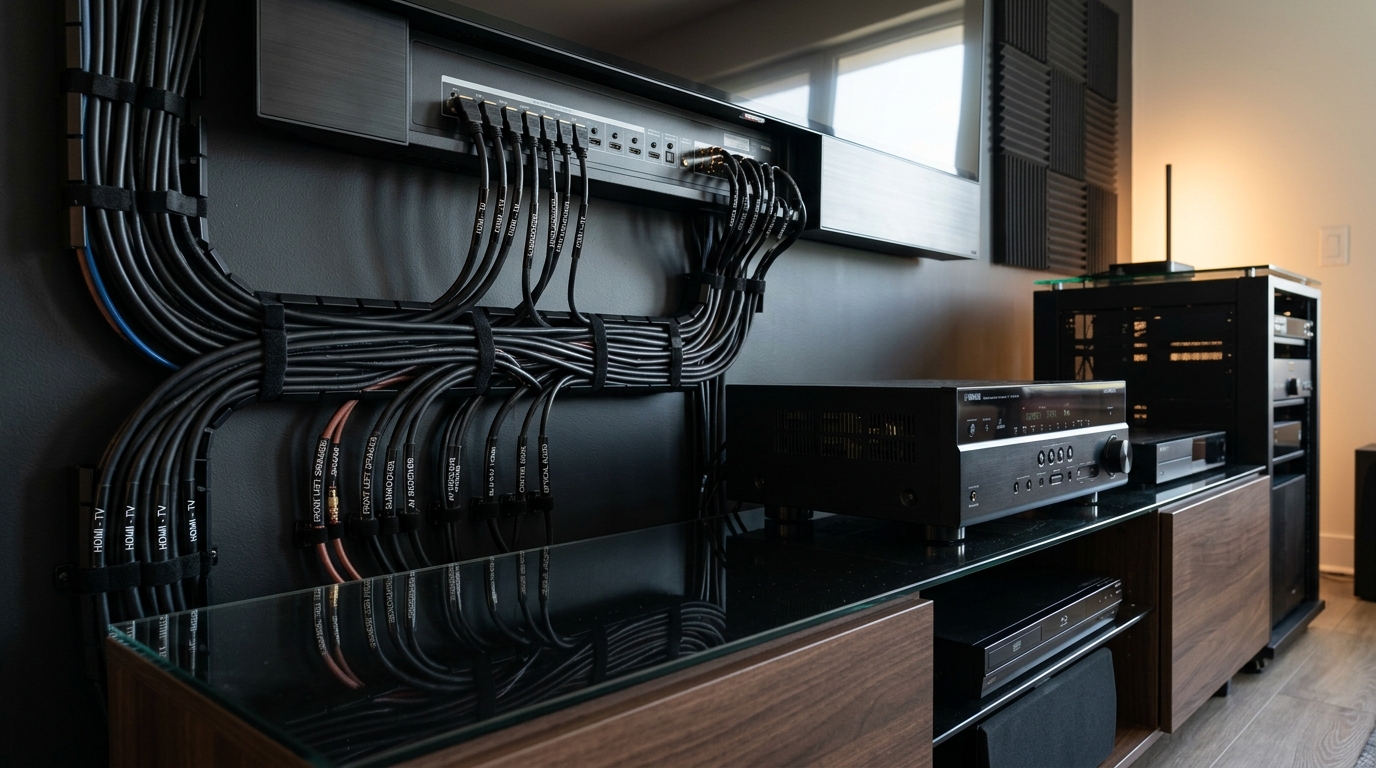
Many home theater enthusiasts are simply put off by this mass of interconnects but in reality, installing a home theater receiver is no more complicated than installing an HDTV. You see, inputs and outputs on the rear panel are always clearly labeled accordingly; therefore, all it takes is a methodical approach to avoid mixing up the different inputs and outputs.

A Home Theater Receiver or Separate Components?

A home theater receiver is just one way of getting surround sound. For those looking for the ultimate in home theater audio, a setup based on separate components would probably represent their preferred option. But both options have their pros and cons.

Investing in a home theater receiver represents the cheapest option; it may take even up to a couple of thousand dollars in a separates setup to get all the functionality enclosed within the typical home theater receiver. An AV receiver also eliminates the mass of cables needed to interconnect the preamplifier with the multi-channel amplifier units as well as the Tuner with the preamplifier. And though less important, the receiver option helps save AV rack space.

The downside of the AV receiver solution is that it is hard for the delicate components within the preamplifier/decoder section to coexist under the same roof of a heavy multi-channel power amplifier while sharing the same power supply. We are not saying that it is impossible and some home theater receivers can do a remarkable job in delivering a great sound. But in general, performance suffers during peaks as power amplifiers tend to draw much of the available power from the rest of the circuitry.

Last but not least, a home theater receiver would make it difficult to isolate any interference caused by the different functions when these coexist in one unit.

On the other hand, a surround sound solution based on a set of separate components would yield the most flexible way of achieving the desired result.

Opting for a separates solution would generally call for a different component for each of the functions highlighted above - namely the tuner, preamplifier complete with switching and surround sound decoder, and the power amplifiers to drive the different speaker channels. The result is a higher level of performance and higher quality sound at even higher power levels. This makes the whole separates solution more appealing to audiophiles. However, the main reason for choosing the separates route is the need for higher power - say to fill a large hall, rather than just the desire for cleaner sound.

We said the separates option is most appealing to audiophiles but you really need to properly match all system components as otherwise, you risk ending up with a more expensive solution that is only capable of an inferior result!

If you want to opt for separates, do not mix brands and possibly not even model lineups within the same brand. Definitely, do not mix different amps for the different channels in a multi-channel surround sound setup. You see, most amplifiers react differently when adjusting controls - yielding a sound that is not only of a different volume but one that may even come with a different tonality. This would make it extremely hard if not impossible to balance out the sound on the different channels when using different amplifier models for the different speaker channels.

However... those who know their job well would definitely be able to get the best performance and cleaner sound from a separates surround sound setup.

What to look for in a Home Theater Receiver

So far, we have only discussed the necessary components to get surround sound - whether through the use of a home theater receiver, or through a set of separate system components.

But what should be your main considerations when choosing your receiver, and what features should you look for when making a surround sound or home theater receiver purchase? We discuss these issues in detail below:

Amplifier Power is not Everything

First and foremost, it is important to have a real understanding of amplifier specs in order to get a better idea of what really makes a good amplifier. When it comes to amplifiers and home theater receivers, many just look at the amplifier power rating - which is important but this spec alone cannot be taken out of contest without evaluating the rest of the amplifier specifications.

For example, an amplifier rated at 75W/Ch RMS into 8 Ohms at 0.08% THD deliver a much cleaner and better sound than one capable of 100W RMS into 8 Ohms at 2% THD - especially if both support the same signal-to-noise ratio.

In a similar manner, watch out for manufacturers' tricks designed to give the impression of a better product. One common trick in this respect is playing with the speaker load at the amplifier rated power.

We discuss amplifier specs in detail in our article: Understanding Amplifier Specs; in the process, we explain how the different specs relate to an amplifier's ability to deliver adequate audio power and sound quality.

How much Power is Enough?

An equally important issue to consider is how much amplifier power you need.

Audio amplifier power is often a grossly misunderstood term; in particular, many relate the sound loudness directly to amplifier power alone. This is not exactly the case.

Determining the amount of audio amplifier power necessary to match your expected level of loudness or listening pattern, is critical for both an enjoyable listening experience in the home theater, as well as for the safety of both your speakers and amplifier alike.

The required amplifier power has to be seen in the light of both your home theater speakers and the room environment. All three are equally important and need to be taken into account when planning an audio set-up.

More information on this hotly debated issue can be found in our article: Audio Amplifiers - How much power do you need?

Home Theater Receiver Features

Video Support:

Audio specs are the most important thing as they determine the quality and level of the audio output. But there are many other features one should look at when selecting a home theater receiver, in particular when it comes to the video part especially if you plan to switch all your audio/video sources via your AV receiver instead of just plugging these straight to your TV.

Main issues here relate to both the type of supported video connections that the receiver can switch - say component video, HDMI, composite video, etc., as well as the quantity of each. This indirectly is determined by the receiver's ability to convert one video signal to another - say from composite to component video, or to HDMI - depending on the type of AV interconnect you will be using with your HDTV.

Some receivers also incorporate the ability to both de-interlace and convert these to a progressive scan format, and to upscale incoming video to 720p or 1080p. This is very much the same as upscaling DVD players but with the functionality incorporated in your AV receiver.

More important is the type of HDMI connectivity and HDMI switching function supported by the receiver. As further explained in our HDMI Cable Guide, HDMI carries both video and audio. However, accessing both the audio and video parts present on the HDMI interconnect depends on the receiver's capability to access both; some lower-end models simply pass-through the video part on the HDMI when switching between different HDMI sources. Higher-end models generally have the ability to access both for further processing.

A 5.1- or a 7.1-Channel Home Theater Receiver - Which is the right one for you?

Another important consideration when planning a home theater receiver purchase is whether to opt for a 5.1- or a 7.1/7.2- multi-channel audio setup; after all, it is the receiver that has to deliver the audio to the respective speakers.

Both options are perfectly capable of delivering an immersive surround sound experience. However, if you are planning to cross the $400/$500 price mark, a 7.1 AV receiver may be worth considering even if you will be implementing a 5.1 speaker set-up.

We discuss this issue in more detail in our article: A 5.1 or a 7.1 AV Receiver - Which is better?

Multi-Room Audio, Networking and iPod connectivity

These are additional features one may find on mid-range and premium home theater receivers.

Multi-room or multi-zone/Zone B Audio is a feature which enables a home theater receiver to send a second stereo signal to a separate speaker system installed in a different room. The audio signal for Zone B may be either the same or different from that of the main room. Depending on the supported features of the home theater receiver, this means that you may be using the DVD player as the source for your main room while the built-in FM tuner incorporated within the home theater receiver will serve as the source for your zone B audio.

Networking, Internet Connectivity and AV streaming/DLNA support are feature that are becoming increasingly popular with home entertainment. It is thus no surprise that these are finding their place on the latest breed of home theater receivers. Typical features include streaming of audio from your networked PCs and Internet radio, as well as upgrading of the AV receiver firmware straight from the Internet.

iPod Connectivity: iPod compatibility is another popular feature you may be interested in. This is normally provided either through a special adaptor cable or through the use of a docking station.

iPod support on home theater receivers comes in under many different forms. Therefore, check the receiver ability to control the iPod and access the iPod menu via the home theater receiver remote. It is also equally important to check whether you will be able to access both the video and audio on your iPod, or if the receiver will access the audio part only.


Looking for affordable Multi-channel Home Theater Receiver?

Amazon offers an extensive range of AV receivers at significantly reduced pricing. In addition, the various buying options available from the different retailers present on the amazon storefront make amazon one of the most comprehensive online sources in this respect. 

Prior to any decision, we advise to do some research of your own. Look at what other customers had to say about their purchase especially with respect to product quality and manufacturer customer support. A good starting point is the customer feedback posted on amazon. 

You can search the amazon storefront without leaving our site by using the amazon search box below; your search results will appear here under.


Home Theater Sound

Articles covered under this section 

SUBMIT a Home Theater Receiver Review
Would you would like to submit a review of your latest home theater receiver purchase to be featured on our site?

Rest assured that your first-hand experience will be of value to many others.

Click here for details

AV Receiver & Amplifiers

A Buyer's Guide to Home Theater Receivers: What to look for when planning an AV receiver purchase

5.1 vs. 7.1 Home Theater Receivers: Which multi-channel home theater receiver represents the better option?

Understanding Amplifier Specs: How different specs relate to an amplifier's ability to deliver adequate audio power and sound quality.

Amplifier Power: Matching the amplifier power output to your expected level of loudness.

Time Delay Setting in Surround Systems: Correct delay settings are essential for a unified sound-field.

Best AV Receivers: Reviewing the best midrange home theater receivers for home entertainment.

Surround Sound Formats

Dolby Sound formats including High-definition Audio Formats and Virtual Surround Technology

DTS Sound formats including DTS High-definition Audio

High Definition Audio for Music Listening covering DVD-Audio and Super Audio CD - including DualDisc and Hybrid SACD.

Audio Speakers

Home Theater Speaker Basics: An introduction

Selecting Speakers for Multi-Channel Audio: Discussing the different types of speakers and the speaker requirements associated with the different surround sound channels.

Ceiling and In-Wall Speakers Guide: More speaker options for your home entertainment

The Subwoofer Guide: Complete guide to passive and powered subwoofers

Home Theater Speaker Choice: What to look for when shopping for audio speakers for use in multi-channel audio

Speaker Placement in Multi-Channel Audio: Discussing the home theater speaker placement associated with both music listening and movie watching

Understanding Speaker Specs: Explaining the different terms associated with audio speakers.

Additional Articles:

Tips for Better Sound: Simple steps you can take to a better home theater sound sound.

Dolby vs. DTS - Which is better?  Discussing the differences between these surround sound formats.

THX Home Cinema - An Overview: This short guide to THX explains this certification system, together with the different certification logos, and related technology.


 Home Theater Guides:

Recommended Technical Guides 

3D TV in the Home
We experienced 3D in the movie theater; now 3D is coming to your home thanks to the latest 3D HDTVs. Discover all you need to know about the 3D technology in home entertainment.

The Complete LCD TV Guide:
LCD HDTVs are turning out sharper, bigger, better, and cheaper. Discover all you need to know about LCD TV sets in this series of articles on LCD televisions.

Plasma Television
Discover all you need to know about plasma TVs - from the features to look for when purchasing a plasma television, to installing and protecting your plasma TV investment.

Guide to Digital Satellite TV
Covering satellite TV basics - with a special emphasis on satellite TV decoder choice and satellite dish installation.

Equipment Racks:
There is more to equipment racks than a storage space for your system components. More in this informative home theater guide.

TV Viewing Distance
Buying a big screen TV? Care should be taken as you may easily fall into the trap of buying a too large TV.

Room acoustics and lighting
Acoustics & lighting are dependent on the shape, size and layout of your room – a fact often overlooked by many during their home theater design stage...

Home Theater Seating
Don’t underestimate the importance of proper home theater seating - the layout of home theater seats play a determining role in your home theater experience.

Equipment Placement
Just as important as which equipment to buy, is deciding where to put them. Correct placement of system components is a major contributor towards...

Selecting and Installing Speaker Wire
A correct home theater wiring approach is important for your home theater sound. Poor workmanship and low quality speaker wire will surely impact...

HDMI Cable Guide
To many, HDMI is still an unfamiliar term. This easy-to follow home theater guide explains all you need to know about HDMI.

Understanding HDTV Formats
Discover the strengths and weaknesses of the different HD formats - 720p, 1080i, and 1080p - in this HDTV Guide.

 HT Books and Magazines

Recommended Home Theater Reading

Home Theater

Loads of useful information, equipment reviews and buyer's guides.

Home Theater Magazine

Sound & Vision

Provides good reviews on the latest home theater gear.

Sound & Vision Magazine

Practical
Home Theater
Well-written home theater guide - a useful reference to anyone interested in home theater.

Practical Home Theater

Quick Guide to Home Theater Design

How to research, design, and build your Home Theater.

Home Theater Design e-book

by Duncan McClelland
More information HERE


Featured Home Theater  Receivers

Check out the latest reduced pricing  at amazon

Yamaha RX-V671BL 7.2-Channel AV receiver

A follow-up to the highly rated RX-V667, the new Yamaha RX-V671BL is one of the best home theater receivers for 2011 at this price bracket. It comes with excellent sound, better connectivity than most of the competition, and sports a great user interface.


Onkyo TX-NR709 7.2-Channel 3-D Compatible Network AV Receiver

The Onkyo TX-NR709 is a 110W per channel THX certified AV receiver with extensive switching capabilities and supported audio formats. Features include networking with streaming support and internet radio, iPod connectivity, and 3D-compatibilty.


Pioneer Elite SC-35 AV Receiver

The Pioneer Elite SC-35 is a 140W per channel AV receiver capable of excellent audio performance. Features include network connectivity, Internet radio support, iPod connectivity, Air studios monitor certification, HDMI 1.4a with 3D capability, and 3-Zone A/V distribution with GUI.


Harman Kardon AVR3600 7.1-channel AV Receiver

The AVR3600 is an 85W per ch. AV receiver capable of very good quality sound. It comes with numerous features - including HDMI ver. 1.4 with 3D support, analog to HDMI video conversion and 1080p upscaling, on-board HD audio decoders, Bridge III™ iPod® dock for full audio/video playback, assignable channels for zone 2, and zone 2 remote.


Find us on Facebook

Follow us on twitter


Subscribe To This Site [?]

XML RSS

Add to Google

Add to My Yahoo!

Add to My MSN

Subscribe with Bloglines


Please Note:

Double-underline links represent additional info related to the page content supplied by Kontera. To view this info, place your cursor over these double-underline links.


Best AV Receiver Reviews

Submit your AV Receiver Review

Surround Sound - Main Index

Home Theater Design

Home Page