Home
E-zine Subscription
CRT TVs
LCD TV Guide
LCD TV Reviews
Plasma TV Guide
Plasma TV Reviews
Projection TV
DIY Projection TV
RPTV Reviews
Projector Reviews
Projection Screens
Digital TV Guide
Satellite Television
Surround Sound
HT Cables
HDCP
Set-Up DVDs
Home Theater Design
HT Pictures Gallery
Equipment Racks
MoviePoster Guide
The Poster Store
Headphone Guide
Wireless Speakers
Media Players
Books & Magazines
Catalogs
Power Protection
Home Theater Sites
Useful Links
Refurbished Products
Price Search
HT Online Store
Advertise on this Site
About Me
Contact Form
Privacy Policy
Site Search
Site BLOG

XML RSS
What is this?
Add to My Yahoo!
Add to My MSN
Add to Google

A step-by-step process to selecting the right
Home Theater Projector Screen

Selecting the right home theater projector screen is critical for optimum viewing results. This guide aims at providing the necessary information to help you in this selection process.


Home Theater Front Projector Screens


The wide array of available projector screens - each with a choice of projection surfaces to suit the different applications, may make the whole selection process appear to be somewhat complicated.

Yet, selecting the right combination of screen array and projection surface for your home theater is essential for optimum viewing results ...but not only!

It is one thing selecting a front projector screen for a business presentation, and another if what you are after is a home theater solution - this in view that in the home theater, we are concerned not only with the visual impact of the projected image but also with the overall sound quality. Why?

Surprising as it may seem, yet the type of screen material as well as the screen placement with respect to your speakers can do a lot to help you get even more wrapped into the movie experience itself.

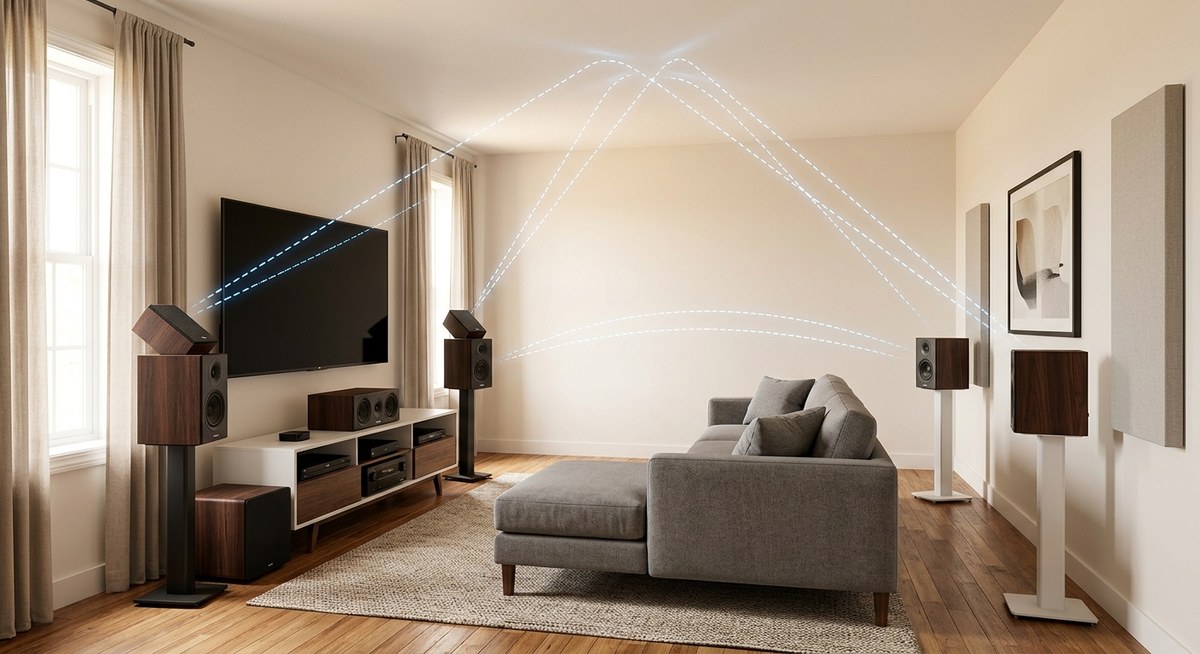
The use of acoustically transparent home theater projector screens, together with the correct placement of speakers with respect to your projection screen surface, can do a lot to help support the overall home theater sound.

For the relevant details on the use of acoustically transparent projector screens, we suggest that once you complete this guide, you would take a look at our Guide to Projector screen surfaces - fabric selection.


Although the thought of choosing the right combination of home theater projector screen array and screen fabric may seem rather intimidating, yet it is a straight forward process - simply follow through the information contained in this Front projection screen guide to discover more.


Selecting the right Home Theater Projector Screen

A simple step-by-step process to selecting the right combination of screen array and screen surface for your home theater application:

Step 1: Determine the Screen Type

Fixed Screen Systems are the simplest and most straight-forward home theater projector screens. Usually, these are found among the more serious home cinema installations.

Generally, all attention is focused on room design and equipment performance, while less attention is paid to "hiding" equipment, so permanently mounted home theater projector screens are more often installed.

The screen fabric is stretched onto a finished aluminum or wooden  frame and attached with snap fasteners, creating a smooth, wrinkle-free surface.

This type of front projection screen is typically installed to 'float' several inches off your wall. If the room dimensions permit however, this distance should be increase to accommodate the placement of the center speaker behind the screen.

This would eventually give a greater sense of dept in your home theater sound and would render your home cinema experience even closer to that enjoyed at the movie theaters. 

Should you decide to go for this setup - (where the center speaker is placed behind the projector screen) - you will have to make use of acoustically transparent home theater projector screen fabric.

Acoustic transparency is achieved through the use of micro perforations within the projector screen fabric - thus allowing for the placement of a center channel speaker behind the projection screen surface while allowing the sound to transmit through the material.


Tripod Projection Screens and Portable Screens are more of a tight budget solution for facilities with multiple presentations or training rooms rather than for home theater use. These can be folded, stored and moved from room to room whenever the need arise.

Portable projector screens in particular are for the traveling presenters. These screens fold into neat, compact cases and are ready to use in seconds. They are smaller (by design) than most other projection screens.

Wall mounted 'pull-down' video screens can be mounted to the wall, to the ceiling, or even installed in the ceiling itself. The manual version is less expensive than remote controlled electric screens; the latter however can be raised and lowered at the touch of a button.

A retractable home theater projector screen - in particular if it is mounted in a false ceiling - can easily be concealed when not in use, rendering this solution most suitable in those situations when a dedicated room is not available for your home theater setup.

Step 2: Decide on the Screen size

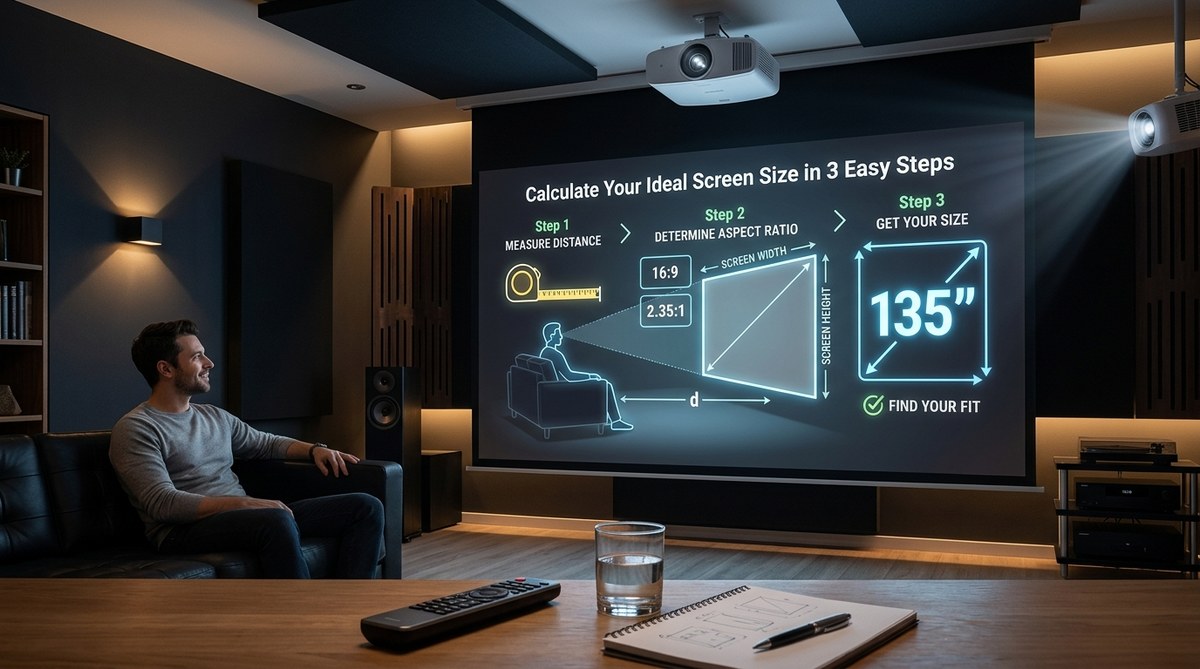
The best performance is achieved by determining the correct size. Ideally, the screen size should occupy a minimum of a 30° field of view for the audience.

The rule of thumb here is to use a home theater projector screen whose width is approximately one half the distance from the screen to the audience seating. For a more detailed discussion on the optimum viewing distance and screen size, please check our TV Viewing Distance article.

In general, screen placement should be determined according to the sightlines of the installation. This should allow all members of the audience to see all parts of the screen in an unobstructed manner.

Step 3: Identify your Screen Format

To select the appropriate format for your home theater application, you need to identify the type of video signal you will be viewing most.

The most common formats and their aspect ratio formulas are as follows:

  • Anamorphic (Cinema-Scope) 2.35:1

  • Letterbox Video: 1.85:1

  • HDTV: 1.78:1

  • Standard video format (NTSC and PAL): 1.33:1

The diagram below depicts the differences between these picture formats:

Different video formats

Step 4: Choose the right Screen Surface

There are a number of factors which must be considered when choosing a front projector screen surface that best meets the needs of a custom installation. Seating configuration, projector model and type, as well as ambient light are all factors that must be put into the overall equation.

This also explains why all major projector screen manufacturers offer a diverse selection of screen surfaces to meet the needs that arise out of the different environments.

For detailed guidelines on selecting the right home theater front projector screen surface, we suggest that you take a look at our Guide to Projector Screens - Surface and Fabric selection. This guide explains the criteria that should be taken into consideration to arrive at a most suitable screen surface for your application.


...but the screen surface alone is not everything! There are other items in the list to consider when setting up a front projection screen setup.


Screen Borders and Screen Drops

A suitable home theater projector screen is a crucial element in any home theater setup. But there are two other important accessories which one has to consider when setting up a projector screen - these are black masking borders and screen drops.

Black Masking Borders are in general, a standard feature found on most front projection screens available from major screen suppliers.

Borders enhance the perceived brightness of an image on a screen. The human eye perceives the image to have more contrast and a sharper picture with brighter colors. Borders also allow the projected image to "bleed-off" the screen for a professional appearing presentation.

Drops are available on most wall and ceiling electric screens. The 'drop' is that extra fabric added to the top or bottom of the screen to adjust the screen surface to within normal viewing heights. Drops  are normally either black or white.

In general, masking borders and drops are set to match a fix screen format. However, it is also possible to find electrically operated adjustable masks that can be adjusted to alter the projection screen aspect ratio to suit a different video format e.g. when viewing a standard video format onto a home theater projector screen that has been designed to accommodate also HDTV viewing.


Looking for affordable Projector Screens & Accessories?

In collaboration with amazon.com, we have put together a selection of home theater projector screens and accessories from major suppliers at our Home Theater Store; major suppliers covered include: Elite Projector Screens, Da-Lite Screens, and Draper Screens.


Please remember to subscribe to our free monthly e-zine to remain abreast with the latest additions to our site.  Click here for details.

Last updated on:   11th April 2005

Next topic: Guide to home theater projector screen fabrics

Back to: Home Theater Screen Index Page


return from Projector screen selection guide                                  back to Home page