![]() |
||||||||||||||
![]() |
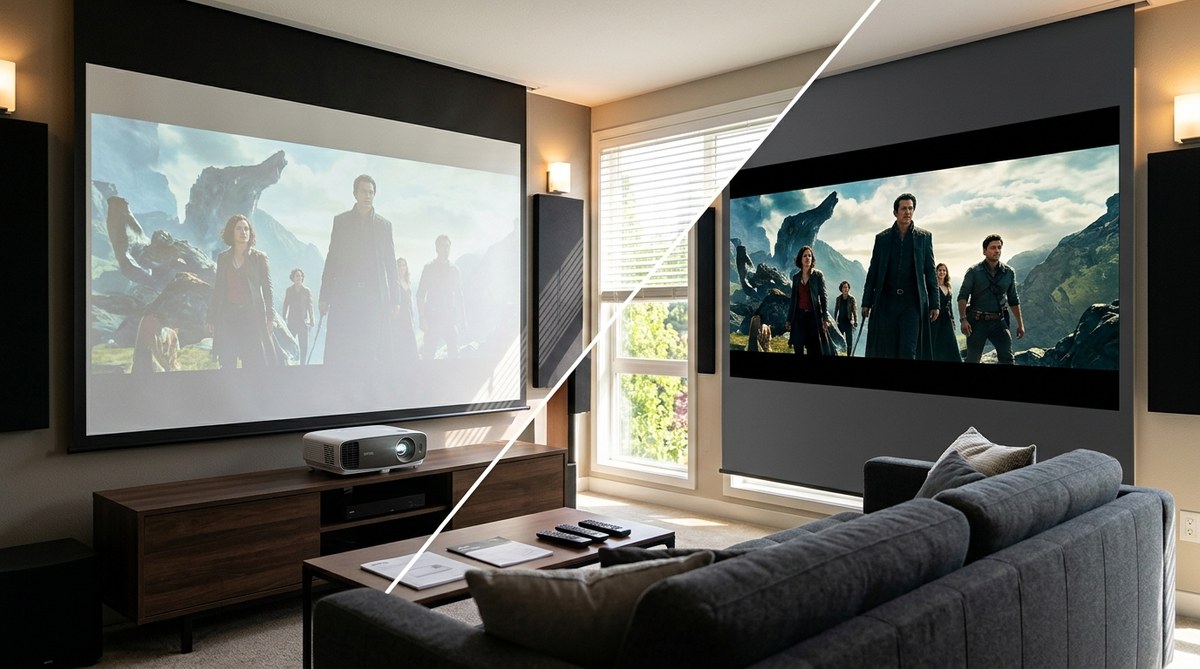
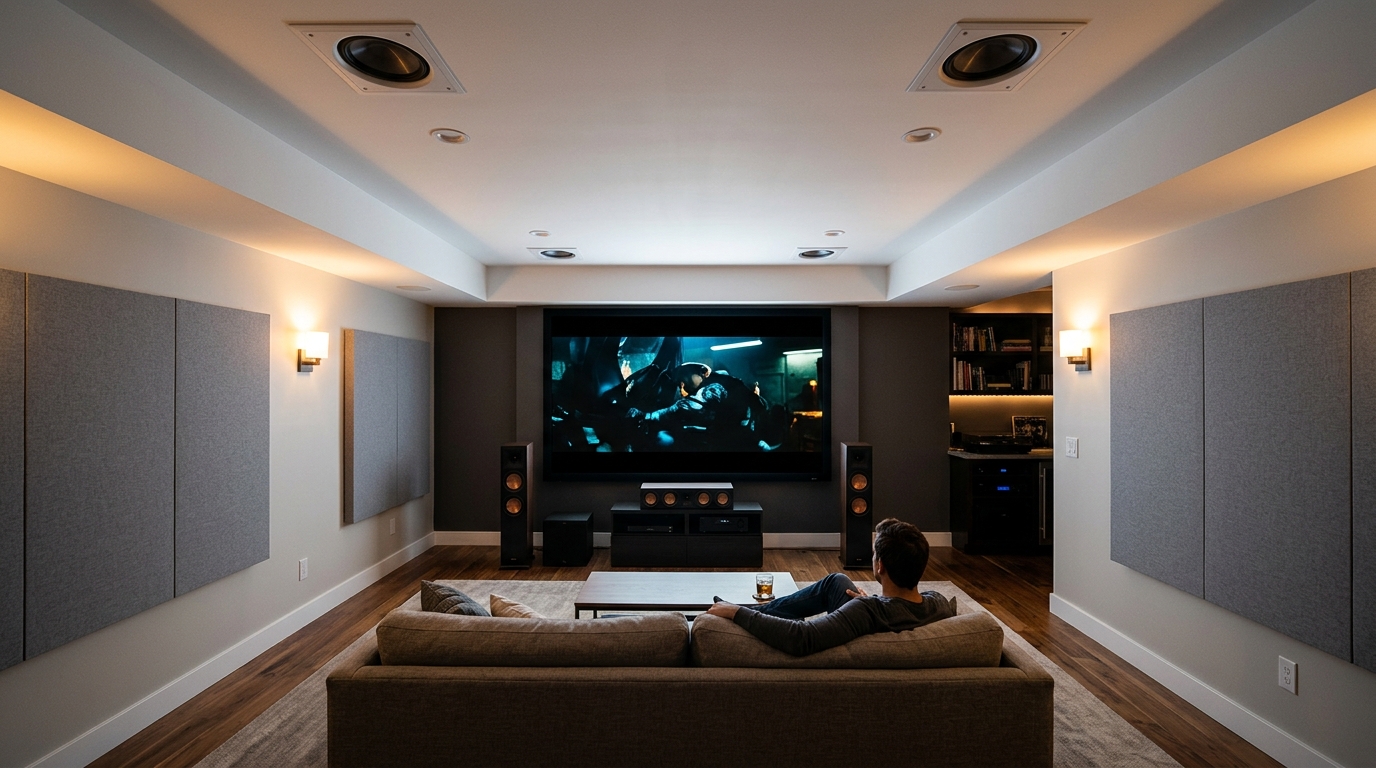
Designing your own home theater is becoming even more exciting than ever. Televisions are getting bigger, better, cheaper and slimmer. The home theater enthusiast has got a vast selection of big screen systems ranging from direct view flat panel Plasma TVs to large screen rear projection sets and video projectors. Unfortunately, few realize that nothing sets you closer to the movie theater magic than a front projection setup - more precisely,
Picture, size, and quality, provided by front projection TVs resemble most closely the movie-theater experience. Most home theater enthusiasts seem to ignore this option completely - partly due to the misconception that projectors are priced well out of reach of their budget. Yet, if you have got the necessary room space, the video projector solution is most probably the best way forward. At this point, it is worth clarifying that though many refer to front projection as 'front projection TVs', yet one cannot technically call a front projection setup a television - this in view that home theater projectors do not normally come with a built-in TV tuner. We hope that the information contained in this introductory guide to front projection, will put you in a better position to determine if the home theater projector option is for you; it provides you with all the basics you need to know before getting started with a front projection TV solution.
If you want to put the 'real movie magic' in your home theater, the projector and movie screen approach delivers it; rear projection TVs are just big televisions. Front Projection: An Affordable Big Screen Option for your Home Theater A great deal of consumer appeal for rear projection TV systems arises out of the shear simplicity that this product offers as an immediate solution to getting a bigger TV. In addition, most big screen high street retailers seem to give the impression that rear projection television systems are cheaper than most front projection TVs. This may be true in retail stores, but not necessary so when buying online. On the internet, it is most likely that for a given budget level, front projection TVs will deliver a much more cinema-like experience in terms of picture size and quality than any other TV picture technology. (Should you decide to buy online, please check out Projection TV Buying Guide for more information.) Clearly, there is market for both - the main decisive factor being your home theater room size. At the same time, one cannot ignore the fact that front projection TVs seem to offer a number of advantageous over rear projection. In particular, a front projection setup:
We take a detailed look at each of these issues to further expose the main differences between rear and front projection TVs. Screen size: An obvious difference but worth thinking about for a moment. Front projection TVs would easily deliver a 100" screen - that's four times the surface area of a 50" rear projection TV. Yet a home theater projector for your front projection setup would not cost more than a good quality 50" rear projection set. Viewing angles: Rear projection sets have a rather small optimum angle of view; move away to either side of the optimum viewing position, and color, contrast, and brightness degrade considerably. This is not so much of an issue with front projection TVs - the image is both larger and much easier to view from a wider angle - though the use of a good quality projection screen surface is essential to ensure the best results when viewing the picture from different positions. Reflections: Reflections may create a serious degradation of picture quality in Rear projection TV systems. Front Projection TVs do not normally have reflection problems - especially with matte screen surfaces. Optimum use of floor-space: A rear projection TV is a large box that will stand out from the wall by as much as 30 inches - shrinking the viewing space by approximately three feet. It is true that some of the latest LCD and DLP rear projection TVs are getting extremely slim; a case in point is the popular 50-inch Samsung HL-R5067W reviewed on our site, which at 14 inches in depth, is one of the slimmest in its range. (For a review of the Samsung HL-R5067W, please click HERE). BUT still, a rear projection TV is difficult to disguise when not in use. With a front projection TV setup, the screen is usually either wall, or ceiling mounted. Therefore it lets you use the full room depth for viewing. A wall mounted screen can be covered with a curtain when not in use, while a ceiling mounted electric screen can be retracted. A great advantage of front projection TVs is that the projector and screen combination gives you more flexibility in terms of 'making it disappear' when not in use, while using no floor-space. Aspect ratios: A serious issue with any video display system is aspect ratio management. Rear Projection TVs come with a fixed aspect ratio of either 4:3 or 16:9. But today video material comes in a variety of aspect ratios. So if you are designing your own home theater, it is important to give this issue careful thought. The aspect ratio of a video image is the ratio of its width to its height. Standard television screens are 4:3 (1.33), which means they are four units wide for every three units of height. All standard (non-HDTV) television broadcast material today, as well as most older classic movies, come in the 4:3 format. However, modern films are normally produced in one of several widescreen formats. On the back of many DVDs you can find the movie's actual aspect ratio in the fine print; a most common aspect ratio is 2.35.
'Image stretching' and 'horizontal/vertical bars' can be extremely irritating while in the 'pan and scan' you are giving up film information to have a full screen view. Worst of all, in the case of CRT based projectors, prolonged use of black or gray bars to adjust aspect ratio may lead to tube burn-in at HUGE costs to you. The incompatibility
between screen formats renders the decision on aspect ratio a rather
complicated issue when choosing a rear projection TV set. For best results, you still need to match the projector native resolution with that of the incoming video signal if you do not want to loose picture information when adjusting the image aspect ratio. Price: Are you still being faced with the dilemma of choosing between a rear projection system and a home theater projector set-up? If you are interested in the higher quality digital systems available today, in particular, if you are thinking in terms of a digital projection setup that is both 480p and HDTV compatible, then price-wise, a 100-inch front projection set-up would fall within the same price bracket as some of the latest 55inch 16:9 DLP or LCD rear projection TVs.
For example, the Toshiba 52HM84 52" HDTV-Ready Projection DLP TV
referred to earlier on, is presently selling online at amazon for around $2,000.
Similarly, the slightly bigger Gateway 56" Widescreen HD-Ready DLP Rear-Projection TV
At these price levels, you can
get an HDTV-compatible
Panasonic PT-AE700U Home Cinema LCD Projector Making the Choice: The bottom Line - Your Room Size! If you are looking for a high quality rear projection TV and your viewing room can accommodate an 80" to 100" screen, do not overlook the possibility of a front projection TV setup. Price-wise, if you can afford a good quality 50" rear projection HDTV, you can also afford a good quality home theater projector and projection screen. If you think that a Front Projection Setup represents a solution to your needs, we suggest that you also take a look at the following Projection TV guides:
Visit also our Projection Screens section for detailed information on how to choose an appropriate projection screen (surface) for your front projection TV. Front Projection TVs at amazon.com At present, amazon has got a full range of multi-media and home theater projectors from major brands - available at reduced prices; for more information, please check out the following links:
...back to Projection TV Guides - Main Section Index
|
Copyright © - Practical-Home-Theater-Guide.com All rights reserved. |
||||||||||||