left image


Home Page - Projection TV - Contrast Ratio and Video Displays   

Date: 22nd February 2010


A Quick Guide to Home Theater Design

How to research, design, and build your Home Theater.

Home Theater Design e-book

by Duncan McClelland
More information HERE


Samsung UN55B8500 LED LCD TV with local dimming

Samsung 55" UN55B8500 LED TV

with 3,000,000:1 contrast ratio

A Popular Trend: Playing with Contrast Performance Figures 

Big numbers sell better, and manufactures know this very well.

This number battle is everywhere, from the use of interpolated, instead of true optical image resolutions in digital image scanners and cameras, to the latest 240Hz and 480Hz refresh rates in LCDs and the 600Hz sub-field drive in plasma displays. It is as if manufactures do their best to come with the biggest number to deliver the message they have the best product.

However numbers on their own do not mean anything; unless you know what you are really talking about, one may end up misinterpreting facts.

The same applies to contrast ratio. By 2004, TV makers came up with an unprecedented 4,000:1 contrast ratio. By 2007, figures for contrast ratio reached 15,000:1 and in 2008 we saw the first 1,000,000:1 contrast rating for LED TVs and plasma HDTVs. Now we have multi-mega contrast ratios. There is really no limit to how much these numbers can continue to grow.

Yet this contrast ratio issue is more than just numbers. Apart from the fact that most TV makers often fail to differentiate between static and dynamic contrast - some TV manufactures are taking consumers for a ride by quoting ultra high ratings for contrast ratio using unspecified test methodologies. Their purpose is to help sell their products over that of the competition.

We are not saying that the latest mega-contrast ratings associate with some HDTVs are incorrect - most probably they are correct if measured in a totally dark room environment.

But...

Blue bullet

What is actually being measured by these display manufactures?

Blue bullet

Does this dark room setting represent the typical viewing environment, and how does ambient light affects the resultant contrast ratio of a display device?

Blue bullet What is the implication on perceived contrast by the eye - is this as much as manufacturers are trying to imply with their big numbers?

Is your Black really Black?

What is Contrast: Defining and Measuring Contrast Ratio

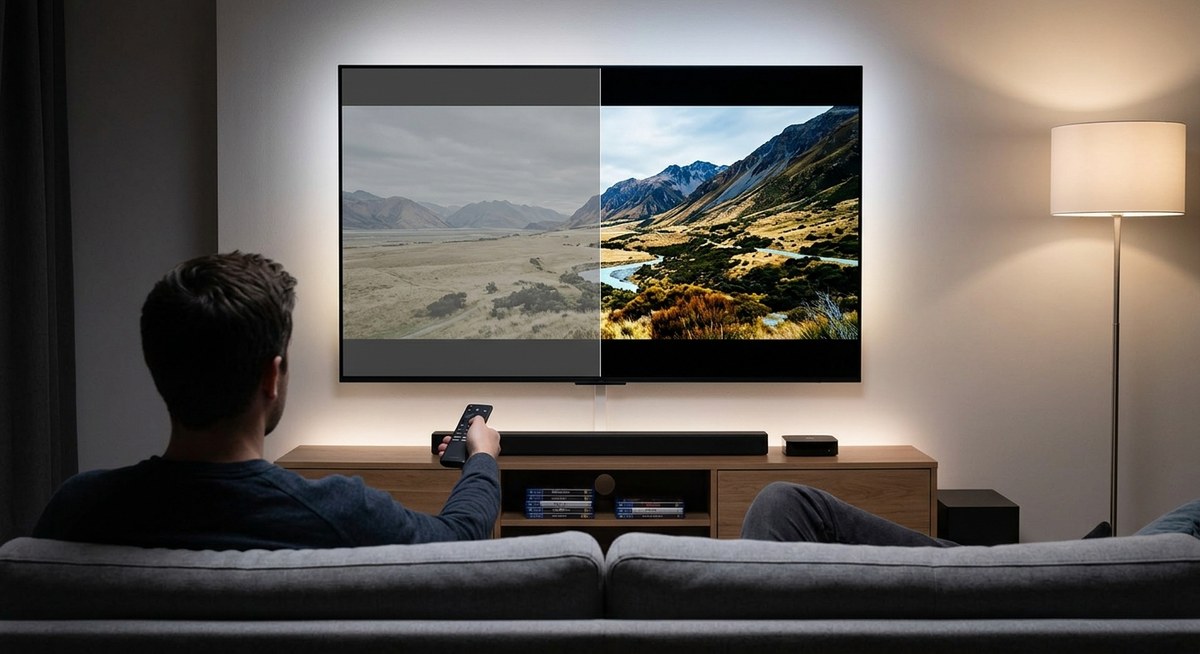
Contrast is the ratio between the white and black parts in an image. A contrast rating of 300:1 means that the luminance or brightness level of the white areas in the image is 300 times brighter than that of the blacks. The larger the contrast ratio, the greater the difference between the brightest whites and the darkest blacks a display device can produce.

Contrast is an important image quality attribute that affects our ability to perceive both image brightness and image detail. Without a sufficient level of contrast, images appear flat with the blacks and white taking a gray shade while finer image detail would be lost.

Static or Dynamic? Static contrast refers to a display device native contrast ratio. It is the more important of the two despite being smaller as it represents the 'true' contrast i.e. the darkest blacks and the brightest whites that a display can simultaneously support at any one time.

Instead, dynamic contrast refers to the maximum ratio between the deepest blacks a display can show and the brightest whites it can handle over its entire operational range but not at the same time. A display device will never be able to handle these two extremes simultaneously.

Dynamic contrast uses a processor inside the display to analyze the average, overall picture brightness and adjusts the backlight level on-the-fly. This helps render deeper blacks in predominantly dark scenes and brighter whites in mostly bright picture content. When done properly, dynamic contrast can give the impression of higher contrast ratios and solid black levels; done poorly, it can crush black to the point of losing shadow detail.

Yet dynamic contrast may also alter the tone response characterizes, or gamma setting of the display and the video signal on-the-fly to produce what most consider a more attractive image. But altering these characteristics means that the presented image may not necessarily be a true and faithful representation of the original video signal. This may not be an issue with video games and most TV content, but it is with material of artistic nature.

As expected, the dynamic contrast ratio results in much larger numbers and is often the contrast ratio most quoted by TV makers.


Note: Some definitions for contrast ratio imply that an increased contrast ratio yields better subtle shadow detail and increased color palette. This is NOT true. These definitions fail to differentiate between an imaging device ability to display finer image detail for which a sufficient level of contrast is necessary for the eye to perceive the finer detail, and subtle shadow and color palette. 

A device ability to display subtle shadow arises out of its ability to display various levels or intensities of gray - referred to as shades of gradation - from complete black to complete white. This depends on its grayscale capabilities rather than on a higher contrast ratio.

There is also the issue of grayscale uniformity - the ability to maintain all shades of gray close to the D65 (or 6,500K) standard across the entire brightness range to preserve color fidelity at all brightness or luminance levels. Many TVs fail here - shifting towards red in the darker areas and blue in the lighter parts of the image.


Measuring Contrast Ratio

The two methods mostly used by the projection and video display industry to determine contrast performance of a device are the Full On/Off, and the ANSI Contrast ratio measurement:

Blue bullet

Full On/Off Contrast is the ratio of the light output of an all white image (full on) and the light output of an all black (full off) image. This is the most favored measurement by manufactures as it yields a larger number for the contrast ratio - 25% to 100% more - than ANSI Contrast measurements for the same display device. Some manufactures of DLP-based displays would even carry this contrast ratio measurement with the 'white segment' of the color wheel turned; this increases the measured figures for the white luminance, hence inflating further the end result.

Blue bullet

ANSI Contrast is measured with a pattern of 16 alternating black and white rectangles - also referred to as the 'checkerboard' test pattern. The average light output from the white rectangles is divided by the average light output of the black rectangles to determine the ANSI contrast ratio.

The 'Checkerboard' ANSI Contrast Ratio test pattern

Checker-box image courtesy of ausmedia.com.au

ANSI Contrast represents a more fair way to test contrast ratio as the presence of black and white at the same time is closer to the real world environment rather than  the all black or all white image used during the full ON/OFF contrast measurement. This renders the average reading obtained from the ANSI Contrast more realistic.

It is thus clear that when comparing the contrast ratings of home theater projectors and video display devices, it is essential to ensure you are comparing the same type of contrast. Full On/Off contrast will always be a larger number than ANSI contrast for the same projector or monitor.

Unfortunately, there is nothing mandatory as to the methodology used by manufactures to measure contrast performance. Even worse, manufacturers are not obliged to specify the method used to arrive at the quoted figures.

This renders a straightforward comparison of contrast performance figures between different imaging devices - especially from different manufactures - almost meaningless.


Don't be impressed with BIG Contrast Numbers!


Making the Display: Contrast Ratio Facts  ...and numbers

Contrast is an important attribute in a display or video projector performance and helps make an image 'pop-up' as it affects our perception of color differences apart from image brightness. A minimum level of contrast is necessary for the eye to perceive an image as 'bright'. Studies show that for a binary black and white image, a minimum contrast ratio of 2 is necessary for comfortable viewing, while a contrast ratio of between 5:1 and 7:1 is necessary for the eye to distinguish color differences.

Yet, today's video projectors and flat-panel TVs come with more than just a minimum level of contrast. The latest home theater video projectors from Sanyo (PLV-Z3000) and Panasonic (PT-AE3000U) have a rated contrast ratio of over 60,000:1. Even more impressive are the latest plasma and LED TVs with their mega contrast ratings. Plasma TVs such as Samsung PN50B650 and LG 50PS80 come with at least 2,000,000:1 contrast ratio, while Samsung UN46B7000 LED TV has a quoted 3,000,000:1 contrast ratio!

Yet, the truth is that contrast cannot be taken on its own. A high contrast ratio can be misleading at best if used incorrectly; and in the promotional media, it can even turn out to be a lie.

A higher contrast ratio implies a device has greater ability to display black as 'a deeper black' instead of dark gray with respect to its brightest whites. A home theater projector with a contrast ratio rating of 8,000:1 is more capable of showing a dark subject than one with an 800:1 contrast ratio. But the difference in performance between the two would only become apparent if projection takes place in a completely dark room, one in which is there no light other than that of the projected image.

Equally important is that the eye would not detect a 10 times improvement in contrast performance between these two projectors. Rather, the perceived difference in image performance between these two devices would be just marginal and detectable only if the room is in total darkness.

Marginal because the eye contrast sensitivity is not linear. While a difference in a contrast ratio of between 10:1 and 20:1 will be definitely distinguishable and a difference between 100:1 and 200:1 as clearly visible, the eye would see the difference between say 400:1 and 800:1 as a minor change. And anything above 1000:1 may not be visible at all.

And it is detectable only in the total absences of ambient light because as we will see further in this article, complete absence of stray light in a room is critical when it comes to contrast performance. This is a rather rare situation in everyday life unless viewing takes place under a controlled environment, such as that of a dedicated home theater with black painted walls.

This absence of light in contrast performance is important as the brightness level of what the eye perceives as black in comparison to the brightest parts of the image, can only be as low as the light reflected by the darkest parts of the image. This applies irrespective of whether the image is being displayed on a projection screen or a direct-view display such as that of an LCD or plasma TV.

Any ambient light will be reflected by the projection screen surface, or the glass surface and the internal display structure in the case of a direct-view display, thus turning black into what may appear as some shade of gray. This lowers image contrast considerably.

Direct-view systems however have the advantage that their contrast performance is significantly less affected by the presences of light in the room. This is mainly thanks to the optical coatings on the display screen surface that help block external light from entering the display panel, and the use of a black surface structure inside the display between adjacent pixels to block more of the ambient light from entering the display.

Presence of Ambient Light and Contrast Ratio

1 LUX: Candle against dark background

With this much light in the room, there is no difference between 900:1 and 10,000:1 Contrast Ratio!

Presence of light: To better understand the impact of the presence of light in a room on the contrast ratio performance, consider the light emitted by just one candle in a room one meter away from a display surface whose black level stands at 0.1 cd/m2 in total darkness. This is sufficient to render the image from say a 10,000:1 rated contrast ratio video projector the same as one projected by a 900:1 CR rated projector when the latter is displayed in a totally dark room!

Increase the light in the room to approximately 30 LUX; this corresponds to the light emitted by a small incandescent lamp. Contrast figures above 100:1 would now turn out to be simply academic even in the case of video projectors with say a relatively high 2500 ANSI Lumens brightness rating. Why?

To maintain a 'low' 200:1 contrast ratio under 30 LUX of ambient light, your projector have to generate more than 6000 LUX for the brightest areas. But to maintain this level of brightness over say a 100-inch diagonal 16:9 unity gain screen (30 square ft), you need a projector with at least 16,000 ANSI-Lumens output. Your 2500 ANSI Lumens projector will never maintain a 200:1 contrast even in a dimly lit room, least image its quoted 10,000:1 contrast ratio under the presence of higher levels of ambient light. (For more information on projector screens and video projector output, please refer to our article: Understanding projector screens.)

Let's continue playing with numbers! To better understand the whole issue of the presence of ambient light and its effects on contrast performance, consider a contrast rating of say 2,500:1 and a maximum luminance level of 250 cd/m2 for the brightest part of the image. Then the darkest part of the image will have a luminance of just 0.1 cd/m2 in the complete absence of ambient light.

Let's introduce the presence of a dim light source in the room and assume that just 5 cd/m2 of this light is being reflected by the screen surface.

Contrast ratio would than change as follows:

= While Luminance/Black Luminance

= (250 + 5)/(0.1 + 5) or 255/5.1 = 50:1

This means that our contrast ratio has now changed from the original 2,500:1 to just 50:1!

And it only takes a very dim light source for a display to reflect as much as 5 cd/m2 of light. A shinny screen surfaces such as that of a CRT may easily reflect as much as 80% of the light falling on the screen.

It is thus clear that unless you watch your moves in a completely dark environment, it would be useless to stress too much and pay more for a device with a too high contrast ratio rating!

Important Factors worth considering:

Contrast and Brightness: As already stated, contrast does not stand on its own! A higher image brightness level would yield a better perceived contrast ratio for a fixed level of ambient light.  This means that a projector with a lower contrast ratio but with higher rated lumens output may under certain light conditions, perform better than one with a higher contrast ratio but lower brightness level.

Cinema: It is interesting how present-day digital cinema projection equipment performs with respect to contrast ratio. Typical contrast ratio is 1000:1; however, this varies according to make and model. For example, one of the world's most popular digital cinema projectors, the Christie CP2000 2K 3-chip DMD DLP Cinema™, despite its 35 trillion colors, has a contrast ratio rating of just 500:1 ANSI, 2000:1 full field.

Note: The reference here to the performance of digital cinema projectors applies to contrast ratio. When it comes to image resolution, traditional 35mm and in particular 70mm movie film systems support far greater image detail than that supported by professional digital cinema equipment today.

Grayscale: While contrast is an important attribute, contrast alone does not provide useful picture information - only the various levels of gray does. It is the grayscale performance of an imaging device - its ability to represent various levels of luminance levels - that is the single most important attribute to consider. Larger number of gray scales or shades of gradation implies a device greater ability to display subtle detail in dark or bright scenes, while creating a wide color palette. Without shades of gray, contrast alone is of no use in delivering image information.


Your eyes are the limiting factor!


The Human Eye: an issue on its own!

The eye is not an absolute sensor - what the eye sees are brightness differences. Unlike electronic sensors in digital imaging systems - which are all absolute in their response, the eye has a dynamic response to contrast - also referred to as dynamic range. This alters the whole equation in that what is really important is not some unrealistically high absolute ratio rating, but rather, how the end image is perceived by the eye. Why?

The eye is an extremely complex sensor with far greater response range than any film or digital imaging device. It is able to function both in bright sunlight as well as in very faint light during the night - that's a range of over 10 million to one! In photographic terms, that's about 23 1/2 stops.

At the same time, it is not possible for the eye to see the faint light from a star in the sky during the day. From a photographic perspective, this is like saying that a camera can operate over an extended range, but then the full operating range is achieved by adjusting the film ISO speed, the camera aperture setting, and even the exposure time.

It is the same with the eye; at any given instant, the eye can possibly see over a range of 400 to 800:1 in contrast detection. Some may even see up to 1,000:1 and possibly a little beyond but the eye would not detect any difference above approximately 1,000:1. For anything above that, the whites would be already too bright and the blacks would be too dark for the eye to distinguish any further detail.

The wider dynamic range of the eye is possible as once the eye moves (saccades), it re-adjusts its exposure both chemically and by adjusting the iris. Over time, it is possible for the eye to resolve a contrast ratio range (sort of the dynamic contrast range in HDTVs) of between 1,000,000 and 10,000,000:1.

But the eyes' ability to detect contrast depends on the scene brightness, with the contrast sensitivity of the eye decreasing to about 8% of its maximum at low light levels; the eye sensitivity also decreases with lower contrast subjects.

To complicate matters, the eye Contrast Sensitivity Function (CSF) is not linear - in as much as it decreases with a decrease in brightness, there is a brightness level above which the eye contrast sensitivity falls once again. It is estimated that the sensitivity of the eye is some 600 times less in bright sunlight.

At low light levels, the eye is able to integrate image information over a period of some 15 seconds to be able to see dimly lit subjects (it is like when you increase the camera exposure time to record subject information during low light level conditions).

However, moving from one brightness range to another would take time for the eye to adapt.  A 'dark-adapted' eye would be able to see a faint star in the sky, but this dark adoption process by the eye takes 30 minutes or so to complete - provided you haven't been exposed to bright sunlight during the day, otherwise, it may take even up to one hour for full adaptation to take place. Looking at a bright subject by a dark adapted eye would simply kill your night vision


This implies:  The first 30 minutes or so during a movie are not the best in terms of contrast sensitivity. What's more, looking at a bright movie scene would not help when the next dark scene comes around!


And as if this is not enough, there are other factors as well that affect our contrast perception. For example, the eye would perceive a higher contrast when looking at static images than it would if it were to look at moving pictures even if these were to have similar contrast ratio to that of the static scene.

There is also the issue of the eye contrast sensitivity with spatial frequency.  Technically speaking, spatial frequency is the number of cycles subtended at the eye per degree of vision.

It can be thought of gaps between adjacent image parts that vary in contrast. There is a point above which increasing the spatial frequency i.e. decreasing the gap between adjacent image parts, will reduce the eyes sensitivity to contrast even though the contrast level of the image remains the same.

Spatial frequency

And what about the loss of contrast sensitivity with age? The amount of light reaching the eye photoreceptors diminishes as we grow older; this in turn affects the eyes' response to brightness and contrast perception.


So what's the whole discussion here?

Do not get carried away with big contrast numbers. The eye dynamic response is the limiting factor; at any one point in time, you would not be able to perceive a contrast ratio of more than at most 1,000:1 - irrespective of display technology.

Equally important is that the presence of even a minimal amount of ambient light would make a home theater projector or a direct-view display device with a high contrast ratio rating behaves the same as one with a much lower rating. Direct-view systems are less affected in this respect though their blacks would still suffer under a bright light environment.

Opt for a high contrast projector or display device only as long as you can view the image in a light controlled room. Despite what might seem to be a huge difference in absolute terms between say a 1,000:1 and a 1,000,000:1 contrast ratio, you will have to view the image in a completely dark room to perceive the resultant minimal difference in picture performance. Paying extra just to enjoy a higher contrast ratio is just waste of money.

Conclusion: Numbers are there to impress and help the marketing people sell the product. But quoted peak contrast ratings do not really give you any information on the video projector or display device ability to render images with lifelike gray scales and colors. Rather, the only information that contrast ratio can deliver is how much brighter the 'whites' can be than the 'blacks'!


Suggested Further Reading/References

Resolution and other Details of the Human Eye
http://www.clarkvision.com/imagedetail/eye-resolution.html

The Fallacy of Contrast:
http://digitalcontentproducer.com/display/video_fallacy_contrast/

Projector Contrast Ratio:
http://www.hot.com.au/homecinema#contrast-ratio

Transflective Displays
http://www.planner.com

Eye Contrast Sensitivity and Spatial Resolution
http://www.usd.edu/coglab/CSFIntro.htm

Contrast Ratio - What does it really mean?
http:hp.com


 Article Content:

Issues discussed in this article 


Defining and Measuring contrast ratio - How black is your black?

Making the Display - Contrast Facts and Numbers

The Human Eye - an issue on its own.

Plasma, LCD, and RPTV HDTV Reviews

Featured Reviews and Product Guides on our site

Panasonic Viera 2009 Plasma Line-up - full product guide.

Plasma TV Reviews - 2009 Update:
Index of plasma TV reviews and product guides prepared by Practical Home Theater Guide.

Samsung 2009 LCD TVs:  The B750 Series:
Series 7 Samsung LCDs have all it takes to become the best selling HDTVs for 2009. More in this LCD TV review.

2009 Samsung LED TVs - the Complete Lineup: Product Evaluation

Samsung LED TVs vs. LCD TVs
Which is Better?

Now that we have reviewed both the new Samsung LED and Samsung Series 7 LCDs, it is only natural that we discuss this LED vs. LCD TV issue.

LCD TV Reviews and Product Guides - 2009 Update
Featuring some of the best LCD TV sets presently available for consumer use.

Rear Projection TV Reviews - 2009 Update:
Covering the latest Samsung and Mitsubishi RPTVs.

 Home Theater Guides:

Recommended Technical Guides 

The Complete LCD TV Guide:
Discover all you need to know about LCD TV sets in this series of articles on LCD televisions.

Plasma Television
Discover all you need to know about plasma TVs - from the features to look for when purchasing a plasma television, to installing and protecting your plasma TV

Projection TV
In search of BIG fun; look to the big screens of Projection TV. A complete guide to front and rear projection television systems.

Digital TV
A complete guide to Digital Television - DTV converters, TV antennas, and DTV transition.

Guide to Digital Satellite TV
Covering satellite TV basics - with a special emphasis on satellite TV decoder choice and satellite dish installation.

The HoloVision Rak Master Pull-out/Swivel AV RacksEquipment Racks:
There is more to equipment racks than a storage space for your system components. More in this informative home theater guide.

The HDMI Cable Guide
To many, HDMI is still an unfamiliar term. This easy-to follow home theater guide explains all you need to know about HDMI.

TV Viewing Distance
Buying a big screen TV? Care should be taken as you may easily fall into the trap of buying a too large TV.

Should You Opt for a 1080p HDTV?
Discover the strengths and weaknesses of the different HD formats - 720p, 1080i, and 1080p - in this HDTV Guide.


 Featured 1080p HDTVs:

Sharper, Better, Bigger...

Check out the latest offers on HDTV sets at Amazon

Detailed review available here.

Detailed product guide available here.

Best-selling 1080p rear projection HDTV; see our review here.

See our  LCD TV Review section for more information.

Best-selling Panasonic plasma HDTV for 2009; see our detailed review for more information.

Samsung best selling plasma HDTV; ref. to our Plasma TV review section for more information.

For the full range of
HDTV sets at amazon
,
please click here.

Featured 1080p Video Projectors:

Better, Bigger, Brighter...


For the full range of
Video projectors at amazon
,
please click here.


Would You like to get the best out of your HDTV?

There is no better way to make the most out of your new HDTV then to invest in a set-up DVD.

A great calibration disc is the Avia II Home Theater Set-up DVD, an exceptional AV calibration tool for both the novice and the expert.

Another interesting calibration disc is the Digital Video Essentials HD, but this is more suitable for advanced users.

For more information, please check our Guide to HT Set-Up DVDs.


Home
HDTV Guides CRT TVs
LCD TV Guide
Plasma TV Guide
Flat-panel TV Reviews Plasma TV Reviews
LCD TV Reviews
Best HDTVs
Projection Systems Projection TV
RPTV Reviews
DIY Projection TV
Projector Reviews
Projection Screens
Digital and Satellite Television Digital TV Guide
Satellite Television
Sound and Wireless Systems Surround Sound
Wireless Speakers
Headphone Guide
Media Players
Home Theater Guides Home Theater Design
Equipment Racks
AV Cables
HDCP
Set-Up DVDs
Power Protection
Books and Magazines Books & Magazines
Catalogs
Home Theater Ideas! Home Theater Sites
HT Pictures Gallery
Useful Links
Movie Posters MoviePoster Guide
The Poster Store
Shopping Online Price Search
Refurbished Products
HT Online Store
Website Information About Me
Website Content
Site Use & Dislaimer
Privacy Policy
Advertise
Site Search
Contact  Form
Site BLOG
E-zine Subscription
-

[?] Subscribe To This Site

XML RSS
Add to Google
Add to My Yahoo!
Add to My MSN
Subscribe with Bloglines


Looking for a Cheap flat-panel HDTV?

Would you like to save anything between 50% and 80% on your HDTV purchase?

Visit RefurbDepot.com to see their vast range of plasmas, LCDs, and Projection factory-direct refurbished HDTVs


Back to:  Projection TV Section Index


Home Page