The
simple answer is good sound! This should be your main determining factor
- implying extensive listening test before choosing your home theater receiver
or amplifier, but...
The
reality is very few will ever have the possibility to listen
to as many power amplifiers they would like to when making a
purchase, especially when buying online. Yet
for the informed, an amplifier specs sheet can tell a lot about
an amplifier ability to deliver good sound.
At this point, it is
important to realize that there is no single
spec that can define a home theater receiver or audio amplifier's
ability to deliver a great sound. So do
not single out one spec - no matter how important it is to
you - without taking into account the rest, whether
that being amplifier power rating, noise level, etc..
Many do the mistake
of assessing an audio amplifier simply on its power capability. Yet power is
one of the most misleading and most abused amplifier indicators
by equipment manufacturers despite regulations mandating specific reporting for
amplifier power.
As such, having an understanding of the most
important amplifier specs and how best to interpret such specs
is crucial to avoid costly mistakes during a purchase while
ensuring your amplifier will be up to your listening habits.
Understanding Audio Amplifiers
Specs - Article Index:
Amplifier
Power Rating: Average power, peak power, and
dynamic headroom
Amplifier
Sound Quality: Distortion levels, audio amplifier
class, and signal-to-noise levels
Watch
out for manufacturers' tricks: Understand the
implications of what may appear a minimal variation
Amplifier power rating
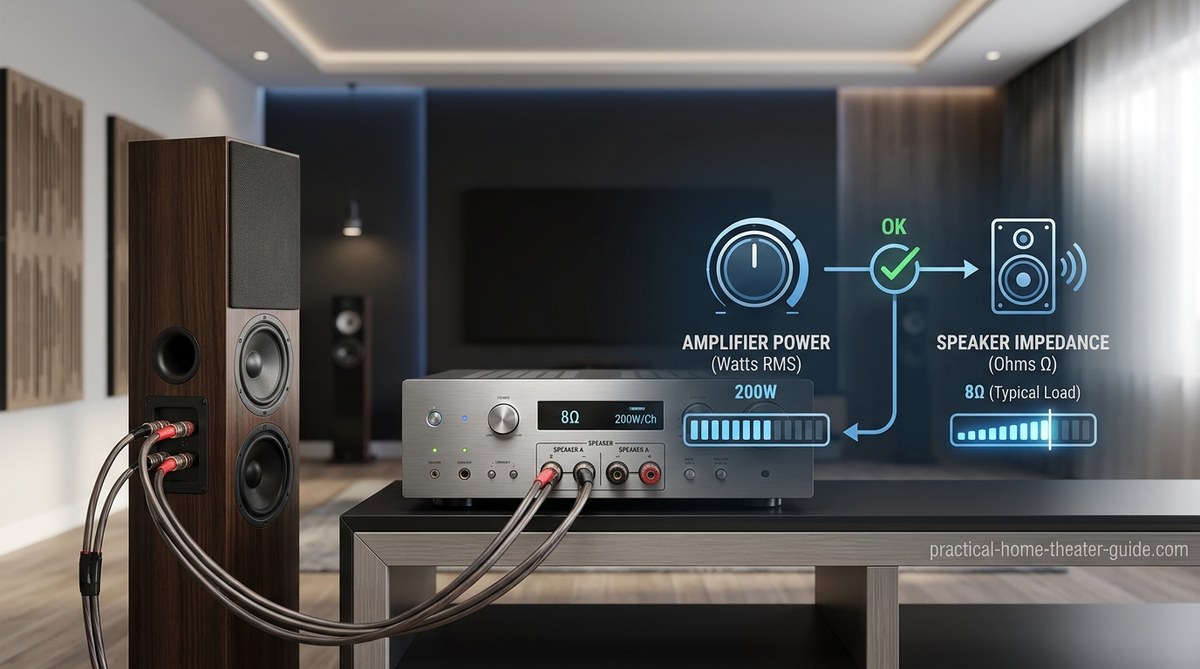
Power is expressed in watts. But in the case
of audio amplifiers or AV receivers, there is a lot more than
just watts; a typical amplifier power rating is defined as say
'80W/Ch RMS 20Hz-20kHz, 8 Ohms 0.09% THD.'
This means that the amplifier is capable of
delivering 80 watts average power per channel into an 8 Ohm speaker load at a maximum 0.09%
total harmonic distortion over the specified frequency range
when driven by a sinusoidal test tone - i.e. a single frequency
swept over the entire frequency range.
This format was originally mandated
by the US Federal Trade Commission and as such, serves to provide
a rather stable reference when comparing different amplifiers from
different brands. Note that this is not the case with powered subwoofers;
there are no such regulations with built-in power amplifiers, thus explaining why
powered subwoofer
ratings are often exaggerated in the way they are reported by
their respective manufacturers.
We said that the reported W/Ch
RMS represents the average power per channel. While many refer
to power as RMS power, when it comes to power, it is more
correct to refer to average power. RMS (root-mean-square)
makes sense only with variables that have both negative and
positive values as in the case of an alternating voltage. There
is no such thing as negative power; hence, the 'root' and the
'square' of the RMS process would only serve to extract the
sign out of a number. This means that RMS power is actually
the average power derived using the RMS voltage values across the speaker load.
In their attempt to come up with even bigger
numbers, some manufactures also specify peak power; this
corresponds to the audio amplifier peak power output as derived
from the amplifier peak output voltage when driving a loud,
transient high point. The actual relation between peak power
and average power depends very much on the type of signal. For
example, in the case of a typical pink noise audio test signal
(i.e. one where each octave carries an equal amount of noise
power) with a 6dB crest factor, peak power is equal to four
times the average power.
While peak power per se is not as important
as the average power, it can serve as a valid indication
of an audio amplifier's ability to respond to musical peaks
say during an orchestra playback and short duration special
loud effects during movie watching. To what extent an amplifier
is capable of responding to such loud transients depends on
the amplifier dynamic headroom.
Dynamic headroom - expressed in dB, represents
the reserve transient power that an amplifier is capable of
delivering for the short period of time that the transient lasts.
This ability of a home theater receiver or audio amplifier to
deliver bursts of power is important for an accurate sound reproduction.
An amplifier rated at 100 watts average power but that can deliver
400 watts peaks is said to have 6dB headroom.
An amplifier that does not have the ability
to reproduce sufficient high peaks will compress those peaks to fit within its
headroom; the result is a significantly reduced sonic impact.
Amplifier sound quality
Directly related with amplifier output is
sound quality. While amplifier power per se is important
as it is what will enable you to match the loudness in the room
to your listening habits, yet it is more important to
have better sound than more sound. You will better enjoy a 50W
amplifier of superior sound quality against a 100W amplifier
of poor sound.
In addition, as we will further
explain in this discussion, doubling amplifier power will not double
the resultant loudness, or sound volume in the room. You need
ten times as much amplifier power for your ears to perceive
sound twice as loud.
So... do not let audio amplifier manufacturers play the power number game
on you; ensure to take into account also the other important specs relating
to sound quality.
In the case of audio amplifiers,
the main indicators that describe sound quality are distortion
or total harmonic distortion (THD) expressed as percentage
THD, and signal-to-noise ratio or S/N level, expressed
in dB. Some would also include the amplifier dynamic headroom
referred to above as part of an amplifier sound quality indicator
in that an amplifier with insufficient headroom would fail
to deliver the highs in the way these were intended to be.
Distortion Levels
Distortion is a measure of the amount
by which an audio amplifier output is distorted, or altered
with respect to the input signal. Distortion levels below 1%
are not considered significant, nor would you perceive any difference
between say an amplifier with a rated 0.05% THD and one with
a rated 0.1% THD. At the same time, keep in mind that high levels
of distortion can make an amplifier unlistenable; an amplifier
with a rated 10% THD at full power would deliver mediocre sound
quality not only at full power but possibly even at lower volume
levels.
The issue with total harmonic distortion arises
as higher levels of distortions affect the higher order harmonics
even more. Harmonics refer to the higher order tones - or frequency
multiples of the original note; these are what differentiate say
a piano note from the same note played on a different instrument.
Note: While THD ratings would
give you an indication of the distortion levels present, yet
it would not give you any indication of the nature of the distortion.
Some flagship amplifier models give the distortion
levels at different order-harmonics - with the most common being the 3rd
and 5th harmonics. This gives a better
picture than just a total level but for the purist, even this is not enough. The only
way is to trust your ears; there is no substitute to
taking the time to listen when making an amplifier purchase
- inasmuch as you have to listen to make a speaker purchase.
Amplifier Class
Directly related with total
harmonic distortion is the amplifier class - A, B, AB , or D. Amplifier
class defines the type of amplification used in the amplifier
output stage and as such impacts the distortion levels produced
by a power audio amplifier. In very simple terms, a power amplifier
output stage consists of two main sub power stages, one to amplify
the negative voltage signal while the other to amplify the positive
part.
A Class A design keeps both stages
'on' at all times; it is the one that delivers the best sound
but also the most inefficient - with an efficiency that can
range from approximately 10% to 20% (excluding other inefficiencies
in the rest of the amplifier stages and power supply.)
It is therefore the one that generates
the most heat as maximum current is present all the time irrespective
of the audio signal level - thus leading to a highly inefficient
design in order to deliver the best sound.
Class B pulls and pushes
- hence the term push-pull stage - current between the two sub-power
stages so that as one is on, the other is off. This leads to
a more efficient design - with an efficiency that can range
from about 50% to 75%. But this design also introduces a much
higher level of harmonic distortion due to this continuous on/off
process.
Class AB is a hybrid between the two
in that it leaves both amplification stages 'on' only for the
smaller part of the signal - thus working in class A for low level signals while switching to class B operation when handling larger amplitude
signals.
This leads to the best of both
worlds in that you get the best sound for lower audio signals
- which in most cases constitute the larger portion of an audio
or music soundtrack, and the improved efficiency of class B operation when
needed most - i.e. when handling high signal levels.
Class D amplifiers convert the input
signal into a sequence of higher voltage output pulses; for
this reason, these are often mistakenly referred to as digital
amplifiers. The output pulses are then fed to a low-pass passive
filter before being feed to the speaker to remove unwanted frequency components from the signal. The resulting filtered
signal is then an amplified replica of the input.
These are the most efficient audio amplifiers
(with efficiencies in excess of 90%) but in terms of sound quality,
these amplifiers are often at the lower end of the scale. For
this purpose, Class D audio amplifiers are mainly used in lower-end
HTiBs and in powered subwoofers, though some high-end designs
are starting to appear.
Noise Levels
Signal-to-noise (S/N) ratio is a measure
of the sound signal level with respect to background noise.
The larger the ratio, the better is the separation between the
sound signal - whether that being music, a movie soundtrack,
etc., and the background noise level. Background noise in an
amplifier can be of various origins and include among others, hum pickup, noise
on the AC supply, and even electrical noise caused by the chaotic
movement of the free electrons within the various electronic
components constituting the amplifier itself.
An audio amplifier with a rated
S/N of 90dB has excellent sound to noise ratio. Noise levels
become noticeable mainly at lower sound signals; for example, with an amplifier
having an S/N ratio of say 65db, noise levels at high volume
amplifier settings may become too noticeable and even annoying
during quite passages of music and dialogue.
Amplifier Power -
Watch out for manufacturers' trick!
Be careful with the way manufacturers
report audio amplifiers and AV receivers power ratings.
Despite the mandated format by the US FTC, many manufacturers
still manage to find ways of exaggerating power ratings.
One very common trick is to reduce the lower
frequency range from 20Hz to 40Hz - just an apparent minimal
reduction but one that would greatly reduce the demand on the
amplifier imposed by ultra-low bass content.
Others may specify peak power with
only one channel driven at a time - thus easing the load on
what would be effectively an underrated amp power supply.
Look for the term 'all channels driver'; unless it is specifically
written in the amplifier specs, there is no guarantee that the
amplifier will be able to run all channels at their maximum
rated average power.
At times, in AV receivers and multi-channel
surround sound audio amplifiers, instead of all channels driven,
you find the term 2 channels driven; this is not enough when
dealing with multi-channel audio amplifiers for surround sound.
And yes, check the audio amplifier weight - a big enough power
supply capable of delivering the full rated power output on
all channels is always big and heavy.
In some case, manufacturers would specify
lower speaker impedance than 8 Ohms - with 6 Ohms being the
most common alternative.
Lower impedance speakers draw more current,
thus enabling the AV receiver or amp manufacturer to specify
a higher power output. An amplifier capable of a maximum 100W average power in a
6 Ohm load may only deliver 75W average power in an 8 Ohm speaker load. For the
same audio amplifier to deliver 100W into an 8 Ohm load, it will require among
others a bigger power supply and a higher power amplifier output
stage.
In other words, unless the manufacturer tells you
the power output at both 8 Ohms and say 6 Ohms, the 6 Ohm power
rating alone would not tell you how that amplifier will behave with
standard 8 Ohm home theater speakers. On the other hand, having
both power out ratings specified will tell you if the amplifier
is capable of delivering more current and if so, at what levels
of distortions.
Note: We discuss the subject of audio
amplifier power in substantial detail in our article:
Amplifier Power - Matching the amplifier
power output to your expected level of loudness.
Prior to any decision, we advise to do some research of
your own. Look at what other customers had to say about
their purchase especially with respect to product quality
and manufacturer customer support. A good starting point
is the customer feedback posted on amazon.