Definitely, a much
debated issue among home theater enthusiasts is amplifier power. Yet few
have a true understanding of how the power output delivered by an audio
amplifier or AV receiver relates to the end loudness level you will hear in the home theater.
Many simply relate
loudness with amplifier power. Yet the sound we hear is
not just a function of the amplifier output power and the audio source only, but also
of the home theater speakers and the room environment.
Speakers impact the
sound loudness and also the overall tonality while your room size
and room decor impact the absorption of sound energy.
In other words, while
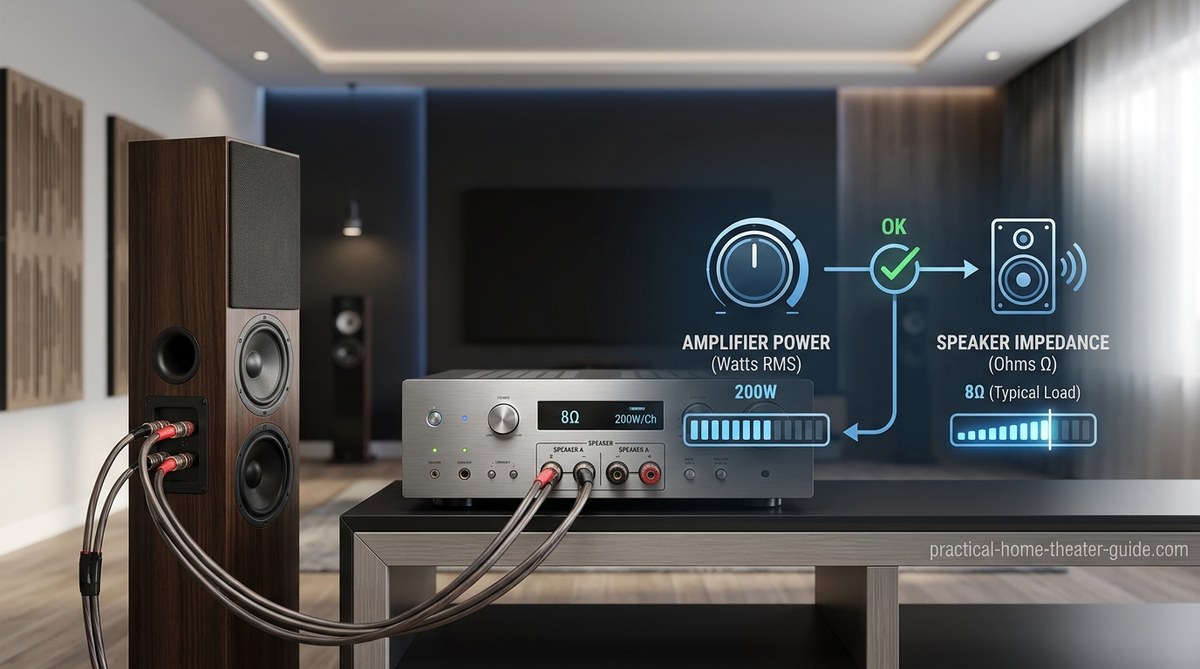
amplifier power is the driving force behind home theater speakers, the resultant
sound you hear depends also on both speaker efficiency and your home theater room.
All three are equally important and we add crucial
factors which need to be taken into account when planning a home theater audio
set-up.
So the whole issue is: How much amplifier
power do you need - taking into account speaker efficiency and room environment
- to achieve a level of loudness that best matches your listening habits?
Audio Amplifier Power - Article Index:
An Introduction to amplifier Power:
A few basics
Sound Loudness:
Loudness
levels in the home theater
Speaker Efficiency: Understand
speaker sensitivity
Room Size: How does it
all relate to an audio amplifier power output?
Conclusion: A few
points worth taking note of
Amplifier Power
There is no simple and straight
forward answer to amplifier power. This partly explains why audio amplifier power
requirement is such a controversial topic.
Audio amplifier power basics
Before delving into how
amplifier power, speaker efficiency and room environment influence the
resultant sound quality and loudness, it is important to first have a better
understanding of a few amplifier power basics.
A very basic concept here is that no matter how one specifies
power, as long as all other things are equal, frequency range, load
impedance, distortion, dynamic headroom, etc., having more amplifier
power is better. It makes your system play louder, sounds better, and less
likely to cause speaker failure.
The latter may be a surprise to many but in reality, speaker
failure as a result of insufficient amplifier power is one of the primary
failures associated with home theater speaker systems. Insufficient amplifier power leads
an audio amplifier into clipping,
thus generating harsh distortion well outside the speaker frequency response. Any
electrical energy within the amplifier output signal falling outside the
frequency range supported by a home theater speaker would not be converted into sound and
ends up as heat. If this is sustained for a sufficient length of time, it may
lead to speaker thermal failure.
This issue of clipping arises
because it is impossible to reach a sufficient level of loudness with a
small audio amplifier. In other words, with a small amplifier for your
speakers and room size, you will not get the perception that the desired level of loudness
is being attained. The tendency for many is to turn the amplifier volume
towards the maximum, pushing the amplifier into clipping to compensate, thus
endangering the speaker integrity due to excessive heat dissipation in the
voice coil especially during loud passages during a movie playback or music
listening.
If your system is not able to
play as loud as you would like it to be without the signal becoming
distorted, then you need a bigger, more powerful audio amplifier.
This does not mean that you
should go out and get the biggest amplifier you can afford. The power rating
of your amplifier should be related to your speakers. Inasmuch as
insufficient amplifier power can hurt your speakers, too much
amplifier power may also lead to both thermal failure as a result of
excessive heat dissipation in the voice coil, and
mechanical failure due to excessive diaphragm movement; the latter often
leads to a shorted and even deformed voice coil due to possible rubbing
along the coil housing and the coil hitting the magnetic pole bottom piece.
So... how much amplifier power
do you need?
In general, audio amplifier power
needs to be larger than the speaker's rated power because an amplifier is
capable of delivering its rated power only when driven by a sinusoidal, or
sine wave signal.
In a real life situation, the audio signal driving
a speaker consists
of a multitude of frequencies all playing at the same time rather than a
pure single frequency sine wave signal; as a result, an
amplifier will deliver less than its rated power.
As a general guideline, many
professionals would advise to allow for a 30%, even 50% increase in
amplifier power over the rated speaker's average, or 'RMS' power. Thus if
your speakers are rated at 100W, the amplifier should be capable of
delivering close to 150W when rated for a sine wave signal.
But there is more to
audio
amplifier power than allowing for the fact that amplifier ratings are based
using a sine wave signal - which in itself is a far cry from what you will be throwing
at it.
In our introduction to this article, we indicated that the resultant sound
loudness you hear depends not only the audio amplifier power output, but also
on both speaker efficiency and the room size.
All three are equally
important and we add crucial factors which need to be taken into account
when planning a home theater audio set-up to ensure that the resultant sound
loudness will match your desired volume level.
Sound Loudness:
Sound
levels are expressed in decibels SPL, or sound pressure level. One
decibel represents the minimum perceptible change in volume by human
hearing. Normal speaking stands at around 65 to 60dB while a concert climax
may reach 105 dB.
In the home theater, the THX
reference level for loudness is 85dB for each of the audio channels except for the LFE
which is set 10dB louder as measured at your seating position.
Additionally, if you
are after a reference audio system, you need to allow for 20dB dynamic headroom -
implying that in the home theater, sound levels may reach up to 115dB (95dB
for the LFE + 20dB headroom) when
setting sound to THX reference. Setting your system to THX Ref for a properly set
home theater system means that you will be hearing the movie soundtrack at a
level the producer intended it to be.
However, the fact that
different people perceive loudness differently means that not everyone will
want to listen to music or watch a movie at the THX reference of 85dB.
People who like to listen at lower levels may reduce this by 3dB - thus
requiring half as much amplifier power while those who would like to listen
at very loud levels may have to double their audio amplifier power to get a
further 3dB increase in loudness above the THX reference.
Speaker efficiency:
The
level of sound at your listening position you get for a specific level of
amplifier power - all other factors being equal - is a function of the
speaker efficiency.
Remember that a speaker is a device that transforms
electrical energy into sound energy. But not all energy from your home
theater receiver or amplifier is transferred into sound; the sound level you
get depends on the speaker efficiency.
Speaker efficiency, also known
as speaker sensitivity, is a measure of the speaker's sound output in
decibels, measured at one meter away from the speaker when feed by one watt
of power (2.83 volts into an 8 Ohm speaker load) in a non-echoing test
environment.
This means that a speaker with say 88dB efficiency will require
half as much amplifier power as one rated at 85dB efficiency to produce the
same loudness level. In a similar manner, one rated at 95dB will sound twice
as much louder than one with 85dB efficiency. That's correct, every 3dB
increase in loudness require doubling of the audio amplifier power output,
while it takes an extra 10dB of power to double the loudness level you here.
Conventional speakers (drivers
using cones and domes with a magnet and voice coil) support reasonable
efficiency, usually in the range of 85 to 90 dB/watt/meter, while horn
loaded speakers may reach levels of up to 100dB/watt/meter and even more.
However... In most cases, high levels of speaker efficiency are normally
obtained only by trading off sound quality.
Room size and environment: How does these relate to amplifier power?
Your room will influence the quality and loudness of sound you hear and
therefore will have an impact on the required audio amplifier output to achieve a
desired level of loudness. For example, too many heavy furnishings in the
room will absorb more of the reflected sound than desired - thus reducing
the amount of reflected sound reaching the listener.
However, while the environment
within your room will impact the sound quality, yet it is the room size that
is the key factor here when it comes to determining audio amplifier power.
A large room will
require typically twice as much amplifier power as an average size room,
while a small room will require half as much power as an average size room.
The actual amount of amplifier power required depends on your desired level
of loudness and the speaker efficiency.
In practical terms...
For the reasons already
expressed above, there is no strict and fast rule as to the exact audio amplifier
power required for a specific room size. However, the rule of thumb is that
for an average medium-to-large room size of 3000 cu. ft (15ft x 20ft x 10ft high), average
speaker sensitivity of 87 dB/watt/m and a listening level that is in line
with the THX reference of 85dB, an amplifier capable of delivering anything
between 50W and 80W average power per channel should be able to deliver more
than this desired level of loudness.
Taking this indicative figure
for the average room and what we have stated when discussing loudness, then
a small room of say 1000 cu. ft would require approximately 25W per channel
average power, while a much larger 6000 cu. ft room needs 150W/Ch and even more,
to achieve the same level of loudness using the same speaker sensitivity.
But as stated, these figures
assume average speaker sensitivity and average listening loudness levels. If
you fall within that category that like to listen at high levels of loudness
- even if it is for just a small portion of the time - then you will have to
possibly double the required audio amplifier power and even more. The
reason is that as further expressed earlier on, doubling the amplifier power
will only lead to a marginal increase in the effective loudness; you need a 10dB increase to
perceive sound twice as loud.
In addition, the resultant
sound level is very much affected by the room environment. For example, if
your room has a large opening leading to another adjacent room, then you
will have to factor this into account - though to a lesser extent than the
combined volume of the two rooms. In a similar manner, a suspended ceiling made
of light structure material may present itself as almost acoustically
transparent; in this circumstance, you will have to add the volume above the
suspended
ceiling in your calculations when it comes to room size.
Conclusion
Whatever is the case,
matching the required audio amplifier power with your desired level of loudness is
critical for an enjoyable listening experience.
At the same time, keep in mind that your
volume level is also a function of the source signal; not all system
components outputs are set at the same level - so for the same audio amplifier
setting, some audio sources may not sound as loud as others. Having enough amplifier
power reserve will enable you to match the audio amplifier output to your desired
listening level even with low level output system components.
Last but not least, having
adequate amplifier power reduces the risk of you literally frying your
speakers out of your attempt to get more power from your audio amplifier by sending it
into clipping.
Prior to any decision, we advise to do some research of
your own. Look at what other customers had to say about
their purchase especially with respect to product quality
and manufacturer customer support. A good starting point
is the customer feedback posted on amazon.