![]() |
|
||||||||||||||||||
![]() ![]() ![]() ![]() ![]() ![]() ![]() ![]() ![]() ![]() ![]() ![]() ![]() ![]() ![]() ![]() ![]() ![]() ![]() ![]() ![]() ![]() ![]() ![]() ![]() ![]() ![]() ![]() ![]() ![]() ![]() ![]() ![]() ![]() ![]() ![]() ![]() ![]() ![]()
More on TV viewing distance and correct seating/TV placement will follow soon.
Subscribe to our free e-zine to
remain abreast with the latest additions to our website.
|
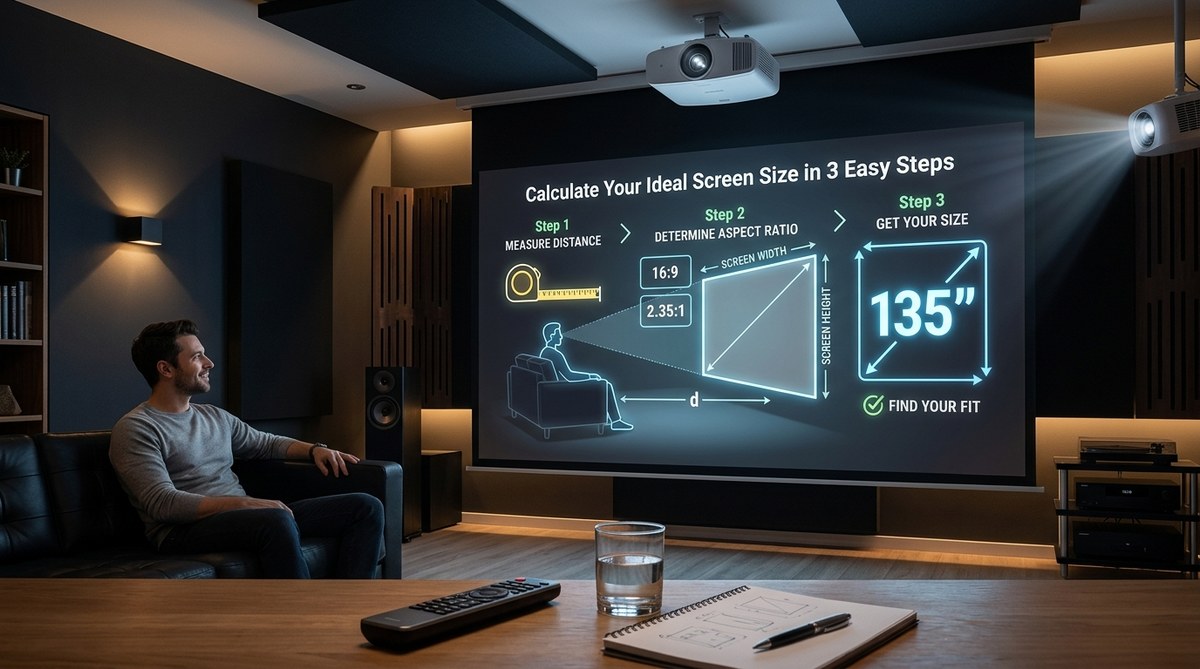
Optimum Viewing DistanceMany home theater owners are tempted to go for the biggest screen they can afford when buying a big screen TV for their home theater. But this type of approach may turn out to be a big mistake - budget should not be your only consideration when planning a big screen purchase. The optimum TV screen size is directly related to the available viewing distance, but... There are other factors as well that need to be taken into consideration. This article aims at discussing a few guidelines that can help you determine the best screen size for your room. TV Viewing Distance: Is it just a matter of personal preference?
Sit too close to your big
screen TV and you will be able to see the image build-up structure -
scanning lines or pixels forming the image – thus distracting your attention
and spoiling your home theater experience. Sit too far away and the
impact will be lost. Just go to the movie theater and you will soon realize that there is a lot of personal preference. Some would sit at the very back; others would go straight to the front row for a bigger picture and a wider angle of view, while some would simply choose their seat randomly somewhere between these two extremes. The truth is that there are no scientific rules her. However, this does not mean there are no guidelines to follow when planning a big screen purchase for your home theater room. SMPTE and the THX Certification StandardsThe Society of Motion Pictures and Television Engineers (SMPTE) recommends that the screen size for home theater use should occupy a 30 degrees field of view - in the horizontal plan - for the audience. Alternatively, the ideal TV viewing distance should be such that the screen width occupies an angle of 30 degrees from the viewing position. This corresponds to a viewing distance that is 1.9 times the screen width. This 30-degree viewing angle has been accepted by many as the standard in home theater design and motion picture viewing. THX Certification: The THX certification standard specifies a range rather than a single optimum position. THX requires that the back row of seats should have at least a 26 degrees viewing angle and while the nearest seating position should correspond to an angle of view of 36 degrees. It is believed that within these viewing angle limitations, the viewer will enjoy a more immersive viewing experience. These subtended angles correspond to a TV viewing distance that varies between 2.2 and 1.54 times the screen width. Vision System Limitations:Both SMPTE and THX specify a viewing angle - or a viewing range in the case of THX - that yields an optimum seating position, but... How does correct TV placement relates to the viewer's vision system - more specifically, how does TV viewing distance relates to a person's visual acuity? The issue with visual acuity does not deal with the optimum viewing distance - rather, this represents the maximum viewing distance beyond which some picture detail will be lost as a result of the limitations of one's eye sight. Technically speaking, visual acuity is a measure of the eye spatial resolving power and indicates the angular size of the smallest detail that a person visual system can resolve.
A person with 20/20 (or 6/6 when expressed in meters) normal vision can resolve a spatial pattern where each element within the pattern subtends a visual angle of one minute of arc angle i.e. 1/60th of a degree at the eye, when viewed at 20 feet away. This represents the minimum angle of resolution (MAR). Expressed differently, a person with normal 20/20 vision is capable of identifying an object with a height of 0.0698-inch or 1.77mm at 20 feet way. From a TV viewing distance perspective, visual acuity represents the point beyond which some of the picture detail will no longer be resolved by the viewer vision system, as it will appear to blend with adjacent picture information. In practical terms, this implies that the smallest element comprising the image - the pixel - should have a size that is not smaller than 0.0698-inch when viewed from a distance of 20 feet. Translating visual acuity limitations in terms of minimum image size when viewing takes places from 20 feet away would give: For NTSC standard definition TV, minimum image width is 640 x 0.0698", or approximately 45-inch. This gives a maximum viewing distance that is five times the screen width. Similarly, for HDTV, this gives a minimum image size of 89-inch for 720p and 134-inch for 1080i and 1080p HDTV. In terms of screen width, these image sizes correspond to a maximum TV viewing distance that is 2.7 times for 720p, and 1.8 times the image width for 1080i/p HDTV. How does all this translate in practical terms?We have already hinted on a simple way of relating viewing distance as resulting from SMPTE/THX recommendations and visual acuity limitations, to the screen size. To make things easier, we have come up with a rule-of-thumb that can help put in practice the guidelines detailed above. This guiding principle for TV viewing distance refers to the screen width rather than the screen diagonal since all is tight up to the subtended viewing angle. Furthermore, referring to the screen width has a further advantage - namely that this guiding principle applies to both 4:3 and 16:9 display formats.
This should give a fairly good approximation for your TV viewing distance. Note however that it does not necessarily represent the ideal viewing distance in a home theater setup; rather it represents the limits within which your TV viewing distance should theoretically be out of the trouble zone. In other words, move closer than twice the screen width, and the picture scanning lines, pixel breakup and any other video artifacts will become too visibly intrusive - leading to distractions that will spoil your movie watching experience. Move further away than 5 times the screen width and your vision system will no longer be able to resolve all picture detail. But…It is important to realize that these maximum and minimum TV viewing distances should be seen in the light of the video signal definition. A fully resolved high definition TV signal (1080i or 1080p, 1920x1080) supports a closer viewing distance than standard analog TV. Thus while one-and-a-half to twice the screen width would represent the ideal TV viewing distance for an HDTV display, it would be a bit too close for standard television viewing. In the later case, two-and-a-half to three times the screen width would be a better option. Similarly, the five times the screen width as the maximum TV viewing distance, while more than adequate for a standard analog TV picture, is too far away for a person to see the fine detail supported by 720p and 1080p HDTV. Thus, when it comes to HDTV content, two-and-a-half to three times the screen width represents a more practical limit for the maximum viewing distance. Note: Our rule-of-thumb for minimum and maximum TV viewing distance applies irrespective of the screen size, yet it would work best with big screen TV sizes in excess of 40-inch diagonal. In our opinion, anything smaller than 37-inch is too small to qualify as a big screen home theater option. At the smaller screen sizes, even if one were to stay within the optimum viewing distance as specified by the SMPTE and THX recommendations, it would still be difficult to get a truly immersive viewing experience. Optimum Viewing: Vertical Angle of View & Screen HeightThere is more to optimum viewing than just a consideration based on the TV viewing distance. For a most comfortable viewing experience - optimum viewing would result when the eyes of the viewer are level with the center of the screen. Maximum vertical angle of view: In those home theater set-ups where this is not possible, the SMPTE guideline suggests that the maximum vertical angle measured at the seated eye height from the front row center seat to the top-most part of the projected image should not exceed 35 degrees. This does not represent the optimum viewing angle but rather the limit beyond which the viewer will be subject to an increased neck strain. This maximum vertical angle limit is always measured from the front row as this represents the extreme angle of view. Minimum vertical angle of vision: While there are no specific SMPTE or THX guidelines in this respect, yet studies have shown that if the screen size occupies less than 15 degrees of the viewer's vertical field of view, than the image appears 'small'. A Few Practical Considerations:In a typical home theater set-up, it is extremely unlikely that you will have to worry about the maximum or minimum vertical angle of view for an effective movie theater experience. If you were to adhere to the recommended TV viewing distance as detailed in our 2-to-5 rule of thumb - based on the SMPTE/THX guidelines and visual acuity issue - you would automatically be complying with the minimum vertical angle of vision. The reason being that there is a fixed relation between screen height and width as determined by your home theater screen aspect ratio of either 16:9 or 4:3. Similarly, the same argument holds true for the maximum vertical angle of view beyond which the viewer will be subject to an increased neck strain. Remember however - you have to stay within the minimum TV viewing distance detailed in our calculations, i.e. no more close than 1.54 to 2 times the screen width. TV Viewing Distance and Multiple-Row Theater SeatingThis discussion on TV viewing distance would not be complete without explaining how all this applies when it comes to multiple-row seating in the home theater. The 30 deg. recommendation by SMPTE refers to the optimum viewing angle. More specifically, it refers to that TV viewing distance where the screen practically fills the field of view of the viewer. Implicitly, it also refers to single row seating since there can only be one position which would result in optimum viewing, and that is the center most seating position situated at just enough viewing distance such that the screen fills the viewer field of view. In other words, one cannot sustain this optimum viewing for all seating positions when it comes to multiple rows without accepting some sort of calculated compromise. The THX recommendation takes a more practical approach when it comes to multiple rows of seats in the home theater. It recommends a viewing angle ranging from 36 deg. max. to 26 deg. min. This is still in line with the SMPTE recommendation except that it defines a range within which every seat - theoretically - can be considered as a good seat. Whether one can really sit at such a close TV viewing distance resulting in a field of view of 36 deg. depends on the quality of the video content. How does this relates to multiple-row seating in the home theater?The maximum number of rows a home theater can take depends not only on the floor area, but equally important on the screen size, or rather the relative size of the screen width with respect to the size of the theater seats. Just to clarify further: Assuming you are using standard home theater seating, then you need approximately 44-inches per row. In this case, a 16:9 screen with a width of 100-inch would easily accommodate a third row and remain within the 36-26 deg. range limit defined by THX. However, simple calculations would show that if you were to move to a smaller screen with a 65-inch width (that's a 75-inch diagonal for a 16:9 screen), you would not be able to fit in a third row.
More on the issue of multiple-row seating in the home theater can be found in our Home Theater Seating Guide.
Return from TV Viewing Distance Guide
|
Copyright © - Practical-Home-Theater-Guide.com All rights reserved. |
|||||||||||||||||
|
Last Update:
Use the following coupon and save $50 off any merchandise order of $1000 or
more!
Issues discussed in this article
SMPTE Recommendations, the THX Standard, and visual acuity issues Optimum viewing: Vertical angle of view and screen height TV-viewing distance and Multiple-row seating This article should also be seen in the light of our discussions on multi-channel correct speaker placement and home theater seating.
Recommended Technical Guides
The Complete LCD TV Guide:
Plasma Television ...the primary choice in BIG screen
TV
Projection Television - the center of attraction in home
entertainment
Surround Sound
Formats
Equipment Racks:
THX Home Cinema - an Overview
The
HDMI Cable Guide
RGB & Component Video, or DVI & HDMI?
HDCP and HDTV:
Home Theater
Set-Up DVDs
Poster Light Boxes:
Buying Online Guides
A
Buyer's Guide to Shopping Online
Buying Refurbished Electronics
Are you buying refurbished electronics? Check out the latest arrivals at Second Act!
Recommended Home Theater Reading
Home Theater
Sound & Vision
Practical Home Theater (2008 Ed.)
A Quick Guide to Home Theater Design by Duncan McClelland
Check out the latest reduced prices at AMAZON...
Product review of the Sony XBR4 LCD series is available here.
Review of the FP-T5084 is available on our site here.
For a review of the Samsung HLT-6187S LED DLP HDTV, click here.
...or click on the following link for a full range of at Amazon.com
|
|||||||||||||||||||
|
|
|||||||||||||||||||