Home
HDTV Guides CRT TVs
LCD TV Guide
Plasma TV Guide
3D TV
Flat-panel TV Reviews Plasma TV Reviews
LCD TV Reviews
Best HDTVs
Projection Systems Projection TV
RPTV Reviews
DIY Projection TV
Projector Reviews
Projection Screens
Digital and Satellite Television Digital TV Guide
Satellite Television
Home Theater Audio Surround Sound
AV Amplifiers
Speakers
Wireless Home Theater Wireless Speakers
Headphone Guide
Media Players
Home Theater Guides Home Theater Design
Equipment Racks
AV Cables
HDCP
Set-Up DVDs
Power Protection
Books and Magazines Books / Magazines
Catalogs
Home Theater Ideas! Home Theater Sites
HT Pictures Gallery
Useful Links
Movie Posters MoviePoster Guide
The Poster Store
Shopping Online Price Search
Refurbished Products
Online Store
Website Information About Me
Website Content
Site Use & Dislaimer
Privacy Policy
Advertise
Site Search
Contact  Form
Site BLOG
E-zine Subscription
.
[?] Subscribe To This Site

XML RSS
Add to Google
Add to My Yahoo!
Add to My MSN
Subscribe with Bloglines


Are You Planning a Projection TV Purchase?
Our Comprehensive TV Buying Guide
can help you choose wisely


A Projection TV buying guide to help you discover what features to look for when searching for a new rear projection TV or video projector for home theater use.


An appropriate Projection television or a video projection setup can turn out to be a key element of a great home theater cinematic experience.

Unfortunately, a big screen TV is one of the most costly elements in a home theater setup. Entry level systems start at $1000; higher-end products may cost anything between $2000 and $5000.

Therefore, going for the wrong product is surely not an option. Great care should be taken in your choice of a big screen TV solution to ensure that you get the features and functionalities you want.

Complete integration of a rear projection TV or a home theater projector with the rest of your home theater components and overall room setup, is also essential.

In this Projection TV buying guide, we discusses a number of basic issues one has to consider when making a video projection system purchase. The issues discussed in this article, apply to both rear projection TV systems and video projectors.

We hope that the comprehensive list of guidelines presented in this TV buying guide will assist you in selecting a most suitable product while helping you avoid costly mistakes.

A TV Buying Guide to Rear Projection and Video Projectors

There are two main aspects that come into play when planning a projection TV or projector purchase - on one side there are those elements that make the picture; on the other side, there are those that make the product.

In this TV buying guide, we take a detailed look at each of the various issues that fall under these two categories.

Making the Picture - the very basics in image attributes

We start this projection TV buying guide by first taking a look at the very basics of image attributes - Image size, projected image quality, and projector resolution.

Projection TV Image Size: 

Once you decide on available budget, the most important issue is to arrive at a most suitable screen size. At a time when projection television prices are going down, many tend to fall into the trap of buying the biggest projection TV they can afford.

Though it is not the main scope of this TV buying guide to go into the technicalities of how to arrive at the right image size, yet one has to be vary careful here. Why? You may end up with too big a screen for your home theater room!

arrow

Keep both the size of your room in mind, as well as the number of persons watching at the same time.

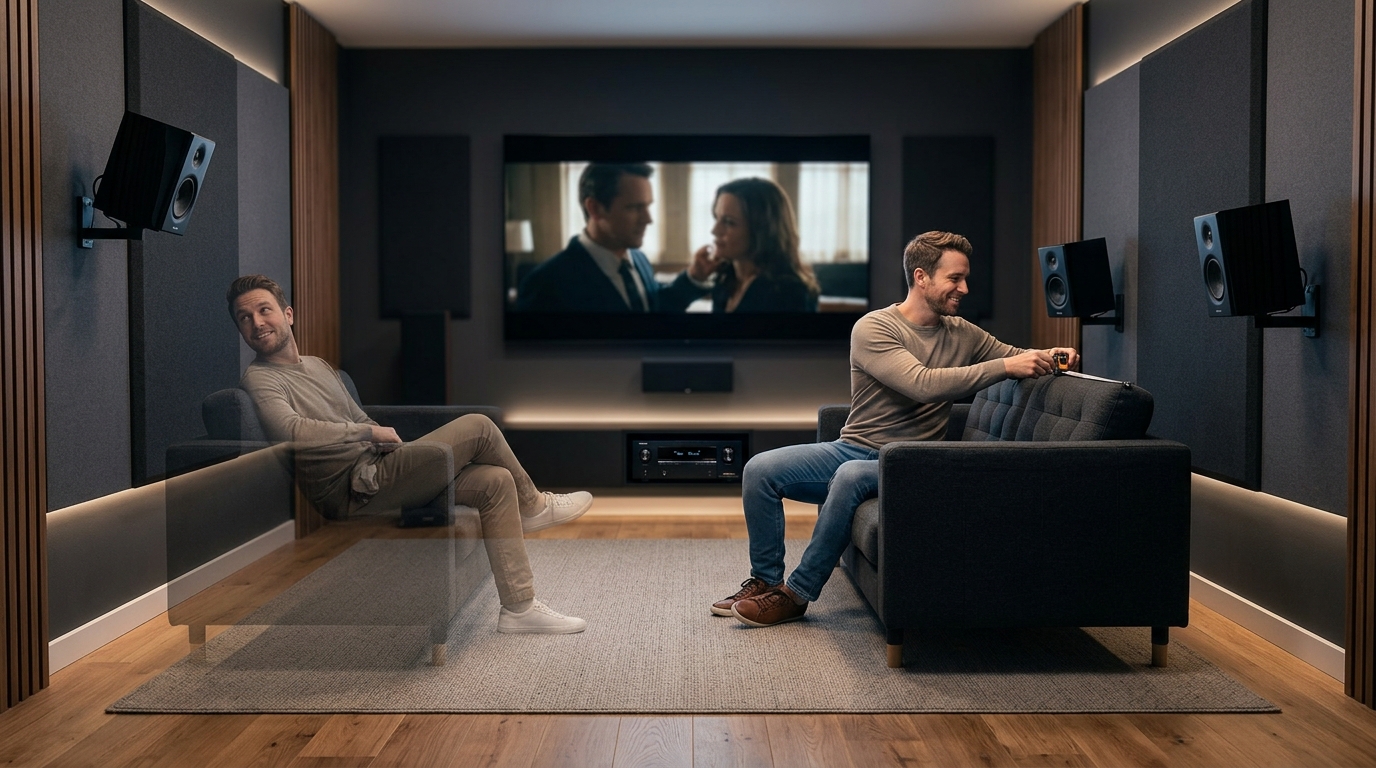
Room Size: Having life size projections is impressive and contributes to get more immersed into the movie action, but if you end up sitting too close to your big-screen TV, you will be able to see the flaws in the picture; this can be extremely distracting. Sit too far away and the impact will be lost.

Choosing the right size in particular is extremely important when working with rear projection TV systems - since here you are stuck with a fixed screen size. This is not the case with front projection.

As a rule of thumb, the viewing distance between you and your big screen TV should be twice to three times the screen width, while the furthest distance being no more than four to five times. This is not the ideal viewing distance but rather the range within which your TV viewing will be out of the trouble zone.

For more info on this subject, please check our TV Viewing Distance & Screen Placement guide.

Number of People: No fast rules here but it is important that your audience will be comfortably seated and without any obstructions within the field of view.

In particular, make sure that the lower part of the screen will be visible from all seats - hence care should be taken with respect to the positioning of the screen. In home theaters with only one or two rows, the lower part of the screen is usually set at 24" - 36" above the floor. This also limits your maximum screen size as these 24" to 36" have to be deducted from the overall room height.

Full details on home theater set-up and room layout are available under the Home Theater Design section of this site.  

Image Quality

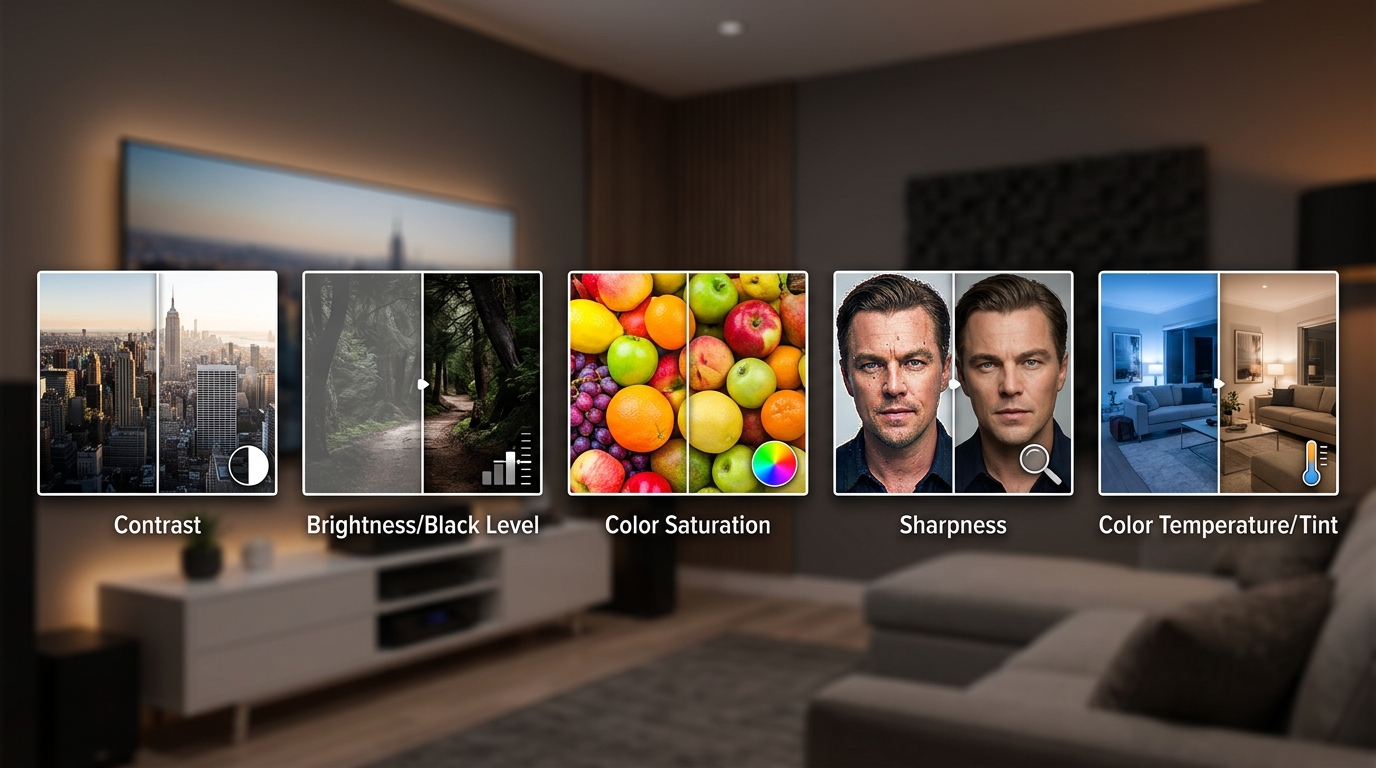
This is different from 'picture resolution'. Resolution defines the level of detail while image quality is the result of the device ability to correctly render contrast, color & shades of gray, brightness and even image illumination.

Contrast: Contrast is the difference between the brightest and the darkest parts of the image. Though often confused with the gray-scale performance of a device, yet the two are completely different.

Contrast helps an image 'pop-up' while gray-scaling helps bring out subtle detail. A minimum level of contrast is necessary for the eye to perceive a real impression of brightness ...BUT do not be impressed with big contrast ratio numbers!

In general, anything higher than a contrast ratio of 500:1 would not be perceived by the eye unless viewing takes place in a totally darkened room. Go for a video projector with a higher contrast ratio e.g. 2000:1, only if viewing takes place in a light controlled room.

Detailed information of the subject of Contrast Ratio ratings can be found in our Contrast Ratio Guide.

Color & Gray-scale Performance: The more colors a projector or projection TV support, the better. A wide color palette helps define the depth of an image by adding a wider range of shades. The larger the number of shades (gray-scale performance), the wider is the supported color palette and the greater is the ability of the imaging device to render subtle detail in dark or bright areas of an image. This leads to more natural looking colors. Typically, projectors can display 16.8 million colors.

When choosing your system, always check how colors look in the brightest and darkest areas of the image. Also, check the degree of color stability from input to input. This may not be important with business presentations, but in the home theater, the capability of a front or rear projection system to render correct color reproduction on all inputs is essential.

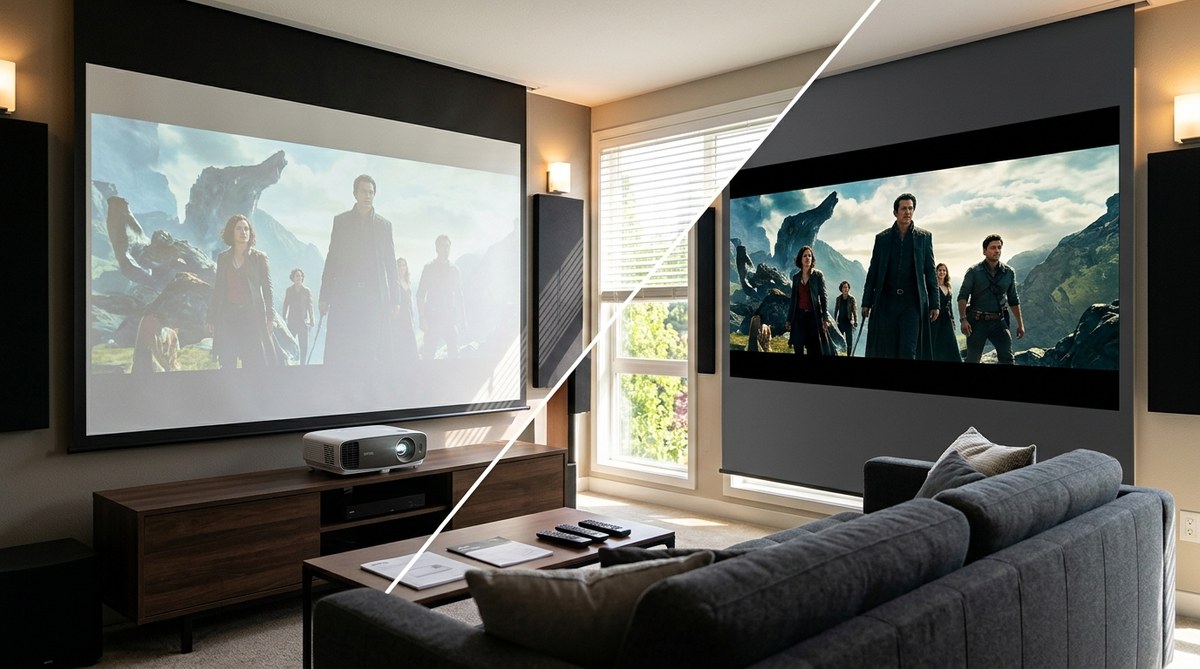
Brightness: The required brightness level depends on the ambient light present - the higher the ambient light level, the brighter the image has to be to achieve a minimum contrast level.

Brightness is usually specified in either lumens or ANSI-lumens. ANSI-lumens is brightness measured according to the ANSI standard. It is not possible to compare a projector brightness expressed in non ANSI-lumens with another projector brightness rating, irrespective of whether the latter is in ANSI-lumens or not.

A 1000 ANSI-lumens projector is enough for use in dimly lit rooms room and medium size projections. However, there are other factors that have to be taken into account here, e.g. the selection of an appropriate projection screen surface. These are not covered in this TV buying guide as more info is already available in the following 'Projection Screen' article.

Illumination: Look for video projectors that are capable of generating even illumination all round the projected image; avoid projectors that produce bright centers and dark corners, or vice-versa. In case of rear projection TV systems, ensure that there wouldn't be a drastic darkening of the image when viewing at extreme angles.

Projector Resolution: SVGA, XGA or Widescreen

The sharpness and clarity of a projected picture is determined by the projector resolution i.e. by the number of picture lines - in the case of CRT-type RPTVs - or the number of picture elements or pixels - in the case of LCD and DLP type projectors - that the projection device uses to create the image.

All digital home theater projectors (LCD and DLP) are fixed-resolution devices. This means that irrespective of the resolution of the incoming video signal, these devices will either up or down convert the video signal to match the projector native or 'true' optical resolution. This is not the case with CRT type projectors; these adjust the display resolution in terms of number of picture lines according to the incoming video signal.

The most common digital projector resolutions are SVGA (800x600 pixels), XGA (1024x768 pixels), and WXGA (1280x720 pixels); the 'W' stands for widescreen. Higher resolutions are also available e.g. SXGA (1280 x 1024 pixels). The first number refers to the number of pixels from side to side while the second number refers to the number of pixels from top to bottom.

Advantage of Higher Resolution: Projectors with greater resolution can reproduce more accurately high-resolution signals (like HDTV). Pixels are smaller and therefore images look more seamless, with less noticeable 'pixel-structure'. To display HDTV signals, a home theater projector should have at least a vertical resolution of 720 pixels. However, you will have pay more for higher resolution projectors and high definition RPTVs.

Advantage of Lower Resolution: Lower resolution projectors are much less expensive, and they can produce images that are just as bright and attractive for moderate size projections as higher resolution projectors. Therefore, unless you really have a need to display fine detail, lower resolution products will still be able to get you the best from your standard DVD movie at moderate projections from a cost perspective.

Matching of video source: Coupled with the issue of projector resolution is the video source; matching the two is important for best results as the up-scaling or downscaling of an image to match the projector native resolution always leads to loss of image content or added picture noise.

Making the Product: Specifications and Supported Features

We continue with our discussion in this TV buying Guide by taking a look at a number of issues - often taken for granted or even ignored - but which one should consider when planning a projection TV or video projector purchase.

Video Format: Composite video standards include NTSC, SECAM and PAL. Your projector or RPTV should be able to support the video standard you require. 

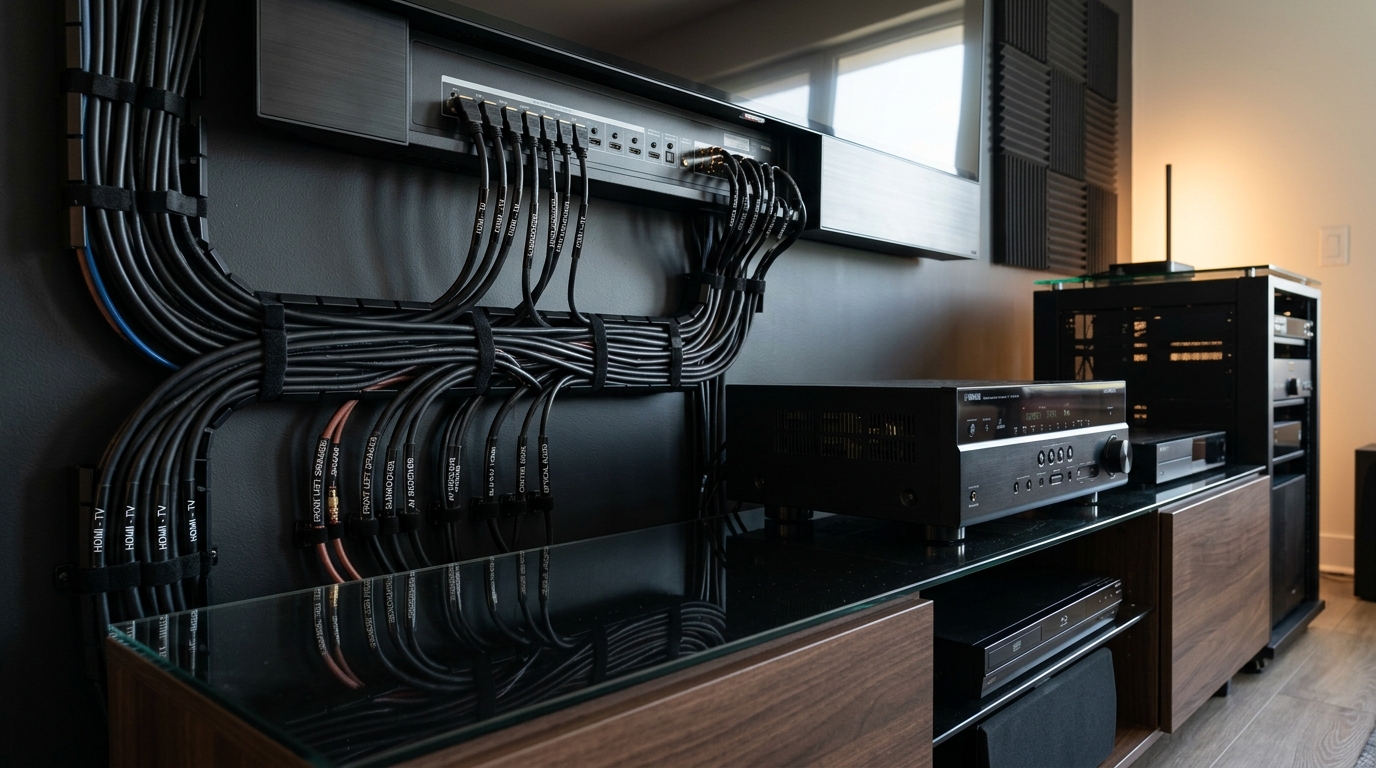
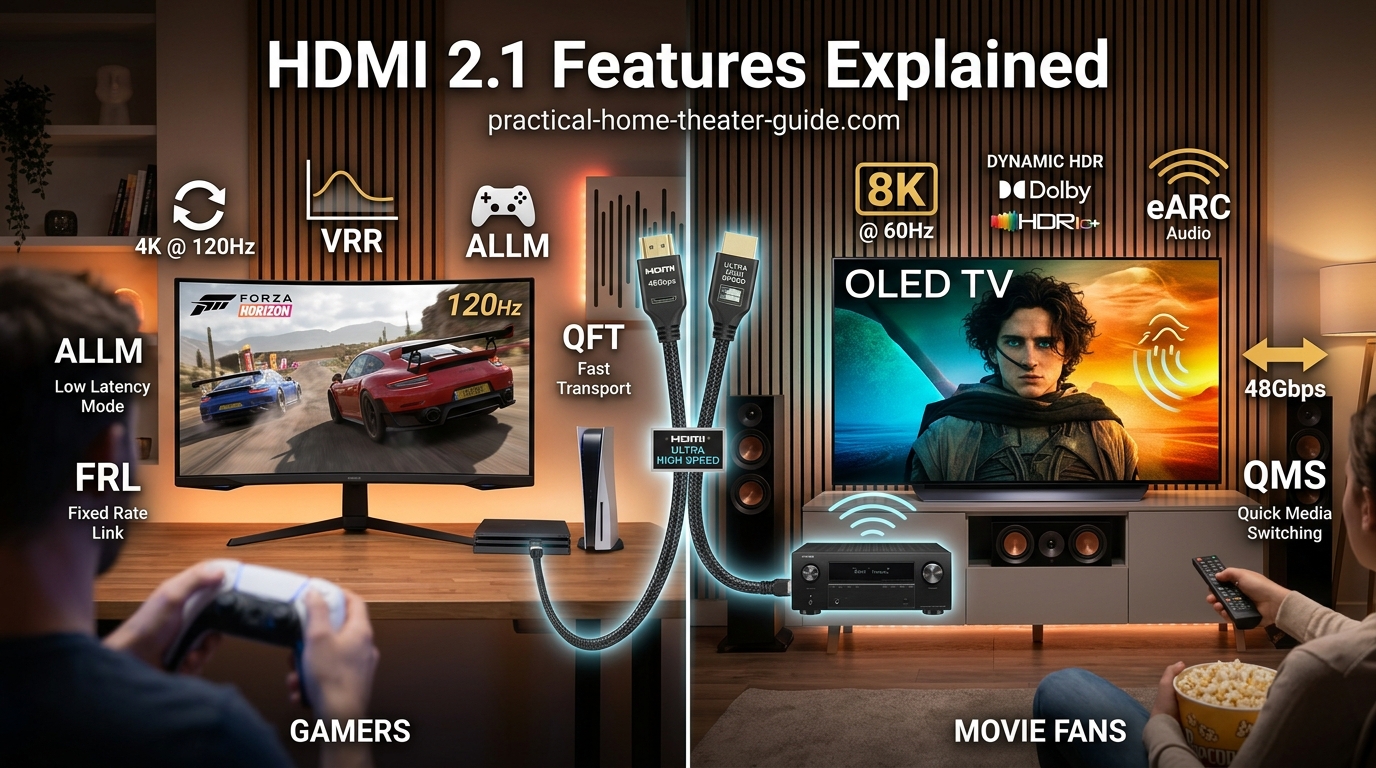
Input panel: It is important to think about the gear you will be connecting to. Ensure that the selected home theater projector or rear projection TV has all the inputs you need: composite and S-video for analog sources, component inputs for DVD, and DVI or HDMI inputs for HDTV. Most systems also include a VGA-type input for computers.

Build-in Speakers (Rear Projection TV Units): Do NOT rely on the internal speakers of your rear projection TV, not even as a substitute for the center channel of your home theater receiver. This applies even if the set has got a dedicated center channel. Ideally, all sound within your home theater should be coming from the same surround receiver, and using a matched set of speakers.

Powered Lens (Video Projectors): Power zoom and power focus lenses provide quick and easy adjustment of your image size. This can be a bonus but in general, if you plan on permanently mounting your projector, this feature is not so important.

Fan Noise: The noise generated by the cooling fan - in particular on video projectors - can turn out to be an annoying factor during silent parts of a movie scene; a low fan noise is essential for best results in the home theater.

Projection Screen: The end quality of your projected picture quality is partly the result of the projection screen itself. So, do not cut short on a good quality screen in your front projection TV setup, nor do under-rate the importance of the projection screen in your rear projection TV. For a complete guide to projection screens, please refer to our Projection Screens section.  

Lamp Replacement on DLP and LCD Units: Projector lamps can be expensive and represent a substantial running cost. Spare lamps may run into a few hundred dollars each. Expected lamp lifetime vary from as little as 1000 hours up to several 1000s hours on video projectors. Lamps on LCD and DLP rear projection TVs may need replacement every 6,000 to 7,000 hours. So always take into consideration the lamp replacement costs, the expected lamp lifetime, and the lamp replacement process - can you handle this directly yourself, or is there the need for professional assistance?

Price: Price can never serve as some sort of performance indicator - in other words, price has NO bearing on system performance. Never choose your product simply because it is more expensive.   

Warranty: Most projector and RPTV warranties range from 1-5 years. Always read the small print, and go for a product that is covered by the best warranty terms and conditions! 


Buying Online is Cheaper    ...but is it safe to buy online?


This TV buying guide will not be complete without mentioning something on the possibility to make your projection TV or video projector purchase online. The Internet offers great benefits in this respect - mainly because it is cheaper to run an online store than a bricks and mortar one. Hence what may be expensive from a high street retail store may be affordable when purchased online.

However, there are a few points worth taking note of when buying online:

  • Projectors and TVs are expensive items - hence be more selective with the vendor.

  • Prior to buying online, it's a good idea to see the product in person somewhere to make sure it's exactly the one you want. Alternatively, visit the manufacture site for additional product details and pictures.

  • Check also the vendor website to determine its policies, especially on returns - not all vendors allow TV returns and you may have to deal directly with the manufacturer.

  • Make sure the warranty will be honored; some manufacturers won't honor warranties on products purchased from so-called unauthorized vendors; call the manufacturer and ask.

  • Look at what other customers had to say about both the product and the vendor. Some major online stores like amazon allow shoppers to post in product reviews on message boards; read these customer reviews and evaluate objectively.

  • Check also the vendor rating with organizations such as the Better Business Bureau.

Last but not least: It would be inappropriate to conclude this TV buying guide without reminding you to check everything once the product arrives. Open the package immediately and carefully check its contents in the presence of the delivery persons before they leave. DO NOT sign anything if you suspect that the product is damaged or that it is not the product you ordered.


On our part, we have setup our Home-Theater-Store in association with AMAZON - a world leader in online business where safe, secure purchasing is always assured. To view the full range of products available under the Electronics section of our Home Theater Online Store, please click here.


Please remember to subscribe to our free monthly e-zine to remain abreast with the latest additions to our site. 
Click here for details.


Last updated on:

12th December 2005

 ...back to  Projection TV Guides - Main Section Index


return from   Projection TV Buying Guide

to  Home Page


 Copyright © - Practical-Home-Theater-Guide.com  All rights reserved.