|
The
Practical-Home-Theater-Guide.com E-zine
Issue
# 030:
What's New
Date: 5th May 2007
The Practical HT Guide Update brings you the latest additions in a
series of informative home theater design articles, unbiased system reviews,
practical guidelines and free advice.
If you like this e-zine
,
please do a friend and me a BIG favor and pay it forward. If
a friend DID forward this to you, and if you like what you read, please
subscribe by visiting
The Practical HT Guide Update subscription page.
Welcome to Issue 30 - May 2007 of the
Practical HT Guide Update
In this issue:
Enhancing Home Theater Lighting
Correct home theater
lighting plays an important role in setting the right atmosphere for your
home theater.
Many would
surely agree that for the best movie experience in the home theater, viewing
should take place either in total darkness, or under very low ambient light,
that is, either with the lights switched off, or significantly dimmed. In
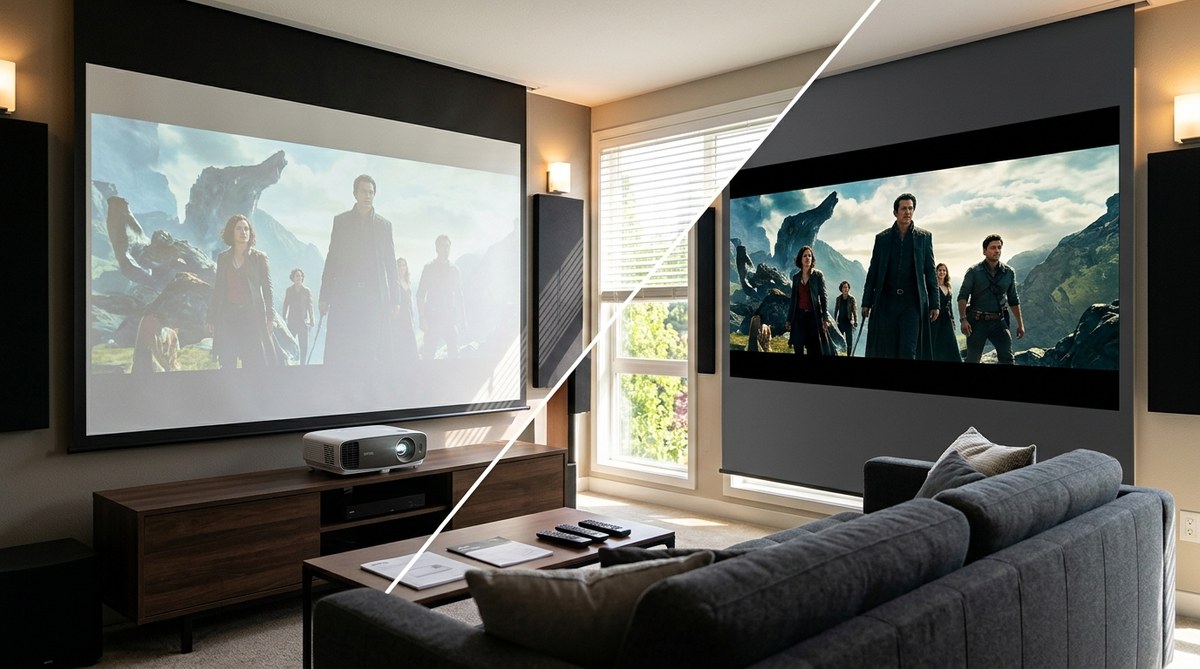
particular, projection-based video display systems would ideally require
total darkness for the best image quality, otherwise, you would end
with a washed-out image.
But even
with direct view displays, too much ambient light in the room, as
well as outside natural light coming from windows, can create glare
especially with plasmas and CRTs.
This would
normally imply that ideally, door and windows should be closed, and shades down, to cut on both any
external light and noise.
Additionally, choosing a suitable color scheme for the walls, ceiling, and overall
decor for your home theater room, can do a lot to help you enhance your home
theater lighting.
This especially applies
when it comes to a front projection setup. The requirement here is to avoid
having light from the projected image itself being reflected by the walls
and ceiling back onto the image. This would eventually reduce the overall
image quality because of a reduced image contrast. Particular attention should be
given to the ceiling - use a dark non-reflective color; go for black if your
big screen size is such that the upper part of the home theater screen is
close to the ceiling.
Due consideration should therefore be given to the overall home theater
lighting at an early stage of the home theater room design. Fortunately,
room lighting is relatively easier to control than room acoustics - by using black-out material, dark colored paint, dimmers,
drapes, and if need be, a lighting control system.
A home theater lighting
control system can turn to be a central feature in any home theater
room, and is instrumental to create that much-desired ambience of a
'cinema-in-the-home'.
For more information on
home theater lighting and the use of lighting
control systems and X10 devices to control the lighting in your home
theater, please read the full article here:
Home Theater Room Design - Enhancing Lighting
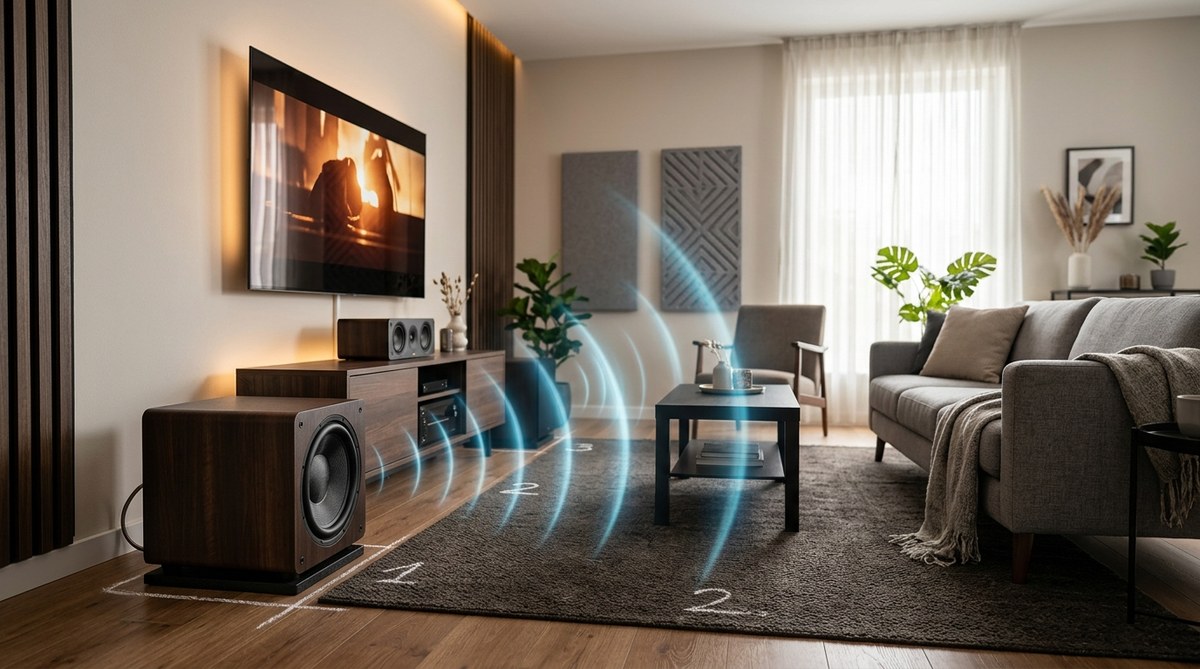
Room Acoustics
and
Soundproofing
The acoustic performance of
your home theater room represents an important element for a clear and
optimal home theater sound. No matter how good your home theater sound
system is, if the environment within which it is operating is not geared
towards good quality sound, it would simply sounds terrible.
This in
itself is dependent on the nature, as well as on the overall area of the
different surfaces within your home theater room. In particular, the room's
construction, furnishings, widows, and wall surfaces, all have a massive
impact on the acoustic performance of your home theater.
Unfortunately, many would-be home theater rooms are less than ideal for the
purpose from an acoustics perspective. Sound reflections as a result
of the different surfaces and refractions as sound travels through
different materials, lead to server sound distortions.
There is
also the issue of noise transmission both from within the home
theater and from the outside. One has to look at ways on how to stop sound
crossing the room boundary, specifically to soundproof the home theater
room.
Soundproofing can turn out to be a massive and demanding job - so it is best
carried out by a professional as if it is done wrongly, it can make things
sound worst. And this would surely turn out to be an extremely
expensive mistake!
Yet, there are a few basics
about soundproofing, which if followed carefully by the DIY enthusiast at
the early stages of a room design, may help avoid wasting thousands of
dollars in sound isolation and sound control measures.
More on how to
improve room acoustics and soundproofing can be found at
Home Theater Acoustics and Soundproofing.
Audio Video Equipment Racks -
more than just storage space for your gear!
While you can place
audio and video system components almost anywhere, yet it is recommended
that you install your AV gear in a fixed dedicated enclosure, or component
rack.
Keeping
system components in an appropriate equipment rack will help you ensure the
safety of your equipment, while making the system easy to access for service
and future growth.
It is true
that in its simplest form, inexpensive rack systems are merely a cabinet
with shelves to take AV equipment. Yet today's rack mounting solutions have
evolved far beyond the simple enclosure designed to stack your gear. Rather,
the more elaborate and expensive racking solutions found in advanced home
theater installations form a system in itself; these include accessories for
power distribution, thermal protection, and cable management.
Furthermore, while the
traditional standard 19-inch rack would often take a more industrial look,
yet many manufactures have started to offer rack options that complement any
home theater room decor. There is a never-ending list of equipment rack
designs of all shapes and sizes, for use in media-closets, in the home
theater on their own, or embedded within some piece of furniture or cabinet.
And there is more...
You can find equipment racks that come with support shelves on rails that
can be pulled out for ease of equipment handling and maintenance.
Others
would even allow you to pull out the whole shelving assembly and rotate it a
full 180 degrees for ease of access to the back panel of system components.
Such an example is the range of
Pull-Out/Swivel Audio Video Rack solutions by
HoloVision. The AV rack shown here may be mounted direct in a wooden
cabinet to integrate better with the rest of the home theater room decor;
alternatively, it can be floor standing and rolled on castors.
For more information
on the use of cabinet enclosures in the home theater, please check out our
series of articles appearing under the
Equipment Racks section of the site. Items
discussed include:
Standard 19-inch Rack Enclosures - The Basics
Covering the basics of rack enclosures for a better
understanding of standard rack solutions.
Selecting and Mounting Audio Video Rack Enclosures
Selecting a suitable rack enclosure may turn out to
be a tedious and time-consuming process. However, this does not have to be
so!
In this second part of our
guide, we cover the subject of rack selection and equipment mounting in rack
enclosures. We also discuss the important issue of thermal management and
see how to keep your equipment cool.
Available Rack Solution for the Home Theater
AV equipment racks range from the industrial style
EIA 310-D compliant 19-inch rack enclosures to the more decor friendly rack
solutions available specifically for home theater use.
LCD Displays: Image Retention -
Isn't it just an issue with Plasma TVs?
Image sticking
is surely one of the least
known phenomena associated with the use of TFT LCD panels. Yet, despite what
many may believe, image retention or ghosting is not just an issue with
plasma televisions.
What is Image Sticking?
Many are aware that if you
leave a static image for a prolonged period on a plasma TV, you may risk
phosphor burn-in. The result is that once you remove the static image, you
would still be able to see a faint outline, or ghosting of the original
image, even when you change the picture content.
LCD TVs do not suffer from
burn-in, yet as surprising as it may seem, they still suffer from image
retention when a static or semi-static image is left displayed on the screen
for too long.
The
intensity of image retention depends on various factors, not just the
duration the static image remains displayed on the screen. Issues such as
image makeup, working temperature, and the LCD panel brand itself, should
also be factored in.
Image
retention in LCD panels is often referred in the LCD industry as 'image
sticking'. As with burn-in, image sticking is a phenomenon where a faint
outline of a previously displayed fixed or semi-fixed image remains visible
on the screen even when the image is changed.
It should be remarked that
though burn-in in plasma televisions and image sticking in LCD display
panels both result in image retention or ghosting on the display panel, yet
burn-in and image sticking are two different phenomena.
To learn more on image
sticking in LCDs, to what extent it is reversible, and what can you do to
avoid it, read the full article appearing under the
LCD TV Section of the site:
Image Sticking in LCD TVs
Hope you will enjoy
and profit from these additions to our site. More new content is
available on our site. We suggest to subscribe to the Practical Home
Theater Guide RSS feed for an immediate update once new content is
available.

  
Stay tuned to
Practical Home Theater Guide!
Take care,

Please feel free to send
your comments, suggestions, remarks, using the website feedback form at
http://www.practical-home-theater-guide.com/feedback-form.html
To visit the Practical
Home Theater Guide Homepage,
click
here.
A
practical-home-theater-guide.com publication. © 2004 - 2007 All
rights reserved.
|