left image


Home Page - Home Theater Screens - Projector Screen Fabrics and Surfaces

Date: 27thJanuary 2010


A Quick Guide to Home Theater Design

How to research, design, and build your Home Theater.

Home Theater Design e-book

by Duncan McClelland
More information HERE

 
Accuscreen 106-Inch HDTV Fixed Wall Sound Screen

AccuScreens 800019
106-Inch Fixed Wall Sound Screen

An affordable acoustically transparent screen for the home theater 

Projector Screen Fabrics and Materials

Manufacturers have come up with a wide range of projection screen arrays in a vast choice of projection surfaces to suit different presentation media.

This projector screen fabric selection guide focuses on a specific media application, namely that of home theater and home entertainment.

Clearly, there isn't an all purpose projector screen surface that performs efficiently under all home theater conditions.

This is itself should not be an issue in that whatever your requirements and constraints are - ambient light conditions, limited room configuration, budget restrictions, etc., you can always find a high quality projector screen surface that represents an optimum solution to your needs.

This projector screen guide highlights the basic selection criteria one has to consider to identify the right projection screen surface in a front projection setup.

However, prior to discussing these criteria, we thought that it would be beneficial to present a few 'movie screen basics' in view that the same operational principles apply in the home theater.

Movie Screen Basics

It is a fact that at first glance, movie screens look incredibly simple - a big stretched sheet of white fabric. But a deeper inspection would soon reveal that there is a fair amount of technology and design involved in their creation.

Usually, these are made of heavy white vinyl - but there is more. The movie screen surface is categorized by the amount of light it reflects.

There are four main categories of screen surfaces:

Matte white: This represents a surface with less than 5% reflectivity; black is very dark gray to black but the image is not very bright.

Pearlescent: Surface reflectivity is typically 15%; black is dark gray and image is bright, provides best overall contrast.

Silver: 30% reflectivity; black is medium gray and image is very bright, dark colors may seem a little dull.

Glass bead: This represents the surface with the highest level of reflectivity - typically 40%; black appears as light gray and image is usually too bright. Normally, this type of projector screen surface is used only under special conditions.

Pearlescent is probably the most common choice for a typical movie theater. To make a pearlescent or silver screen, a reflective coating is added to the matte white vinyl.

A glass bead screen uses thousands of tiny glass marbles embedded in a transparent coating on the surface of the screen.

Yet surface reflectivity is just one aspect of a movie theater projection screen. As further detailed in the first part of this series of home theater screen selection guides, movie screens are designed not only to present a great picture but also to support the theater sound system. For the purpose, most movie screens have tiny perforations in them to render the screen acoustically transparent. In this manner, the audience will be able to hear speakers placed behind the screen.

AcousticPro 1080 - Acoustically Transparent Woven Screen Material by Elite Screens

Elite's AcousticPro1080 - close-up of the micro perforations achieved through the use of a special fabric weave.

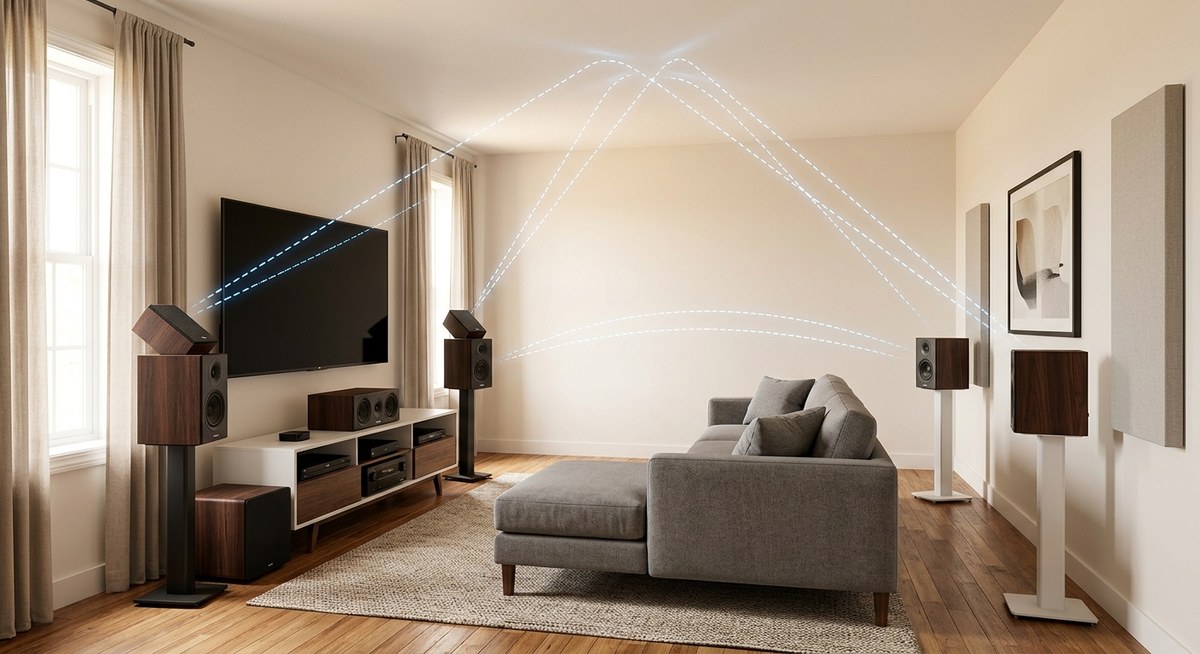
In a typical movie theater application, you'll find three speakers behind the screen, located at the far left, center and far right. In the home theater, usually it is only the center speaker that is positioned behind the projector screen - but this mainly depends on the overall projector screen width.

Placing the speakers behind the screen leads to a more realistic sound experience, particularly with the movie dialog. It also leads to an overall surround sound field that better encompasses both the projected movie image and the audience.


  Selecting the Right Front Projection Screen Surface

There are a number of basic parameters you have to consider to arrive at the right projector screen surface. Projection method, ambient light, display brightness, seating layout, projector placement, and image detail are all important issues to consider when selecting a projector screen.

Equally important is the projection screen maintenance; this is something many fail to think about at the time of purchase but regular projection screen maintenance is important to ensure that your projector screen continues to deliver the very best images years down the line.

Understanding how these issues impact image performance is essential prior to choosing a projector screen surface. Many would argue that most major projection screen manufacturers' websites include easy-to-fill checklists which once completed, would automatically present you with their recommended screen fabric for your application.

This is true and to a certain extent, these checklists and screen calculators render the selection process a straight forward one. Yet we still say that having a proper understanding of the basic projector screen selection criteria is the only way to ensure that you make the right choice.

Projection Screen Surface Selection Criteria

1: Projection Method 

The type of projector screen surface to use is partially dependent on the projection technology of your video projector.

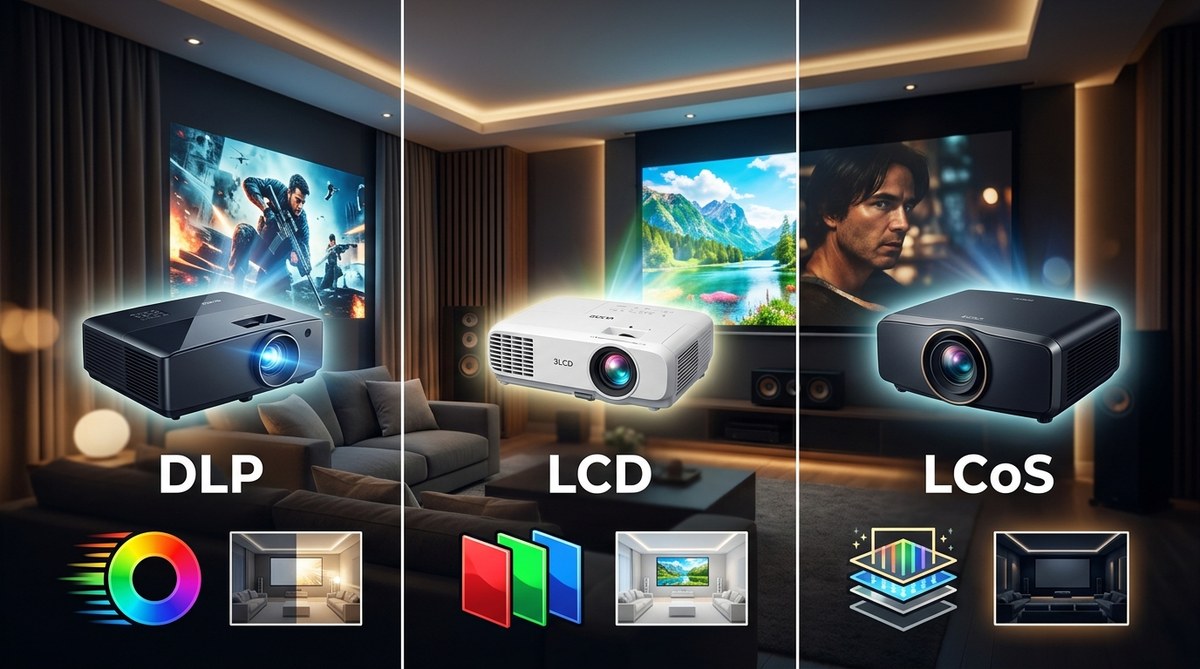
Common technologies in the home theater area include 3-LCD, single and three-chip DLP, and LCoS; LED driven DLP video projectors have also already started to appear.

Each of these technologies handles brightness, contrast and color intensity in a different manner. Hence projection screen manufacturers have developed  specially formulated color corrected screen surfaces that best complement these different imaging technologies.

2: Ambient Light 

Any projected image is at its best when viewed in total darkness - this being so independent of the projector brightness output. However we live in an imperfect world where not everything is under our full control.

Obviously, the first step is to minimize ambient light during a movie, in particular, avoid any stray light falling direct onto the projector screen  as this causes the projected image to washout.

However, selecting a suitable high contrast projection screen surface can still help you enjoy an image with a sufficient contrast even under moderate ambient light levels.

3: Projected Image Brightness 

The brightness output level of your projector is a measure of the projector output power in terms of light intensity. Yet, it is important to realize that the end projected image brightness - or image luminance - is a different issue as brightness falls in proportion to the area of the projected image size.

This means that the bigger your projected image is, the dimmer it will look for a fixed level of projector brightness.  At the same time, it is extremely important that you would not end up with a too bright an image that would be uncomfortable on the eyes - hence the need to match the screen gain with the projector output level, screen size and ambient light. This also means that one cannot proceed with a projection screen purchase in isolation from your video projector.

We discuss this subject in more detail in the third part in this series of Projection Screen Guides.

4: Room Layout 

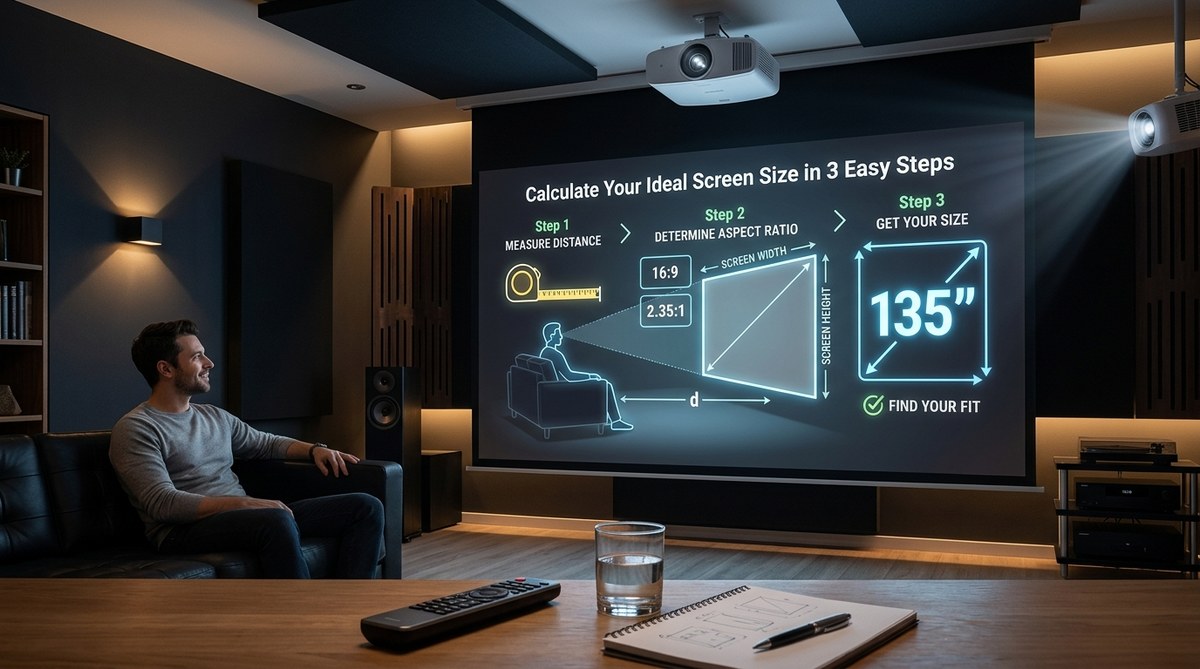
The Society of Motion Pictures and Television Engineers (SMPTE) recommends that for the best viewing experience, the ideal screen size for home theater use should occupy a 30 degrees field of view in the horizontal plan at the seating position. This in itself limits the seating area in your home theater room. This 30 degrees field of view is necessary for a person to feel immersed into the movie action.

Some projection screen companies recommend limiting the seating area to approximately 30 degrees from either side to the center of the projector screen. These 30 degrees arise not out of the SMPTE recommendations referred to above for home theater viewing but represents the limit beyond which sitting at the extreme sides of the projector screen would be too uncomfortable for normal viewing. It does not represent the ideal seating in the home theater. For more information on viewing distance and home theater seating, please refer to the following guides on our site:

TV Viewing Distance - viewing distance versus screen size

Home Theater Seating - home theater seating layout

However... if your home theater room configuration calls for a wider viewing angle, then you should make use of suitable screen fabric that can maintain adequate image brightness even at extreme viewing angles.

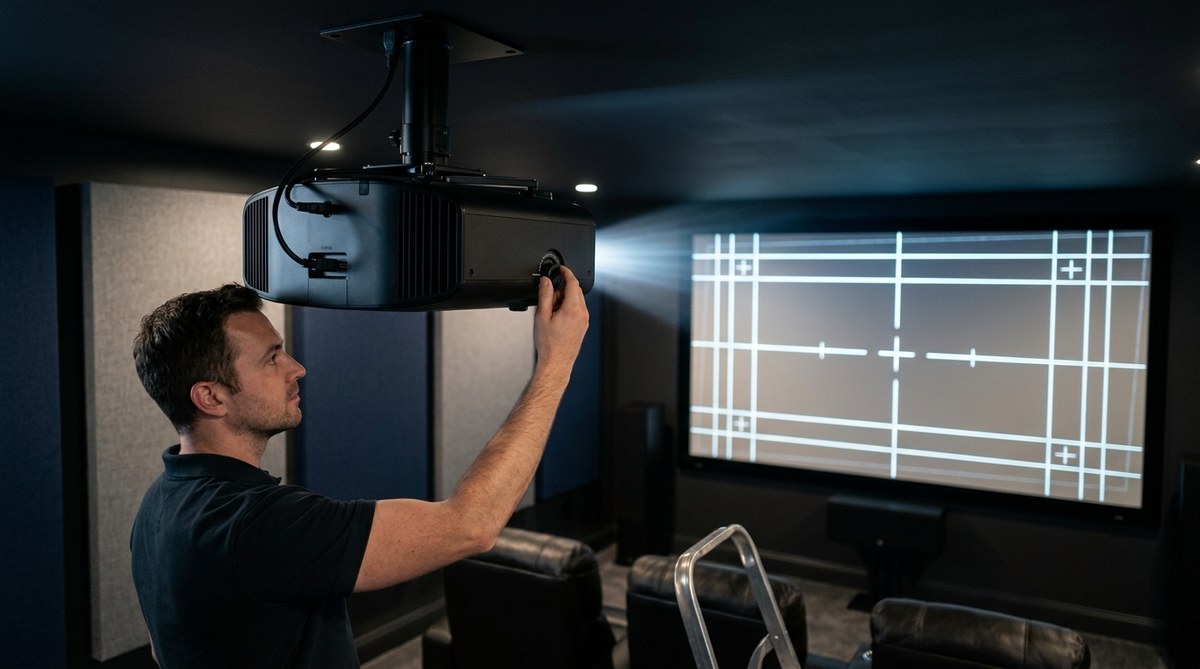
5: Projector Placement 

Projector placement with respect to the projection screen is another important factor to consider when selecting a projection screen surface. The issue mainly arises when making use of a high-gain projection screen; placing your video projector on a floor-stand would require a different type of screen surface than when the projector is ceiling mounted. Why?

Video Projector placement and screen surface

Image: Courtesy Da-Lite Education

If the projector and the audience are on the opposite sides of the normal to the projector screen (the ceiling mounted version), use should be made of a high gain screen with a reflective surface.

When the projector is positioned on the same side of the normal to the screen center as the audience (the floor mounted version), use should be made of a high gain screen with a retro-reflective surface. 

6: Projected Image Detail

This is all a matter of whether you are displaying standard or high definition content.

Screen surface is not much of an issue with standard definition video but to fully enjoy the fine image detail supported by today's 1080p high definition video - especially at close viewing distances, you need to ensure that you use a screen with an exceptionally smooth surface.

7: Screen Maintenance 

Hardly considered during a projector screen purchase, yet to get the best performance, the screen surface should be kept clean all the time.

While in general this is not a problem especially in the dedicated home theater room, yet there are situations where the screen surface may be subject to a higher level of airborne debris and dust that may settle on the surface. Worst is the case where the screen surface may be subject to potential soiling or even damage from constant handling.

Under such circumstances, an easy to clean screen surface is a pre-requisite for continued best performance over time.


Suggested Further Reading/References

Da-Lite Education - Guide to Selecting Front Projector Screens:
http://www.da-lite.com/education/guide.php?page=intro


Looking for an affordable Home Theater Screen?

Amazon offers a vast choice of projection screens - often at significantly reduced pricing. In addition, the various buying options available from the different retailers present on the amazon storefront make amazon one of the most comprehensive online sources in this respect. 

However, prior to any decision, we advise to do some research of your own. Look at what other customers had to say about their projection screen purchase especially with respect to product quality and manufacturer customer support. A good starting point is the customer feedback posted on amazon. 

You can search the amazon storefront without leaving our site by using the amazon search box below; your search results will appear here under.


Projection Screen Guides

Other articles under this section 

Selecting a home theater projection screen
A step-by-step guide to selecting the correct projection screen setup.

Understanding Projector Screens: Screen gain, ambient light and projector output
With today's powerful video projectors, one may easily end up with too bright an image. Discover how to best match the projector output with your screen.

Home Theater Screens Product Reviews:

Brands reviewed under this section include...

Da-Lite Screens

Draper Projection Screens

AccuScreens for the Home Theater on a Budget

Elite Screens

Stewart FilmScreen

Goo Systems Projection screen paints

 Home Theater Guides:

Recommended Technical Guides 

Projection TV - the center of attraction in the home theater
In search of BIG fun; look to the big screens of Projection TV. A complete guide to front and rear projection systems, and DIY projection television.

The LCD TV Guide:
LCDs are turning out sharper, bigger, better, and cheaper. Discover all you need to know about LCD TV sets in this series of articles on LCD TV.

Plasma Television
A complete guide to plasma TVs - from the features to look for when purchasing a plasma television, to installing and protecting your plasma TV investment.

Guide to Digital Satellite TV
Covering satellite TV basics - with a special emphasis on satellite TV decoder choice and satellite dish installation.

The HoloVision Rak Master Pull-out/Swivel AV RacksEquipment Racks:
There is more to equipment racks than a storage space for your system. More in this informative home theater guide.

Feel the Shake!
Bass Shakers, Buttkickers... Add the sensation of tactile sound and discover a whole new world in home entertainment.

Contrast Ratio - Playing with Numbers!
To what extent high contrast ratios affect the performance of a home theater projector or a video display device?

TV Viewing Distance
Buying a big screen TV? Care should be taken as you may easily fall into the trap of buying a too large TV.

1080p HDTV - What you need to know
Discover the strengths and weaknesses of the different HD formats - 720p, 1080i, and 1080p - in this HDTV Guide.

Dolby vs. DTS - Which delivers better sound?
We discuss the differences between these surround sound formats to help you understand why this Dolby vs. DTS controversy prevails.

Home Theater Design:
A series of articles covering all aspects of a home theater from design to realization.


Featured Home Theater Screens

Check out the latest reduced pricing on some of the most popular projector screens at amazon


Find us on Facebook
Follow us on twitter

Home
HDTV Guides CRT TVs
LCD TV Guide
Plasma TV Guide
3D TV
Flat-panel TV Reviews Plasma TV Reviews
LCD TV Reviews
Best HDTVs
Projection Systems Projection TV
RPTV Reviews
DIY Projection TV
Projector Reviews
Projection Screens
Digital and Satellite Television Digital TV Guide
Satellite Television
Home Theater Audio Surround Sound
AV Amplifiers
Speakers
Wireless Home Theater Wireless Speakers
Headphone Guide
Media Players
Home Theater Guides Home Theater Design
Equipment Racks
AV Cables
HDCP
Set-Up DVDs
Power Protection
Books and Magazines Books / Magazines
Catalogs
Home Theater Ideas! Home Theater Sites
HT Pictures Gallery
Useful Links
Movie Posters MoviePoster Guide
The Poster Store
Shopping Online Price Search
Refurbished Products
Online Store
Website Information About Me
Website Content
Site Use & Dislaimer
Privacy Policy
Advertise
Site Search
Contact  Form
Site BLOG
E-zine Subscription
.

[?] Subscribe To This Site

XML RSS
Add to Google
Add to My Yahoo!
Add to My MSN
Subscribe with Bloglines


Please Note:

Double-underline links appearing on this site represent additional information and special deals related to the page content; this added information is being supplied directly by Kontera.

To view this information, please place your cursor over these double-underline links.


Back to:
Home Theater Screens - Main Section

Next topic:
Guide to projection screen gain and projector light output

Home Page