![]() |
Samsung UN55C7000 55" 240Hz 3D LED HDTV |
3D TV: a new way of home entertainment
It was something to be expected - moving 3D entertainment into the home.
The success of 3D movies in local cinemas surely could not have gone unnoticed by the consumer electronics industry. 3D films have turned out to be a hit in the movie theater. And James Cameron's Avatar has drawn an even larger number of moviegoers to the theater than ever, rolling up an amazing $2.5 billion worldwide in the first 66 days!
It is clear that the consumer electronics and entertainment industries believe that moving 3D into the home should translate into an equally success story.
So there we have 3D Television!
|
|
The year 2010 will surely be remembered as the year of 3D television, with six major TV makers - LG, Samsung, Sony, Toshiba, Panasonic and Vizio announcing new 3D HDTV models for this year during CES2010. Mind you, the first 3D-ready HDTVs appeared on the market in 2007, with the first set being released by Samsung in April 2007. |
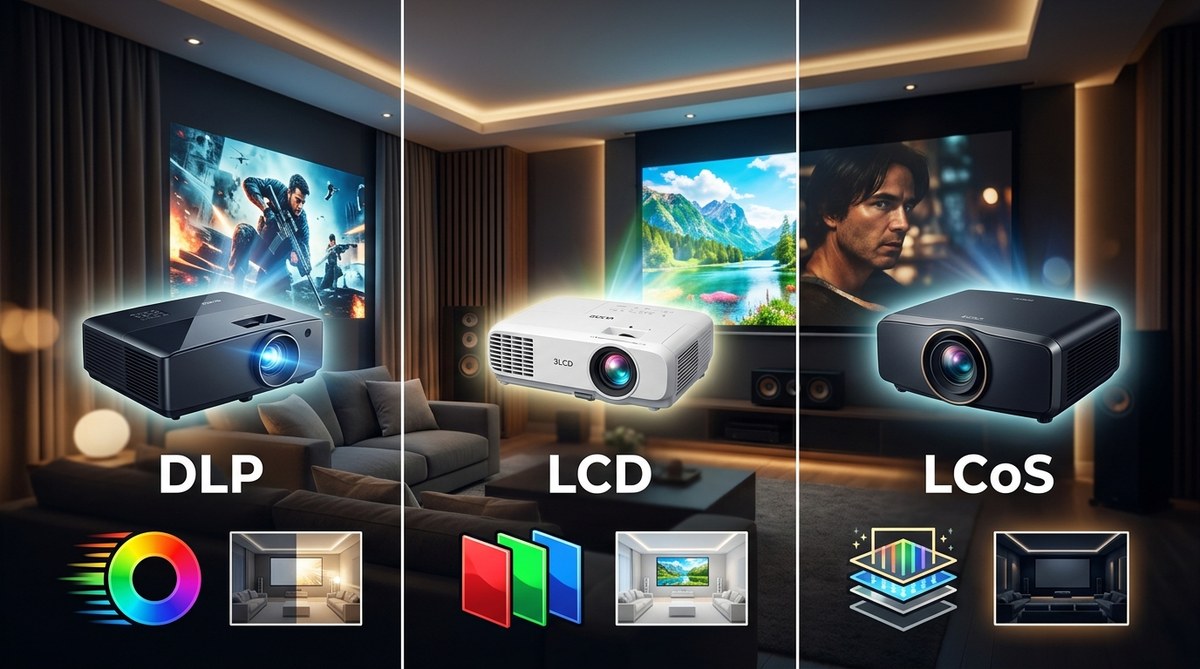
In that year, Samsung released four DLP series, two lamp-based and two LED-based DLP series. In 2007, Mitsubishi also released its 833 DLP series of 3D-ready DLP HDTVs.
These DLP HDTVs used Texas Instruments wobulated DMD chip, which created a 1920 x 1080 pixel image from a 960 x 1080 DMD chip through the use of an optical actuator that offset (wobulate) the image by ½ pixel 120 times a second to create the full 1080p 60Hz image. It was this ½ pixel displacement of the optical actuator on the DLP chip that made it possible for these Samsung and Mitsubishi DLP HDTVs to integrate 3-D capability by displaying a checkerboard pattern of the 3D content; and as with the present 3D HDTVs, these early 3D-ready TVs also made use of an LCD shutter glasses for the viewer to be able to see the image in 3D.
In 2008, we saw a total of 13 DLP 3D-Ready HDTVs - including the Mitsubishi flagship L65A90 65-Inch Laser DLP. But 2008 was also the year when we had the first flat-screen 3D HDTVs. It was again Samsung that managed to achieve this first with its PNA450 series plasma TVs. This situation repeated itself in 2009 with Mitsubishi and its DLP 3D-ready HDTVs and Samsung's Series B450 plasma 3D TVs.
In other words, the 3D HDTV is not a 2010 invention! But what we will be seeing in 2010 is Full HD 3D. Instead, the 3D Television technology as adopted in previous years using the checkerboard pattern, did result in a reduced image resolution presented to each eye that is half that supported by full 1080p HDTV.
Equally important, there seems to be a collective effort by both electronic manufactures and the entertainment industry to come up with all that is necessary to move 3D into the home. You see, a 3D HDTV alone would not bring you 3D entertainment. You need a 3D-enabled playback device such as a 3D-enabled Blu-ray player, and 3D content.
Major electronic manufactures will definitely be coming with all the necessary hardware, from 3D HDTVs to 3D-enabled Blue ray players and home theater receivers with 3D pass-through capabilities, that thanks to the latest HDMI 1.4, will enable you to see Full HD 3D.
During 2010, the entertainment industry will also be coming with various Blu-ray titles in 3D. Sony Pictures announced that Cloudy With A Chance Of Meatballs will be the first 3D title on Blu ray; it should be available this spring. Disney will be releasing its iconic movies, beginning with A Christmas Carol and followed by Alice in Wonderland and Toy Story 3—in a 3D Blu-ray version, while Fox said that it will release Ice Age: Dawn of the Dinosaurs in April on 3-D Blu-ray, making it the first 3-D release on the market. In the meantime, many TV makers are hoping that the box office hit Avatar will be released on 3-D Blu-ray in the coming months. This will definitely help sales of 3D HDTV sets to catch up at a faster rate.
What's more, DirecTV will be the first TV content provider to offer three 3D channels. Discovery and ESPN also said that they will also launch 3D channels this year - with Discovery Communications, Sony and IMAX announcing their plan to launch the first 24/7 dedicated 3D television network in the U.S.
What is actually 3D TV?
I think that before continuing with our discussion, it is important for one to have an understanding of what is actually the 3D TV we are talking about now.
The short answer is that 3D television is a display technology that enables viewers in the home to experience TV programs, movies and video games in what is referred to as a stereoscopic effect. It relies on the use of stereopsis or separation (more commonly known in 3D viewing as parallax), to add the illusion of a third dimension to an otherwise two-dimensional flat image.
This illusion is created by simultaneously displaying two separate full-size but slightly different images of the same scene - one for the left eye and the other for the right eye. The differences in the two images are intended to mimic in very simple terms, the way the human vision system sees an object. The distance separating the eyes of a human being - referred to as interpupillary distance - helps the eyes see objects from a slightly different angle, leading to two slightly but distinct images. The brain then processes these differences to generate among others, depth information to create the 3-dimensional image.
But there are a few differences between 3D Television Technology and Human Vision
While 3D Television relies on the use of two slightly different images in a similar manner to the human vision system to build up a 3-dimensional representation, yet there are a few distinct differences in the way we see a 3-dimensional object and the way 3D TV works.
As we further explain in our article on 3D Technology and the Human Vision, the fact that 3D TV technology generates the illusion of depth by presenting two 2D images on a flat screen is a totally unnatural event for the brain. You see, when we are viewing an object in space, two sets of eye muscles get into action - the convergence muscles which directs the left and right eye towards the same point in space and therefore to converge (because of the interpupillary distance) to the same point, and the eye focusing muscles which causes the eyeball to accommodate to produce a focused image of the object.
The brain directs these two sets of eye muscles to the same point in space because this is the way human vision works, yet present 3D television technology only addresses the issue of convergence. In other words, the convergence point and the eye focusing point in the case of a 3D generated illusion exist at two different points in space - with the focusing being fixed on the TV screen while the converge being set at a different point depending of the difference between the two 2D-images.
This disparity between convergence and focusing leads to various undesirable effects. It is also the reason why producers shooting movie content for 3D presentations use different shooting techniques to ordinary 2D material to minimize as much as possible these effects.
Furthermore, with some viewers, this disparity may even lead to a few ill effects during 3D viewing like prolonged disorientation and headaches. Worst still, the fact that the human brain makes use of various cues to determine relative image depth, delivering relative depth information through convergence alone is not always enough for some viewers to see the 3D illusion created by 3D imaging technology. In other words, as we explain in one of our articles appearing under this section, 3D Television is not for Everyone, some may be literally blind to this 3D TV technology. Worst still, the TV industry seems not doing anything for these viewers - which amount to several millions in the US alone - to hopefully start enjoying the 3D TV experience like the rest of us in the near future.
Challenges of 3D in the Home
Well, 3D TV in the home has become a reality but... we believe that 3D Television still has to overcome a few serious issues before it will make it 'en mass' to the home. In other words, it will still take a few more years for 3D TV technology to become the mainstream TV technology in home entertainment.
And it is not just a matter of a technology that is still relatively very expensive for the average family, there are other issues like lack of 3D content in comparison to availability of 2D content, the added inconvenience brought about by the necessary 3D glasses, and a 3D TV experience in the home that while still pleasant, is less impressive and immersive than that at the movie theaters.
We discuss the challenges of 3D TV and the future of 3D TV in the home in our article here. There you also have the possibility to share your opinion with our site visitors and tell us if you will be an early adopter of 3D in the home, or whether you will wait till prices drop and more content becomes available; and what do you think about the use of the 3D shutter glasses. Well, all you have to do to share your opinion is to fill in the submission form on that same article page.
Different 3D Television Formats
So far, we did not mention anything about the most common 3D television formats. 3D TV formats span from the Side-by-Side 3D as used by DirecTV and Sony's Playstation Top/Bottom 3D, to the latest Blu-ray 3DTM format released recently.
Some may think that this may lead to a format war but do not worry, this is not the case as all TV makers who will be coming with 3D TV models this year said that their HDTVs comply with practically all 3D TV standards in use today.
We discuss the most common 3D TV formats in our article, 3D Television Formats. The article also tries to explain in very simple terms why not all 3D TV formats need the latest HDMI 1.4 to deliver 3D content.
3D TV FAQs
3D TV is surely a relatively new technology and there are still a number of unknown issues for the would-be consumer. We do our best by presenting what we know in our 3D Television FAQs. Most of the information presented in our 3D TV FAQs is covered in more details in the rest of the articles appearing under this section, but these FAQS would just give you all the info you need if you are short of time.
Please keep in mind however that at this point, there is still a lot of information that is missing from the electronics industry. Some of the pending issues will surely clear up as this new 3D Television technology starts to roll out and more 3D HDTVs and 3D TV enabled gear becomes more available on the market.
We will therefore be updating this 3D TV FAQs as more reliable information becomes available.
In the meantime, if you are in the market for a new HDTV but still confused whether to wait or buy now, we suggest to go through our article entitled, Are You Thinking of Buying a New HDTV; the same arguments still holds true. The issue is that unless you are an earlier adopter of new technology with a deep enough pocket, then in our opinion, there is no reason to wait.
Summary of articles appearing under this section:
|
|
3D Television Technology and Human Vision 3D TV technology renders an impression of depth while displaying an image over a 2D surface - a totally abnormal situation for the brain since the latter knows that 3D objects cannot be contained within a flat surface. What are the implications and is there a way to minimize any undesirable effects? |
|
|
Optimal Viewing Distance for an immersive 3D Experience You need to watch out closely on your 3D TV viewing distance to ensure a great
immersive 3D experience. |
|
|
3D Image Technology - Not for everyone 3D TV is not for everyone - and this is not a matter is a technology that is still too expensive for the average family. Some persons are literally 3D TV blind. Why is it so and is the industry doing something for these persons so that in the near future, these will also be able to enjoy the 3D TV experience in the home? |
|
|
Is it worth investing in 3D TV now? Research firms are expecting a sharp increase in 3D HDTV sales. Yet we ask if it is really worth investing in a 3D HDTV now when there are still a few major issues which the present 3D TV technology has to overcome to become the mainstream TV technology in the home. |
|
|
3D TV comes in various formats; not much of a problem in that there is no format war on the horizon but it is still worth knowing the main differences between the most common formats and why certain 3D TV formats do not require HDMI 1.4 connectivity to deliver 3D content. |
|
|
At a time when this 3D technology is at such an early stage, it is only natural that many consumers would have various questions. We try to answer most of the common questions in this 3D TV FAQs, and will continue to update this FAQ list as more information becomes available. |
Looking for affordable 3D HDTVs?
Amazon offers an extensive range of 3D HDTVs - from the latest 3D LED and plasma HDTVs to DLP sets from Samsung and Mitsubishi - often at significantly reduced pricing. In addition, the various buying options available from the different retailers present on the amazon storefront make amazon one of the most comprehensive online sources in this respect.
However, prior to any decision, we advise to do some research of your own. Look at what other customers had to say about their HDTV purchase especially with respect to product quality and manufacturer customer support. A good starting point is the customer feedback posted on amazon.
You can search the amazon storefront without leaving our site by using the amazon search box below; your search results will appear here under.