![]() |
Samsung UN55C7000 55" 240Hz 3D LED HDTV |
3D TV Frequently Asked Questions
While going through this 3D TV FAQs, please keep in mind that at this point, a lot of information is still missing from the electronics industry.
This is understandable; new technology is always surrounded by trade secrets. The problem is that in the absence of a consumer understanding of new technology, retailers and manufacturers try to push consumers to spend more money on new equipment than possibly needed.
Unfortunately, when it comes to already available equipment in the home like Blu ray players, most of the queries many may have will start to really clear up only as more of the new 3D TV hardware becomes available.
We will therefore be updating this 3D TV FAQs as more information becomes available from the manufacturing industry.
|
|
Questions covered in these 3D TV FAQs
Answers to the most common 3D TV FAQs
What is 3D TV Technology?
3D TV is a TV technology that is capable of rendering the illusion of 3D over the TV 2D screen; for additional information, please refer to our article here.
...back to 3D TV FAQs index
Is 3D in the home different from 3D in the theater?
The impact of any 3D experience is partly determined by the screen size and the viewing distance. In the home, because of the smaller screen size, the viewer sits much closer to the screen with the result that 3D in the home - while still pleasant - can never match the same immersive 3D experience as in the movie theater. For more information, please refer to our article here.
...back to 3D TV FAQs index
Are there other 3D TV formats and can these lead to a format war?
There are various 3D formats that have made it to the home but it does not seem that we are going to face a format war. More details here.
...back to 3D TV FAQs index
What is the best 3D TV viewing distance and screen size for a more immersive 3D viewing experience?
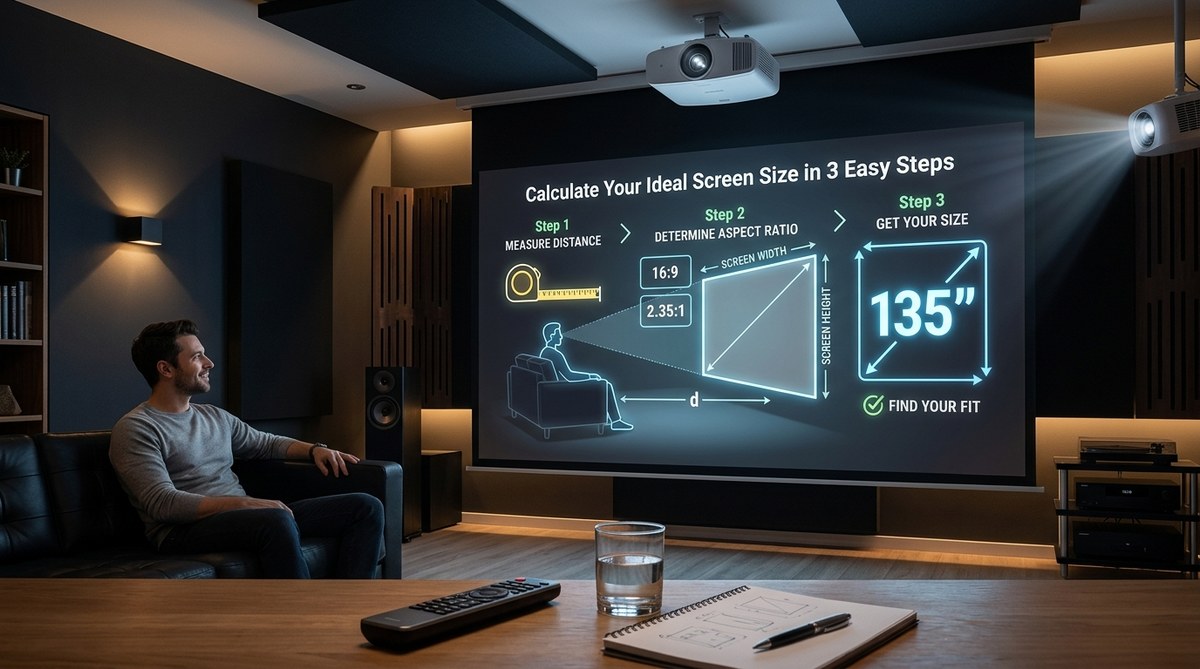
As further detailed in our article on 3D TV Viewing Distance, you need to sit closer to the TV than what is considered the optimal viewing distance for 2D viewing. In a similar manner, a larger screen size than you would consider normal for 2D is essential for an immersive 3D experience. Going for the largest 3D HDTV you can afford and viewing at as close as possible to zero degrees along the TV axis i.e. head-on facing the TV screen, would lead to a more realistic 3D experience in the home.
...back to 3D TV FAQs index
Is it true that 3D can at times cause ill effects?
The majority of people will not suffer any ill effects even after extended period of viewing 3D. But because 3D TV only addresses stereopsis (image separation) to deliver dept information while ignoring eye eyeball focusing, the result is unnatural and in some this may lead to severe disorientation and headaches. More details on this issue appear here.
...back to 3D TV FAQs index
Can everyone see 3D TV?
The simple answer is NO. More than 4% of the American population cannot see 3D the way it is implemented today. This does not mean that these people do not have depth perception when viewing real objects in space. At the same time, it also means that it is best to check your eyesight before investing in the latest 3D HDTVs. More details here.
...back to 3D TV FAQs index
Why do I need to wear 3D shutter glasses to watch 3D TV?
3D TV displays images intended for the left eye and for the right eye in a sequential order. However for the images to be interpreted by the brain as a single 3D image, the left eye should not see the image intended for the right eye and vice versa. The 3D LCD shutter glasses are used to block the respective eye from seeing the image intended for the other eye. Without the use of the 3D glasses, 3D images appear blurred and may at times become almost unwatchable. More information on 3D glasses is available here.
...back to 3D TV FAQs index
How much do 3D shutter glasses cost?
Well, the only 3D TV glasses presently available at the time of this write-up is the one just released by Samsung for use with its 2010 3D LED HDTVs, and this is selling at $150. Rather expensive considering that each member of the family watching 3D has to wear one. More information is available here.
...back to 3D TV FAQs index
Are there 3D displays that do not require glasses?
Yes; these are called autostereoscopic displays but these are extremely expensive, generally available for commercial use, and still have issues of their own when it comes to 3D in the home. More details here.
...back to 3D TV FAQs index
What is 3D Image Crosstalk?
Image crosstalk in 3D viewing is a phenomenon where a subtle washed-out image intended for the right eye appears as a halo around the image intended for the left eye and vice versa.
This affects the 3D image detail - leading to a subtle double image effect that may at times become annoying with some 3D content. In the worst case, it may even cause eye fatigue. An analogy to 3D crosstalk is the trail effect left behind a fast moving object across the screen on an LCD panel.
3D image crosstalk can be caused by a variety of factors including lack of accuracy in the synchronization between the TV and the shutter glasses, as well as too high contrast TV settings or a high contrast image. But it is also enhanced by an insufficient pixel response time; rather this is the main culprit with LCD and LED HDTVs. Even the superfast (for an LCD) 1 msec response time of the latest LED TVs is not fast enough to eliminate image crosstalk completely. The latest 3D DLP rear projection TVs from Mitsubishi and 3D plasma HDTVs from all major brands have a much faster pixel response time. In particular, plasma TVs come close to around 0.001msec, almost a thousand times faster than LCD TVs; this is the time it takes to ignite or switch off the phosphor.
This means that image crosstalk in 3D TVs is much more pronounced on LCD and LED TVs than on DLP and plasma HDTVs. In fact, comparative reviews of the latest 3D LED and plasma TVs show that while image crosstalk on LED TVs though subtle is clearly visible, with plasma 3D TVs, this is hardly an issue. In this respect, plasma TVs takes the upper hand.
...back to 3D TV FAQs index
Which display technology is better for 3D - plasma or LCD/LED TVs?
We have already indicated that LCD and LED TVs suffer from a more pronounced 3D image crosstalk than plasma TVs due to their slower pixel response time. This renders plasma the TV display technology of choice for 3D.
But there is even one more important issue with LCD and LED TVs that is not present with plasma TVs that renders plasma the ideal display technology for 3D TVs. Because of the polarizer layer used on LCD panels - both on the TV display panel and the 3D glasses, the viewer has to sit in an upright position to get the 3D effect; try to tilt or sit back with the glasses at an angle to the LCD screen and the image would go dark as the polarization plane of the display panel and that of the glasses cross each other. This is more of an annoyance problem but one that may turn out to be a major issue when considering that this is not the normal relaxed position when watching TV on your couch.
...back to 3D TV FAQs index
Do 3D TVs use more power than 2D TVs?
Reviews of the latest 3D TVs show that once the 3D mode is activated, an HDTV uses considerably more power than when displaying 2D content. Studies on the Samsung 50-inch PN50C7000 3D plasma TV have shown that this 3D TV uses close to 290W in 3D using the standard picture mode against 135 watts when displaying 2D content - more than twice as much.
The reason behind this high power arises because 3D TVs have to increase the picture brightness to compensate for both the on/off switching action of the shutter glasses that would in effect result in half as much light reaching each eye, as well as for the reduced brightness due to the polarizing filters on the glasses itself.
...back to 3D TV FAQs index
Do I need a new TV to watch 3D TV Content?
Yes, in that none of the 3D-ready HDTVs we have seen in the recent past are capable of the latest full HD 3D TV. The latter is capable of delivering two simultaneous streams of 1080p 60Hz video - one for each eye. Only HDMI 1.4 is capable of handling the required data throughput to support two such video streams at these resolutions.
This does not mean that it is not possible to use one of the older 3D HDTVs to watch the latest 3D but you would need some converter box. Mitsubishi already indicated that they will come with a set-top-box for their DLP HDTVs but Samsung remained completely silent on the matter. In addition, none of the 3D-ready plasma and DLPs released up to last year would support full HD 3D TV. So what you will see on these HDTVs is a lower resolution 3D. Mind you, we still expect 3D images to look great as the slightly lower resolution would not make much difference on the relatively small screen of home TVs.
...back to 3D TV FAQs index
Can I see 2D content on a 3D TV?
Yes, any good 3D TV is in essence an equally good 2D TV. These 3D HDTVs work like any other standard HDTV - using basically the same power, operating in the same manner, and come with the usual picture controls; the only difference being that these have extra features - together with the associated controls - that enables them to process 3D content - delivering full HD 3D when viewing with a 3D glasses.
Interesting here is that even Blu-ray 3D specifications - to which these 3D HDTVs comply - require that any 3D disc will also include a 2D version of the movie on the disc.
...back to 3D TV FAQs index
What do I need to watch full HD 3D TV in the home?
Besides one of the latest 3D HDTVs, you also need a 3D content source such as one of the latest Blu ray 3D players to view Blu-ray 3D moves. With certain equipment set-ups, you may also need a 3D-enabled home theater receiver. These devices all come with an HDMI 1.4 interface. And obviously, you also need 3D content that will start to be available later this year as further retailed here. But...
Sony Playstation 3 also made it to the list of 3D compatible devices. It will require a simple firmware upgrade to play Blu ray 3D movies which Sony confirmed that will be made available later this year. This is basically the same with DirecTV's satellite receivers which will be upgraded through a firmware upgrade to process 3D. But both the PS3 and DirecTV receivers come with HDMI 1.3 - so no matter what the firmware will include, these will not deliver full 1080p 60Hz content to each eye; HDMI 1.3 can only support 3D at 720p60 and 1080p24.
This means that most probably, fans of 3D movies would not need to upgrade their Blu-ray player, nor replace any cables. After all, if the PS3 made it to the compatibility lost, then we see no valid reason why BD-Live capable (i.e. Profile 2.0) Blu-ray players cannot play 3D movies following a firmware upgrade. One has to see if the firmware upgrade will ever arrive and if made available by Blu ray players manufactures; and even if these firmware upgrades will be made available, there might still be some limitations with some chipsets.
This also explains why DirecTV set-top-box will only require a firmware upgrade to support 3D TV. In simple terms, any devices with an HDMI 1.3 interface will be able to deliver 3D TV at up to 1080p24, but not full HD 3D at 1080p60.
...back to 3D TV FAQs index
How much does it cost to have 3D TV in the home?
If you are not one of those early adopters or avid players with a deep enough pocket to spend an extra $1000 over and above what you would normally spend on a 2D set-up, then I am afraid that 3D TV will no longer appear much fun anymore.
The price for a 3D TV is expected to be some $600 to $700 more than an equivalent 2D HDTV. As for the glasses, prices are expected to range from close to $150 to $300 each. Samsung has just released its 3D glasses for its 3D LED HDTVs. These are available online at $150 dollars each and at this expensive price tag, what you get is a basic 3D glasses that cannot be scaled down for use by kids nor is it a rechargeable model. And remember, you need a pair of 3D glasses for each member of the family that will be viewing 3D content.
Research firm iSuppli expects that prices of 3D TV sets will start to fall considerably by 2012 - by which time, 3D will also start to be more readily available. In the meantime, TV makers will be able to test the market and get a better feel of customers' acceptance of this new technology. The big hurdle here remains the 3D glasses. But more on this issue can be found in our article Challenges of 3D TV in the Home.
...back to 3D TV FAQs index
And if you are in the market for an HDTV, should you wait or buy?
Basically, the same arguments we have come up with in our article entitled, 'Are You Thinking of Buying a New HDTV' still holds here. The issue is that unless you are an earlier adopter of new technology with a deep enough pocket, then in our opinion, there is no reason to wait.
Keep in mind that at present, content is still lacking and there are still a lot of unknowns for the industry as well. The industry does not know yet if consumers will be ready to wear 3D glasses for an extended period of time. Nor do we have any feeling of consumers' readiness to upgrade their equipment at a time when many have just had their first and in some cases, their second flat panel TV in the home. And what will be the impact on sales of 3D TVs once consumers realize that the 3D experience in the home is much less immersive than that enjoyed in the movie theater?
...back to 3D TV FAQs index
We hope that the answers presented in this 3D TV FAQ list have been of some assistance to you. We will be updating these 3D TV FAQs as more information becomes available. So, if you have not found an answer to your query, we encourage you to revisit this page in the near future.
Looking for affordable 3D HDTVs?
Amazon offers an extensive range of 3D HDTVs - from the latest 3D LED HDTVs to DLP sets from Samsung and Mitsubishi - often at significantly reduced pricing. In addition, the various buying options available from the different retailers present on the amazon storefront make amazon one of the most comprehensive online sources in this respect.
However, prior to any decision, we advise to do some research of your own. Look at what other customers had to say about their HDTV purchase especially with respect to product quality and manufacturer customer support. A good starting point is the customer feedback posted on amazon.
You can search the amazon storefront without leaving our site by using the amazon search box below; your search results will appear here under.